
What is recorded here
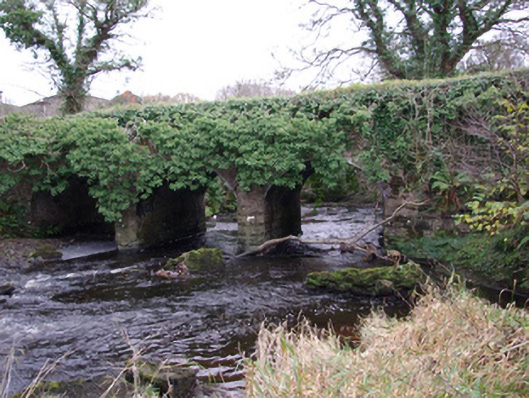
Triple-arch railway bridge, built c. 1893, having rock-faced V-profile cutwaters to central piers. Originally built to carry the former Donegal Town to Killybegs narrow gauge railway line over the Oily River. Railway lines no out of use with tracks removed (c. 1960). Segmental-headed arches with rock-faced ashlar voussoirs having dressed margins; squared and coursed rubble stone construction to arch barrels. Snecked and squared mildly rock-faced stone construction to spandrels, abutments and to parapets with rock-faced coping over parapets. Side elevations now covered with ivy; deck now overgrown with vegetation. Located to the north-west of Dunkineely and to the east of Killybegs. Located just to the north of where the Oily River discharges into McSwyne’s Bay.
This impressive and robustly-constructed triple-arched former railway bridge retains its original form and character despite the closure of the line in 1960. The good-quality rock-faced masonry used in its construction is typical of Victorian railway engineering and architecture in Ireland. Although now overgrown to the side elevations and to the deck, this bridge survives in good condition, which is testament to the quality of its original construction. It was originally built by the Donegal Railway Company as part of the Donegal Town to Killybegs section of the Derry (Victoria Road) to Killybegs railway line, which opened in August 1893 and closed completely on January 1st 1960. This railway bridge forms part of a group of structures associated with this former narrow gauge railway line in the Dunkineely/Killybegs area, and is an important element of the built heritage and transport history of County Donegal.
This does not grant access. Most recorded buildings are privately owned; view them only from public ground unless the owner allows entry.
Places near here
 bridgebridge · 74 yd
 Church of SS Joseph & Conalchurch/chapel · 183 yd
 Wych ElmWych Elm · 616 yd
 Aighan Ecclesiastical Enclosure and Holy WellEcclesiastical enclosure · 636 yd
 Bruckless Enclosure near Bruckless HouseEnclosure · 647 yd
 European BeechEuropean Beech · 1318 yd
 Killaghtee Old Church GraveyardGraveyard · 1.1 mi
 Bawn in Rahan NearBawn · 1.6 mi
 Bawn in KillybegsBawn · 2.1 mi
 Rashenny PointHeadland · 2.2 mi
 Carntullagh HeadHeadland · 2.6 mi
 Rotten IslandIslet · 2.6 mi
Other information
Photo: National Inventory of Architectural Heritage · Website use allowed for educational or private purposes with source credit