What is recorded here
An adult body has lain in Tomb 17 for more than five thousand years, wrapped in a chamber no larger than a bedroom. The passage still holds thirteen leaning stones, and five of them carry chevrons, zigzags and lozenges drawn by a hand that never expected to be forgotten. The chamber has lost most of its walls to a later drain and pit, yet the sockets remain like the shadows of absent giants. A skylight now pours daylight into the ruin, meeting the dark fill that once closed the dead below.
Knowth cemetery, Tomb 17: This is situated c. 3m from the kerb of the great mound of Tomb 1C, at ENE, and c. 12m from the entrance to the E tomb of that mound. Its mound partly overlies a spread of exotic stones in front of the entrance to Tomb 1 (ME019-030087-), and the mound would also impinge on that of Tomb 18 which is just to the SE, but it is thought that the latter is the earlier although the evidence is not conclusive. This monument consists of the remains of a kerbed mound (diam. c. 15m) built on the original humus which survived partially at SE (max. T 0.12m), and charcoal from this layer produced radiocarbon determinations of 4875 +- 150 bp (3669 +- 185 cal. BC) and 4795 +- 185 bp (3555 +- 218 cal. BC). The mound (max. H 0.7m) consisted of boulder clay with sods and was delimited by 21 surviving kerbstones that were laid on the sod SE-W-NW. Within the mound was a N-S passage that was entered at S and ended in a ruined cruciform chamber. The passage (surviving L 4m; Wth 0.7-1m) began 1.6m inside the kerb at S but there was no immediate evidence of missing orthostats, a blocking stone, or of sillstones. The passage has 13 orthostats increasing in height towards the chamber but almost all leaned to the W. Seven sockets at the outer end of the passage (total L 5.6m) were later identified, connecting the passage with the kerb (Eogan and Cleary 2017, 256-7).
The chamber (int. dims 3.6m E-W; 3.2m N-S) was destroyed by the digging of a drain and a later pit but it is represented by one surviving orthostat and the sockets of six others. There were 3 small scatters of cremated material within the homogenous fill that is derived from the mound, but two of the contexts are disturbed. The undisturbed sample was small and represented one adult (Buckley et al. 2017, 313-14). Some pottery sherds and a few flints were recovered from uncertain contexts. There is art on five orthostats but the motifs are limited to chevrons, zigzags, and lozenges, and there are two spirals on one stone. Two radiocarbon dates from the pre-tomb old ground surface provide a wide range of 3755-3050 cal. BC, but the human remains provide dates of 3328-2921 cal. BC and 2874-2634 cal. BC, which is either one of the longest periods of use of any tomb or might include a re-use for burial at a late stage (Schulting et al. 2017, 357-8). The mound is completely reconstructed with natural light in the chamber provided by a skylight. (Eogan 1984, 132-146, Site 17; 1986, 70-2)
The above description is derived from the published 'Archaeological Inventory of County Meath' (Dublin: Stationery Office, 1987). In certain instances the entries have been revised and updated in the light of recent research.
Date of upload: 10 July 2007
Amended: 16 September 2020
See the attached plans:
_1 Cemetery plan from Knowth 6, Fig. 2:1
_2 Tomb plan from Knowth 1, Fig. 56
Passage tomb, dating to the Neolithic period (c. 3300–2500 BCE), associated with the larger Knowth complex, one of the key sites of the Brú na Bóinne World Heritage Area. Its proximity to Tomb 1C and the presence of exotic stones suggest ritual or symbolic significance in the broader ceremonial landscape.
This remains an important historical record, but the official description says the monument is no longer visible or has been destroyed. The monument record does not grant public access. Check the route and ask the landowner before entering private land.
- What survives
- No visible remains or recorded as destroyed
Places near here
 Knowth Timber CircleHeritage attraction · 29 yd
 Not indicaetdPassage tomb · 35 yd
 KnowthArchaeological place · 55 yd
 MoatPassage tomb · 55 yd
 Knowth Fox CovertWood · 458 yd
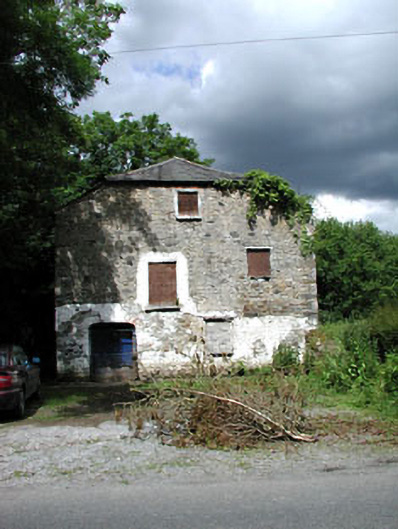 Mill Housemill (water) · 1706 yd
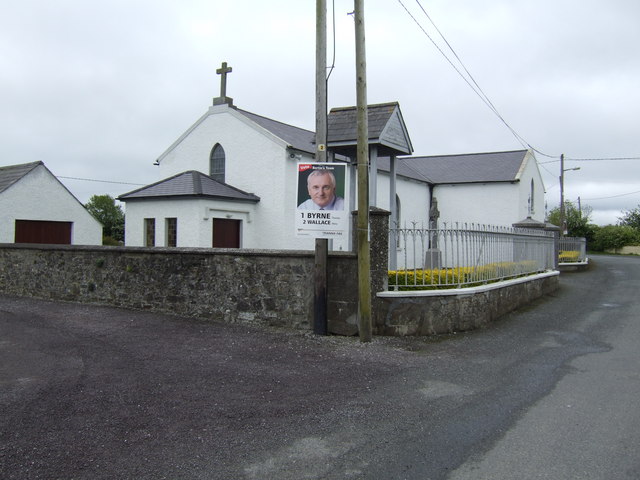 Catholic Church of the Nativity of Our Ladychurch/chapel · 1.1 mi
 Brú na Bóinne Visitors CentreVisitor information · 1.8 mi
 Dowth CastleCastle, tower house · 1.8 mi
 Fennor CastleCastle · 2.0 mi
 RiverviewMemorial · 2.1 mi
 Little WoodForest · 2.2 mi