The London Eye is a 135-metre cantilevered observation wheel on the South Bank of the Thames. Architects David Marks and Julia Barfield proposed it in 1993 as a new London landmark for the millennium, continued after the original competition produced no winner, and secured public and commercial support. Construction…
Read the whole record
The London Eye is a 135-metre cantilevered observation wheel on the South Bank of the Thames. Architects David Marks and Julia Barfield proposed it in 1993 as a new London landmark for the millennium, continued after the original competition produced no winner, and secured public and commercial support. Construction began in 1998, it was ceremonially opened in 1999, and passengers first rode in March 2000. Planned as a temporary structure, its popularity led to permanent retention. Its rotating glass capsules changed the way visitors viewed central London and made the wheel a repeated setting for national celebrations and the city's New Year events.
What this place is
The London Eye is a giant observation wheel beside the Thames, designed so that its wheel is supported from one side by an A-frame and cables. Thirty-two enclosed glass capsules move around the rim, each representing a London borough, and a full rotation takes about thirty minutes. Unlike a fairground wheel intended to travel, it was conceived as a large city landmark that would give moving, wide views across central London.
People and events
David Marks and Julia Barfield developed the idea after entering a 1993 competition for a millennium landmark. Although the competition did not select a winner, they pursued the scheme, gaining press attention through a campaign and financial backing from British Airways. Construction began in 1998. Prime Minister Tony Blair performed a ceremonial opening at the end of 1999, but technical work meant that the first paying passengers rode in March 2000. The wheel later became a central feature of televised New Year celebrations.
How it was used
The wheel was built to carry visitors slowly above the South Bank and provide a changing view of the capital rather than serve as transport. Each enclosed capsule remains upright as the wheel turns, allowing passengers to walk around and see landmarks in every direction. It has also been used for private events, public campaigns, coloured lighting and major celebrations. This continued use explains why a structure first expected to last only a few years became permanent.
What survives
The complete wheel, hub, cables, river-side support and thirty-two capsules remain in operation on the original South Bank site. Maintenance and replacement of working parts are necessary because it is a moving machine as well as a landmark. The saved record's 1999 start date marks the ceremonial opening, while public operation began in 2000; keeping both dates avoids turning two different events into a false contradiction.
Why it mattered
The London Eye mattered because it converted an unsuccessful competition idea into the most visible lasting London structure made for the millennium. Its one-sided support and great scale became an engineering and design statement, while its moving viewpoint gave visitors a new way to read the older city around it. Remaining after its proposed temporary life also shows how public use can change the fate of a modern structure before it becomes old enough for traditional heritage protection.
Sources for this account
Sources checked 15 August 2026.

 'Nobility of Time' Dali sculpture on The Queen's Walk, LondonPublic sculpture · 58 yd
 The London DungeonHeritage attraction · 96 yd
 Jubilee OracleSculpture · 106 yd
 Royal Air Force MemorialMemorial · 269 yd
 The Royal Air Force Memorial, Whitehall StairsListed building · 269 yd
 Fountain in Courtyard of Shell CentreListed building · 272 yd
 Battle of Britain MemorialMemorial · 288 yd
 Korean War MemorialMemorial · 327 yd
 2017 Westminster attackStabbing attack · 350 yd
 Queen Mary's Steps Whitehall PalaceVisitor information · 352 yd
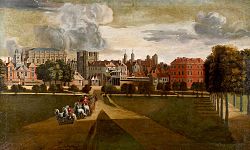 Former Whitehall Palace StepsArchaeological place · 361 yd
 Royal Tank Regiment monument Whitehall CourtMonument or public art · 522 yd
What do you know about this place?Tap to add a comment or ask a question