What is recorded here
Labbydermot is a poorly preserved wedge tomb on a low Kerry ridge, its displaced roof stone and surviving portico still framing a narrow gallery that points east toward the bay. People may have built it to hold the dead beneath an open sky, using massive local stone to mark a boundary between the living pasture and the forgotten dark. The modern field fence at its south edge reminds us that the tomb has never stopped sharing the land with ordinary life.
Labbydermot: Located on the N side of a low ridge of pasture, about 800m from Ballinskelligs Bay, this poorly preserved wedge-tomb commands an extensive outlook to E and NE. It features a fine septal stone as well as the S side of a portico at its W end. Adjacent to the surviving portico stone is a low stone which may have formed part of a facade. The gallery is partially covered by a displaced roof-stone and measures at least 4m in overall length, decreasing in width from W to E. Its S side consists of a single, substantial stone which decreases slightly in height from W to E. One small orthostat survives on its N side. A modern field fence runs adjacent to the tomb at S (de Valera and Ó Nualláin 1982, 64-5).
The above description is derived from A. O'Sullivan and J. Sheehan (compilers), 'The Iveragh peninsula: an archaeological survey of South Kerry'. Cork University Press (1996), no. 82. In certain instances the entries have been revised and updated in the light of recent research.
See linked document with details from Ruaidhrí de Valera and Seán Ó Nualláin, Survey of the Megalithic Tombs of Ireland. Volume IV. Counties Cork, Kerry, Limerick, Tipperary. (Dublin: Stationery Office, 1982)
Date of upload: 28 July 2013
Wedge tomb, dating to the Late Neolithic or Early Bronze Age (c. 2500–1000 BCE). Its septal stone and location suggest it was part of a broader funerary and ritual landscape associated with coastal communities in west Munster.
The monument record does not grant public access. Check the route and ask the landowner before entering private land.
- What survives
- Recorded monument
Places near here
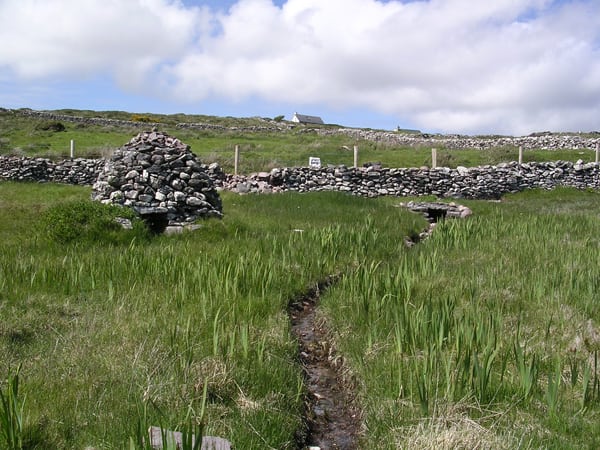 St. Michaels WellHoly well · 1654 yd
 Holy well in An CluainHoly well · 1719 yd
 Waterville Beach (Reenore) HotelRuins · 1.0 mi
 Trá an GhleanntáinBeach / strand · 1.4 mi
 Ballinskelligs Castle (in Ruins)Castle, tower house · 1.7 mi
 Reglaish Church (in Ruins)Church · 1.7 mi
 Fermoyle Castle (in Ruins)Castle, tower house · 1.7 mi
 Emlagh LoopWalking route · 1.8 mi
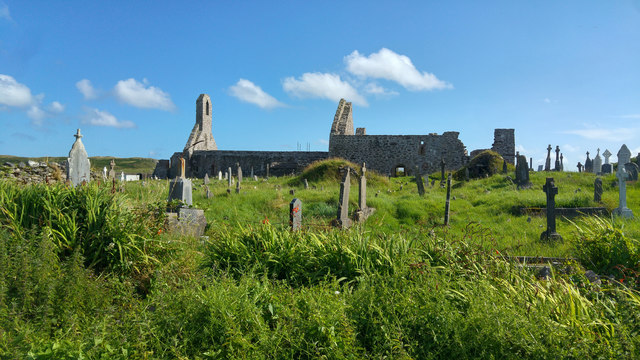 Ballinskelligs PrioryVisitor information · 2.0 mi
 Ballinskelligs Abbey (in ruins)Religious house, Augustinian canons · 2.0 mi
 Bá na ScealgBay · 2.2 mi
 KillurlyMountain / peak · 2.3 mi