
What is recorded here
Originally located on Friar's Island, Co. Tipperary, on the River Shannon (TN025-022001-) until its removal and re-erection in the grounds of Killaloe RC church in 1929. St. Molua's oratory (built around the 10th/11th century) was moved due to flooding of the River Shannon by the ESB for the Ardnacrusha power station. The church was called after St Molua of Clonfert-mulloe (Co. Laois) who is said to have had a church in the Killaloe district and who died in the early 7th century. Present remains consist of a nave (ext. dims. nave 5.57m N-S ; 8.2m E-W; wall T 0.8m) and chancel (4.2m N-S; 4m E-W; wall T 1.05m) church, the nave of which is the earlier building with the chancel being added later (Leask 1930, 130-35), as revealed when the church was being moved to its present location. The nave walls are constructed with uncoursed cyclopean sandstone masonry while the chancel walls are constructed with roughly squared stones of smaller size. The chancel has a single-light round-headed E window with stepped sillstone and unusual flat-headed doorway in the S wall. The round-headed chancel arch has curious jambstones which are not flush with the chancel arch and project inwards. The triangular-shaped stone chancel roof is bonded with lime mortar and is well preserved. The nave walls are poorly preserved and only survive several courses high with a poorly preserved trabeate doorway in the W wall. Excavations at Friar's Island prior to the removal of the church revealed that the church was constructed on a stone platform enclosed by a possible cashel with a revetment wall of unknown purpose. A second stone platform (22ft (6.71m) N-S; 50ft (15.25m) E-W) was located to the S of the church and eleven skeletons were uncovered under or close to the foundations of the N wall of the church (Macalister 1929, 16-24). The stone-roofed chancel of this church may have been constructed to house some relic of St. Molua, an earlier saint than St. Flannan who probably lived in the 8th century (Harbison 2005, 72). St. Molua's church is a National Monument in State Care, no. 279. Vol. 1 - North Tipperary' compiled by Jean Farrelly and Caimin O'Brien (Dublin: Stationery Office, 2002). The following images have been uploaded:
CL045-033015-_01.jpg View of church from SW. CL045-033015-_02.jpg View from SSW. CL045-033015-_03.jpg View from SE. CL045-033015-_04.jpg View of E gable. CL045-033015-_05.jpg View through chancel arch from W. CL045-033015-_06.jpg View of trabeate doorway in W wall. CL045-033015-_07.jpg Interior of roofed chancel showing stepped sill. Revised by: Mary Tunney
Date of revision: 10 January 2018
Originally located on Friar's Island, Co. Tipperary, on the River Shannon (TN025-022001-) until its removal and re-erection in the grounds of Killaloe RC church in 1929. St. Molua's oratory (built around the 10th/11th century) was moved due to flooding of the River Shannon by the ESB for the Ardnacrusha power station. The church was called after St Molua of Clonfert-mulloe (Co. Laois) who is said to have had a…
From the National Monuments Service (Archaeological Survey of Ireland) record CL045-033015
The monument record does not grant public access. Check the route and ask the landowner before entering private land.
- What survives
- Recorded monument
Places near here
 Saint Flannan's Catholic ChurchChurch/chapel · 28 yd
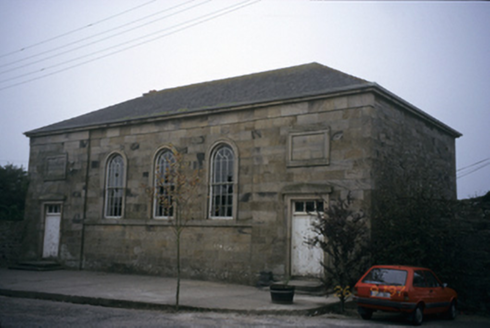 Killaloe CourthouseCourt house · 116 yd
 Brian Boru Heritage CentreVisitor information · 311 yd
 Cath.Cathedral · 398 yd
 TobermurraghHoly well · 435 ydMy Next AdventureHeritage attraction · 464 yd
.jpg/250px-Brian_Boru's_Fort_(51357382309).jpg "Photo: Discover Lough Derg, Wikimedia Commons · CC BY-SA 2.0") Brian Boru FortHeritage attraction · 1537 yd
Brian Boru FortHeritage attraction · 1537 yd Rinnaman PointHeadland · 2.3 mi
 MoylussaMountain / peak · 3.7 mi
 European ash4.0 mi
 Laghtea HillMountain / peak · 4.5 mi
 Crow IslandIslet · 4.9 mi
Pictures: NateBergin, Wikimedia Commons · CC BY 4.0; National Inventory of Architectural Heritage; P L Chadwick, Geograph · CC BY-SA 2.0; Andreas F. Borchert, Wikimedia Commons · CC BY-SA 4.0; Oliver Dixon, Geograph · Creative Commons Attribution-ShareAlike 2.0; Discover Lough Derg, Wikimedia Commons · CC BY-SA 2.0; David P Howard, Geograph · CC BY-SA 2.0; Colin Park, Geograph · CC BY-SA 2.0; Willow, Wikimedia Commons · CC BY 2.5; JP, Geograph · CC BY-SA 2.0
More historic places in County Clare · All of County Clare
What do you know about this place?