What is recorded here
Mullaghgarve holds a broken court tomb where giant limestone flags once framed a chamber for the dead. Men pulled those flags out in 1936 to build roads, scattering ancient bones and ashes across the land. Only two stones remain upright beside a grassy mound, waiting for the mountain to forget what humanity took from it.
Situated on a slight W-E spur on a shelf that is close to the bottom of the S-facing slope of Slieve Aniarin. This is described in the folk record (IFC, The Schools’ Collection: vol. 0211, 502-06) as ‘big long limestone flags, standing up on end along the sides of the mound and at both ends. Outside the flags there were piles of stones of various sizes and shapes - some of them would weigh about 2 cwt. Inside the same standing flags there were a number of broken flags which appeared to me to have been a cover that reached from the standing flags on one side to those on the opposite side. Of the standing flags there was one on the western end higher than the others. Outside that flag we got ashes similar to that, what comes from a turf fire.’ The description was provided by Terrence Geoghegan who also recovered unburnt bones, and who relates how the material was used in road-building during 1936. Terrence’s grand-nephew, Mícheál Geoghegan (senior), was able to locate the remains and reported the discovery to the National Monuments Service.
Only one stone on the N (dims 0.8m x 0.25m; H 0.4m) and one on the S (dims 1.75m x 0.1m; max. H 0.9m) sides of a chamber (dims 3m plus E-W; 1.6m N-S) survive at the W side of a circular court (dims of base 5.4m N-S; 4m E-W) defined by a grass-covered spread of cairn material (Wth 2.8-5m; int. H 0.2-0.3m; ext. H 0.2-0.7m) that has one upright stone set radially at SE but no opening. A line of four stones (L 3.7m; H 0.1m) aligned E-W on the outer edge of the court at N could be kerbstones of a cairn, some stones of which extend W of the chamber (max. dims 21m E-W; 12m N-S).
Compiled by: Michael Moore
Date of upload: 2 September, 2019
Court tomb, dating to the Neolithic period (c. 4000–2500 BCE). Its orientation and construction reflect early communal burial practices in the Irish landscape.
The monument record does not grant public access. Check the route and ask the landowner before entering private land.
- What survives
- Recorded monument
Places near here
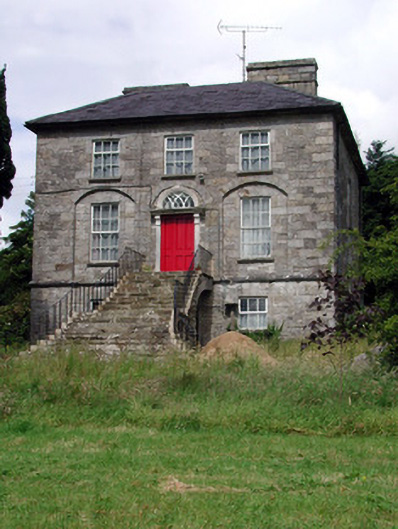 Aghacashel Housecountry house · 714 yd
 Sliabh an IarainnMountain / peak · 1.7 mi
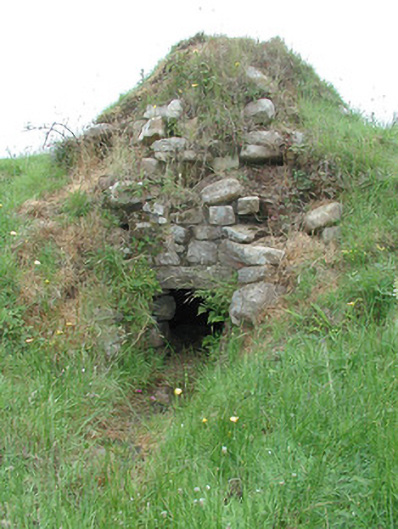 sweat housesweat house · 1.9 mi
 Sweat Ho.Sweathouse · 2.2 mi
 IndicatedEnclosure · 2.2 mi
 Rocking StoneNamed rock · 2.3 mi
 European ashEuropean ash · 2.8 mi
 BencroyMountain / peak · 3.0 mi
 The UltachsMemorial · 3.1 mi
 Turf IslandIsland · 3.3 mi
 Crane IslandIslet · 3.4 mi
 CastleforeCastle, tower house · 3.5 mi