What is recorded here
Poulawack is an ancient Irish chamber grave where a woman’s ashes and a flint scraper still lie inside a small stone box. Hencken dug the chamber in the 1930s, studied its narrow shape, and built the cairn back around it. The woman may have been young, mature, local, visited, beloved, forgotten, or all of those things. The stones have kept her shape longer than memory could have.
Situated S of centre in the upper part of Poulawack cairn (CL009-032002. Excavated by the Third Harvard Archaeological Expedition in Ireland, under Hugh O’Neill Hencken (Hencken and Movius 1935), who subsequently restored the cairn. ‘Grave 2’ in Hencken’s schema, this subrectangular cist (int. dims. 0.8m E–W; 0.45–0.5m N–S; H 0.6–0.65m) was made up of N and S sidestones set on their long edges, two overlapping endstones at the E, one at the W, and two overlapping capstones. The cist had no slab flooring; instead, the sides and ends were supported underneath by smaller stones. The grave contained cremated human remains, mostly likely of an adult female (Hencken and Movius 1935, 198). A flint end-scraper and bone point found in the cairn matrix beneath the cist were interpreted by the excavators as burial offerings from the grave which had been washed down (ibid., 201, 209, Fig. 9).
This cist was constructed within a suboval pit (c. 6.5m N–S; c. 4m E–W; D c. 1.8m) dug into the top of the cairn (ibid., Fig. 2, 199). The cist did not yield samples for radiocarbon dating, however, a cist (CL009-032014-) found c. 1.5m to the N within the same pit and therefore likely to be roughly contemporary (ibid.) was later radiocarbon-dated to between c. 1610 cal BC and c. 1432 cal BC (Brindley and Lanting 1992, 16). This falls within the final broad phase of mortuary activity at Poulawack cairn, during the mid-second millennium BC, when ‘Grave 1’ (CL009-032012-) was also added, and possibly also ‘Grave 7’, a cist (CL009-0032018-) (ibid.) although the evidence for the Grave 7 date is equivocal.
The following images have been uploaded:
CL009-032013-_01.jpg Cist plan and section (Hencken and Movius 1935, Fig. 5)
CL009-032013-_02.jpg Photograph showing the location of Graves '2' and '5' within the cairn (Hencken and Movius 1935, Pl. XX, Fig. 2)
Compiled by: Mary Tunney and Conn Herriott
Date of upload: 12 January 2022
A Neolithic cist tomb, dating to the 4th–3rd millennium BCE, associated with the passage tomb complex of Poulawack; it is significant as part of an early excavated and documented site by American archaeologists in Ireland, contributing to understanding of Neolithic burial practices in the region.
The monument record does not grant public access. Check the route and ask the landowner before entering private land.
- What survives
- Recorded monument
Places near here
 Poulawack CairnArchaeological place · 1 yd
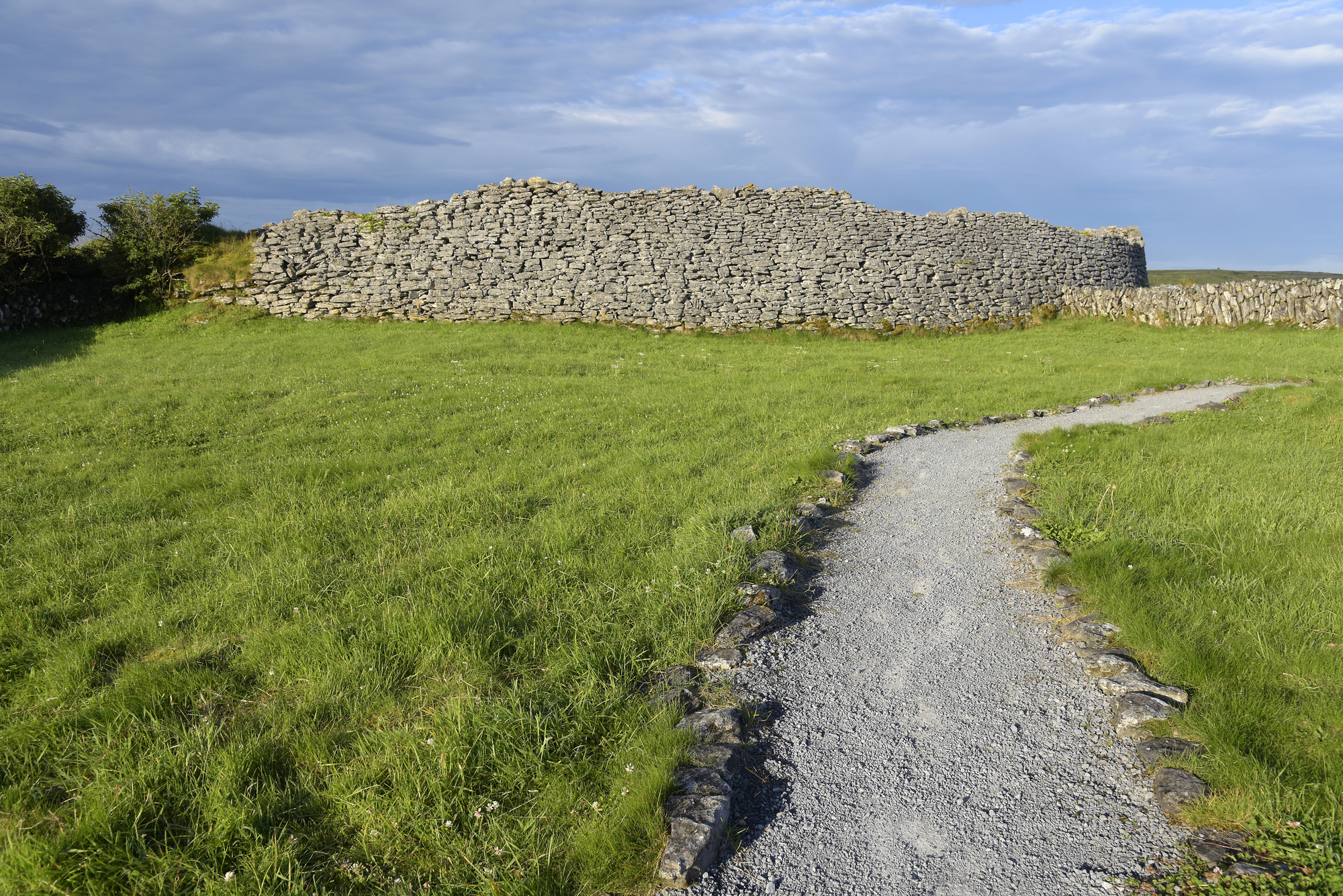 IndicatedEnclosure · 321 yd
 Caherconnell Stone FortRuins · 1131 yd
 CaherconnellHeritage attraction · 1158 yd
 Cave of the Wild HorsesCave · 1335 yd
 Carran Church (in ruins)Church · 1490 yd
 Poulnabrone - Burren GeositeVisitor information · 1.0 mi
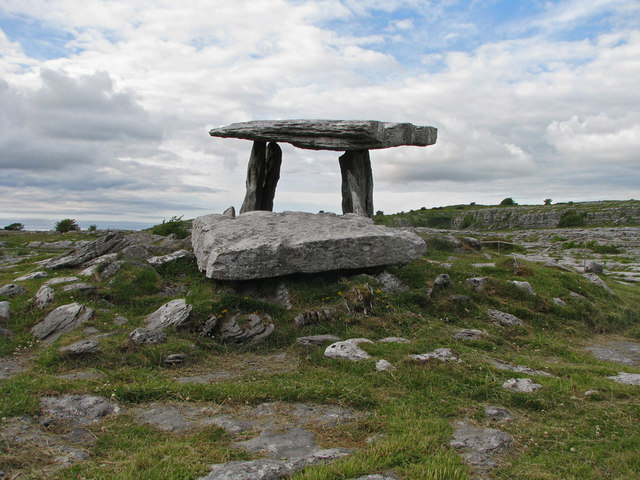 The Portal TombVisitor information · 1.1 mi
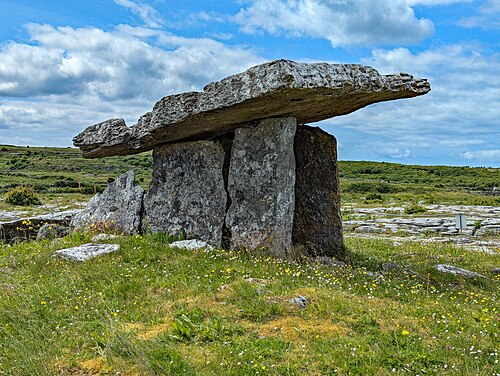 Poulnabrone DolmenHeritage attraction · 1.2 mi
 Gleansleade Castle (in ruins)Castle, tower house · 1.6 mi
 PoulnabroneMemorial · 1.7 mi
 Farbrega RockNamed rock · 1.8 mi