
Places near here
Photo credits
- Philip Halling, Wikimedia Commons · CC BY-SA 2.0
- Paul Gillett, Wikimedia Commons · CC BY-SA 2.0
- PAUL FARMER, Wikimedia Commons · CC BY-SA 2.0
- Peter Barr, Wikimedia Commons · CC BY-SA 2.0
- Stephen Craven, Wikimedia Commons · CC BY-SA 2.0
- Steve Daniels, Wikimedia Commons · CC BY-SA 2.0
- Len Williams, Wikimedia Commons · CC BY-SA 2.0
- [3], Wikimedia Commons · Public domain
- Harry Bond, Wikimedia Commons · CC BY 4.0
- Thomas Nugent, Wikimedia Commons · CC BY-SA 2.0
 Lambeth PalaceListed building · 23 yd
 Soe MonumentMonument or public art · 53 yd
 Church of St MaryListed building · 75 yd
 Tomb of John Tradescant and His FamilyMemorial · 77 yd
 Knot GardenGarden · 77 yd
 Garden MuseumMuseum · 83 yd
Explorer Tom Garden Museum sits beside Lambeth Palace in a rescued church, proving that a good garden can survive even when its original gardeners have been gone for centuries. The former St Mary-at-Lambeth holds collections about plants, design and the people who cultivated them. Outside, the carved tomb of John Tradescant and his family gives this London site a wonderfully exact reason for growing a museum around it. John Tradescant the Elder collected plants and curiosities, and his son continued that work; their Lambeth home became known as the Ark. After the younger Tradescant died in 1662, his widow Hester commissioned the family tomb in the churchyard. The church itself changed repeatedly, with much of its body rebuilt in the nineteenth century. By the 1970s it was boarded up and threatened with demolition, a poor fate for a place with such deep garden roots. Rosemary and John Nicholson began a campaign to save the building and the Tradescant memorial. The Museum of Garden History took shape in 1977, later becoming the Garden Museum. It now welcomes visitors to displays, exhibitions and planted spaces beside the Thames. Look for the tomb, then let the collections show how gardens are made by labour, travel, experiments and taste. Plants may grow on their own, but a garden's story rarely does. I suspect Tradescant would ask Tom to weed first and tell stories later; the museum would be better for it. That is imaginary advice from a real gardening pioneer. Cross into this old church, meet the people behind its plants, and see what a rescued place can grow next.
 Special Operations ExecutiveMemorial · 86 yd
 1973 Westminster bombingBomb attack · 518 yd
 The Jewel TowerScheduled monument · 609 yd
 assassination of Spencer PercevalAssassination · 627 yd
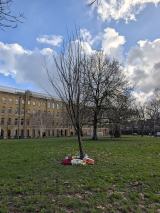 Holocaust Memorial TreeBroadleaf Memorial Tree, exact kind not recorded · 755 yd
 St. Margaret´s ChurchVisitor information · 789 yd
More places in London Borough of Lambeth

What do you know about this place?Tap to add a comment or ask a question