DDiscover AloneMapAbout

Chapel in Innisfallen

Church

The monument record does not grant public access. Check the route and ask the landowner before entering private land.

What do you know about this place?Tap to add a comment or ask a question

What you write will be public.

What is recorded here

National Monument No. 183. On slightly raised ground NE of an Augustinian Abbey (KE066-072001-), on the NE shoreline of Innisfallen Island in Lough Leane. A single-cell, rectangular structure of limestone (ext. dims. 7.2m x 5.15m; int. dims. 5.44m x 3.4m) constructed on three plinths (extending c. 0.1-0.2m beyond the…

Read the whole record
National Monument No. 183. On slightly raised ground NE of an Augustinian Abbey (KE066-072001-), on the NE shoreline of Innisfallen Island in Lough Leane. A single-cell, rectangular structure of limestone (ext. dims. 7.2m x 5.15m; int. dims. 5.44m x 3.4m) constructed on three plinths (extending c. 0.1-0.2m beyond the foundation courses). The gables survive to almost original height (H 1.2m; max. wall T 0.8m) with a Hiberno-Romanesque E window and W doorway of red and yellow sandstone with some sandstone quoins on the W gable. Formerly used as a banqueting hall in the 19th century by Lord Kenmare when a bay window and fireplace were inserted in the S wall and the oratory was re-roofed. Now roofless; both window and fireplace have been removed. The E window (ext. H 2m; ext. Wth 0.4m; int. H 2.3m; int. Wth 0.6m), partially restored, comprises of a semicircular, single arch-stone resting on rebated jambs with five plain voussoirs above. The arch-stone was re-fitted in the 19th century after it fell onto the shore; it is now ill-fitting. The jambstones have half roll-moulding on the external angle with the inner edge of the roll forming the rebate. The elaborate Hiberno-Romanesque W doorway (H 1.9m; Wth 0.75m) comprising of red sandstone jambs, yellow sandstone arches and hood-moulding (where opposite occurs these are inserts). The doorway is of two orders with hood-moulding over. The voussoirs of the inner order are decorated with lateral, centrifugal chevrons in low relief that continue over the arris onto the soffit; four rows on the face and two to three on the soffit. Jambs of the inner order are plain, well-cut ashlar. The nib-holes for centering survive on ingoing of springers. The outer order comprises of jambstones with deeply cut 3/4 roll-moulding on the external angle terminating in a shallow roll at the plinth and the springers. At the plinth the roll is decorated with a shallow scallop design and slight torus. Some graffiti on the jamb and on some blocks are out of sequence or upside-down. The arch of the outer order is formed of unusually moulded voussoirs (possibly called Gear-tooth voussoirs (T. O'Keefe pers. comm.; Weaver 1995)), which are the only example in the country. These voussoirs are 'ridged like the roof of a house, on both faces, so as to form a zigzag moulding in two directions' (Romilly Allen 1892, 159) and are decorated with low-relief chevrons, in three rows frontal to face and soffit (following the moulding). Four voussoirs on the N arc of this order are replacements. The outer hood-moulding are of yellow sandstone and the N arc is a replacement. The remaining sections comprise: six heavily eroded heads, now in the form of bosses, set within the hollow chamfer of a single archstone, and four archstones each with c. three grotesque heads apiece also set within a hollow chamfer (the S-most arc may have had four heads). The central arc is best preserved with three heads: (1) gaunt, narrow face with bulging eyes and twisted mouth carved in relief and small wide-set ears, (2) wide face, wide-set bulging eyes under heavy brow-ridge, large gaping mouth and ears widely set on top of head, with a third loop-like ear at centre, (3) narrow, gaunt face with almond-shaped bulging eyes, twisted mouth and small closely set ears pointing towards each other. The voussoirs of the outer order are unique in Ireland and are similar to 12th-century churches in the Saintonge region of France. This type of voussoir occurs infrequently in Great Britain, and as there are no other examples along the E and SE coast of Ireland, it is more likely that the influence here is French (Weaver 1995). The beasts' heads set within a hollow chamfer are comparable to the Nun's Chapel at Clonmacnoise. Similarities with other Hiberno-Romanesque churches can also be inferred; possible mid/late 12th-centry date. There is a small free-standing ringed-cross (KE066-072013-) on a plinth in the centre of the oratory. (Weaver 1995) M. Weaver 1995 'An architectural survey of Inisfallen Island, Lough Leane, Co. Kerry.' MA Thesis, Dept. of Archaeology, UCC.

From the National Monuments Service (Archaeological Survey of Ireland) record KE066-072002

Places near here

Photo credits
  • Sitomon, Wikimedia Commons · CC BY-SA 2.0
  • Keith Salvesen, Wikimedia Commons · CC BY-SA 2.0
  • Maker not stated on source page, www.pinterest.com
  • Bkwillwm, Wikimedia Commons · CC BY-SA 3.0
  • Maker named on the Wikimedia Commons picture page · Public domain
  • Adrian Beney, Wikimedia Commons · CC BY-SA 2.0
  • Maker not stated on source page, www.dreamstime.com
  • David Dixon, Geograph · CC BY-SA 2.0
  • bdolicki, Wikimedia Commons · CC BY-SA 3.0
  • Maker not stated on source page, killarneyguide.ie
  • Gillfoto, Wikimedia Commons · CC BY-SA 4.0
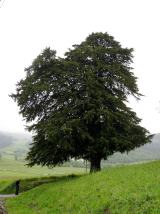
European Yew63 yd

Explorer Tom European Yew in County Kerry says the 1800s were basically a group chat that never got deleted. Everyone was screaming…

Innisfallen Abbey (in ruins)Religious house, Augustinian canons · 72 yd

Explorer Tom Innisfallen Abbey has a family tree that's mostly made up of guesses and old stones. The claustral buildings are north…

Bullaun stone in InnisfallenBullaun stone · 86 yd

Explorer Tom Bullaun stone in Innisfallen is sitting in an abbey where Vikings got so lost they just gave up and built a wall. It’s…

InnisfallenIsland · 262 yd

Explorer Tom Innisfallen is a green island in Killarney's Lough Leane, close enough to see from Ross Castle yet reachable by…
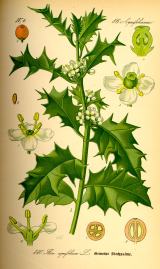
English holly316 yd

Explorer Tom English holly in County Kerry was the site where a priest lost a bet about how many berries it could produce by…

Lamb IslandIsland · 841 yd

Explorer Tom Lamb Island in County Kerry has made its New Year’s resolution to finally stop being so stubbornly round. It says it’s…

Fairy fort / earthen ringfort in Caher (magunihy By.)Fairy fort / earthen ringfort · 954 yd

Explorer Tom Fairy fort / earthen ringfort in Caher has had so many names it’s lost count. It might be a rath, or maybe just Mrs.…

Ross Castle RingwayWalking route · 1575 yd

Explorer Tom Ross Castle Ringway sounds like a fancy office party, but it's really just a circle of rocks judging your life choices.…

Ross Castle (in ruins)Castle, tower house · 1752 yd

Explorer Tom Ross Castle in County Kerry is moaning about damp to the council like it’s a grumpy old tenant. It’s perched on a rock…
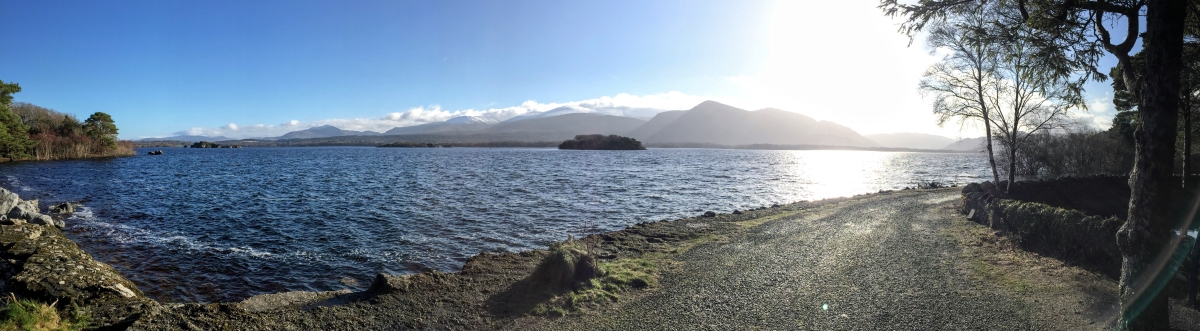
The Ross Island Copper MineVisitor information · 1756 yd

Explorer Tom The Ross Island Copper Mine thinks the road leading to it is a personal insult because it’s too narrow for its grandeur…

Ross CastleHeritage attraction · 1.0 mi

Explorer Tom I would show up by boat, but Ross Castle knows that trick already. Ross Castle watches Lough Leane with the expression…

Ross Island CaveCave · 1.0 mi

Explorer Tom Ross Island Cave in Kerry has a tall tale about a hidden tunnel that goes straight to the pub. The landlord says he’s…

More historic places in County Kerry · All of County Kerry

Add to this placeAdd a picture Add a detailed tip Add a story

Explore the map1,095,414 places to discover

Next place · or swipeEuropean Yew