
What is recorded here
Castle ringwork in Ballinphull stands forty feet above pasture, a steep oval mound with a level summit and a broken bank where an entrance once cut through. It may be Bunnina, the English castle seized by Donnell O'Connor in 1308, burned in 1310, and later taken by the O'Connors themselves. In 1494 Donnell O'Connor was killed there by his own cousins, turning a foreign stronghold into a chamber of family betrayal. Oyster shells still show in the outer soil, hinting that the bay fed the people who lived, fought and bled on that small high ground.
Situated on the summit of a low hill in undulating average pasture overlooking Ballysadare Bay. This may be the castle of Bunnina which was established by the English soon after their arrival in Connacht. In 1308 the castle's constable and many other English were slain by the forces of Donnell O'Connor. The castle is also recorded in the Annals of Clonmacnoise as having been burned and plundered by the O'Connors in 1310 (O'Rorke 1890, 397; O'Conor 1994, pers. comm.). After the explusion of the English the O'Connors took control of the castle and it was here in 1494 that Donnell O'Conner was killed by his own cousins in a dispute over chieftanship (O'Rorke, ibid.). Remains comprise a high, steep-sided, oval-shaped mound of earth and stone (H 4m - 5m). The level summit (dims. 29.4m N-S; 23.8m E-W) is enclosed by a low bank of earth and stone revetted with stone (Wth. 2m - 3m; int. H 0.3m). Break in bank at SSE (Wth. 2.2m) with an accompanying ramp which extends down the slope represents original entrance. No fosse or bailey. Exposed soil on the external face of the mound contains fragments of oyster shell. Local tradition that stonework had been removed from the site to build an adjacent farmhouse and the 'Castle Lodge'. (Kilgannon 1926, 289-91; CUCAP BGM 29).
See also SL013:098---- and SL019:192----*
Compiled by: Patrick F. O'Donovan
Date of upload: 19 January 2011
Built by the English soon after their arrival in Connacht, likely in the late 13th or early 14th century, this ringwork may correspond to the castle of Bunnina mentioned in historical records. It is important as a surviving example of early English military architecture in the region and as a potential link to medieval colonial efforts in western Ireland.
The monument record does not grant public access. Check the route and ask the landowner before entering private land.
- What survives
- Recorded monument
Places near here
 Cliff-edge fort in BuninnaCliff-edge fort · 627 yd
 Enclosure in Ballinlig (tireragh By.)Enclosure · 657 yd
 Lahanacappul IslandIslet · 881 yd
 Ballinlig PointHeadland · 1134 yd
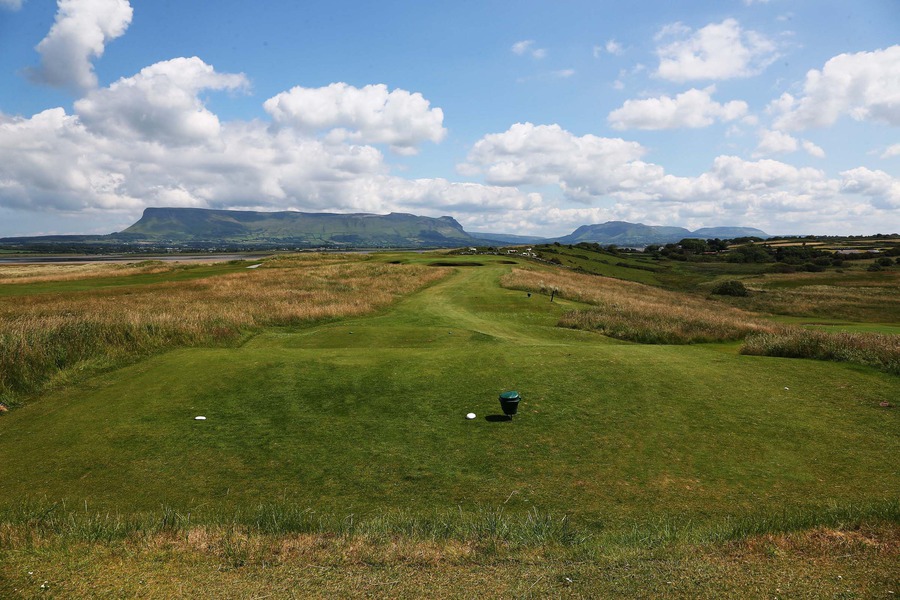 Portavaud PointHeadland · 1157 yd
 Giant's GraveArchaeological place · 1579 yd
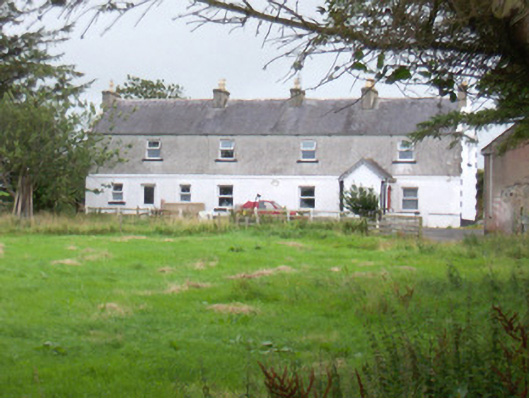 Derk HouseOfficially recorded historic building · 1.1 mi
 BawnmoyleRuins · 1.3 mi
 Bawn in CarrowbrickeenBawn · 1.3 mi
 Bawn in Tanrego WestBawn · 1.6 mi
 CulleenamoreBeach / strand · 1.7 mi
 Strandhill BeachBeach / strand · 2.2 mi
Other information
Photo: Credit not shown · Copyright shown; no reuse licence shown