What is recorded here
Under Poulawack cairn in County Clare, an adult male curled on his right side beside five upright slabs, buried around 1486-1452 BC during the site's final phase of grave-building. Hugh O'Neill Hencken's Harvard expedition exposed the contracted body on bedrock, then restored the cairn above him. The man may have been placed there deliberately, his bones hidden beneath limestone while the community kept shaping the mound around the dead.
Situated under Poulawack cairn (CL009-032002-), on the bedrock outcrop surface immediately SE of the cairn’s inner revetment. Excavated by the Third Harvard Archaeological Expedition in Ireland, under Hugh O’Neill Hencken (Hencken and Movius 1935), who subsequently restored the cairn. This crouched inhumation (‘Grave 1’ in Hencken’s schema) is composed of the very poorly preserved remains of an adult male, buried in a contracted position, lying on the right side and facing W (Hencken and Movius 1935, 198). The burial was partly covered by horizontal limestone slabs. Immediately to the N–NE there were five upright slabs (H c. 0.3–0.6m; L c. 0.4m; T c. 0.1m), four of which formed a NW–SE row. It is unclear whether these slabs are the remains of an irregular cist (Hencken and Movius 1935, 198; Ryan 1981, 134). The burial has been radiocarbon dated to 1486–1452 cal BC (Brindley and Lanting 1992). This falls within the final broad phase of mortuary activity at Poulawack cairn, during the mid-second millennium BC, when the 'Grave 2' and 'Grave 3' cists (CL009-032013- and CL009-032014-) were also constructed, and possibly also the 'Grave 7' cist (CL009-0032018-) (ibid.) although the evidence for the latter’s date is equivocal.
The following image has been uploaded:
CL009-032012-_01.jpg Grave 1 from SE with inner revetment behind (Hencken and Movius 1935, Pl. XIX, Fig. 1)
Compiled by: Mary Tunney and Conn Herriott
Date of upload: 12 January 2022
A Neolithic burial under a cairn; associated with early funerary practices in the region.
The monument record does not grant public access. Check the route and ask the landowner before entering private land.
- What survives
- Recorded monument
Places near here
 Poulawack CairnArchaeological place · 1 yd
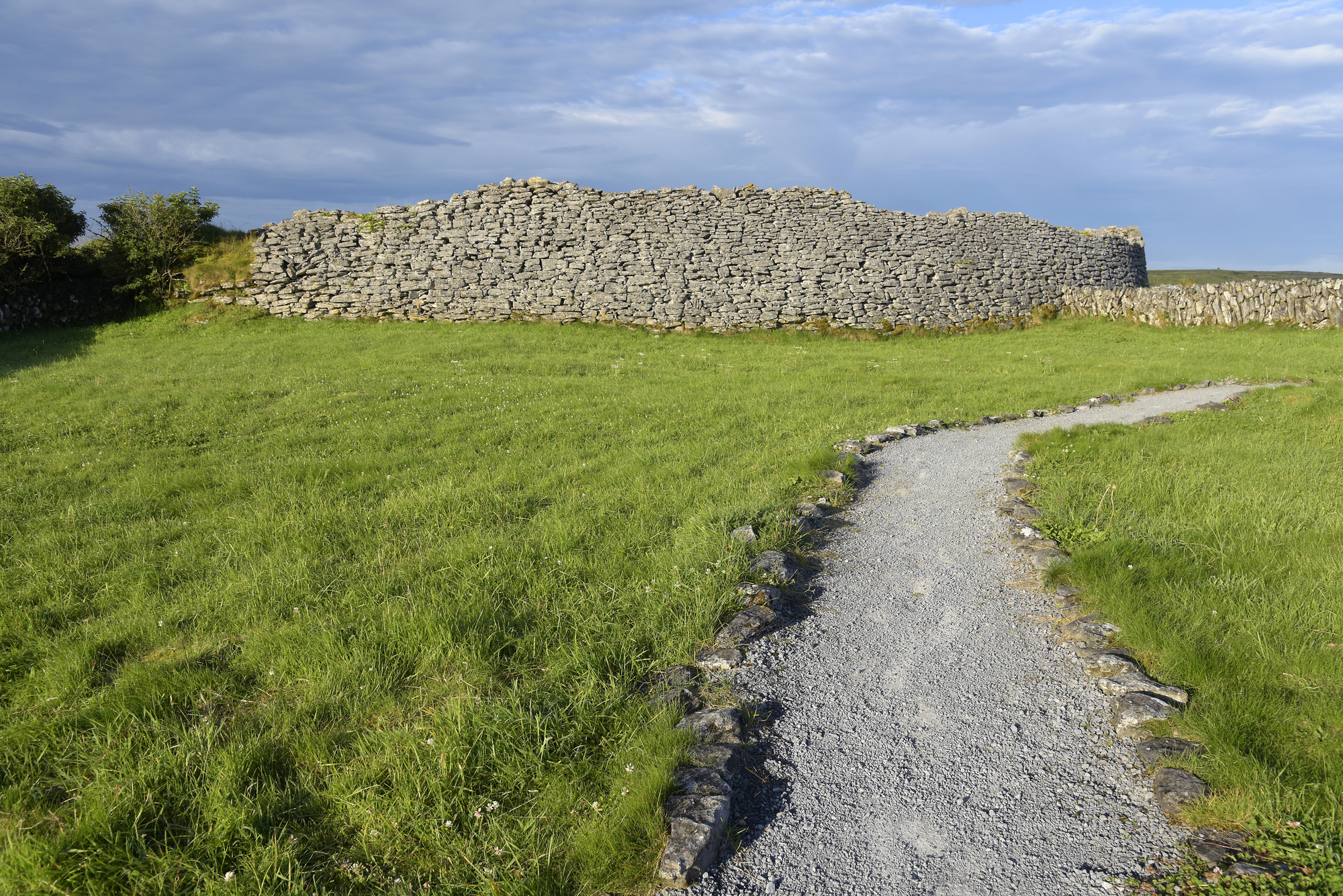 IndicatedEnclosure · 321 yd
 Caherconnell Stone FortRuins · 1131 yd
 CaherconnellHeritage attraction · 1158 yd
 Cave of the Wild HorsesCave · 1335 yd
 Carran Church (in ruins)Church · 1490 yd
 Poulnabrone - Burren GeositeVisitor information · 1.0 mi
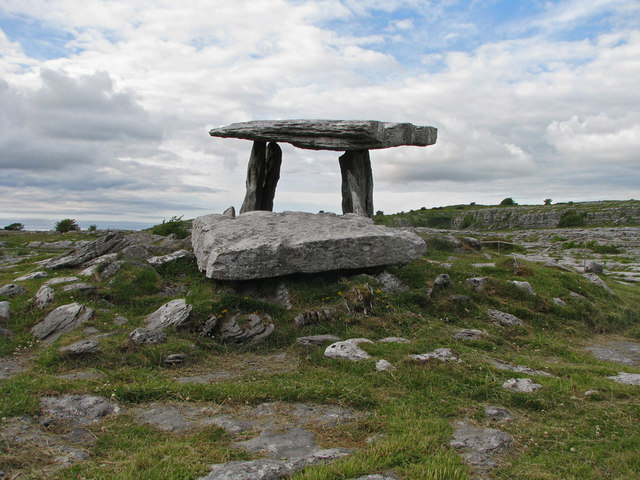 The Portal TombVisitor information · 1.1 mi
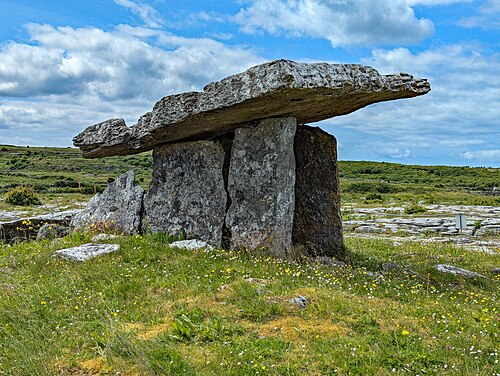 Poulnabrone DolmenHeritage attraction · 1.2 mi
 Gleansleade Castle (in ruins)Castle, tower house · 1.6 mi
 PoulnabroneMemorial · 1.7 mi
 Farbrega RockNamed rock · 1.8 mi