Overview
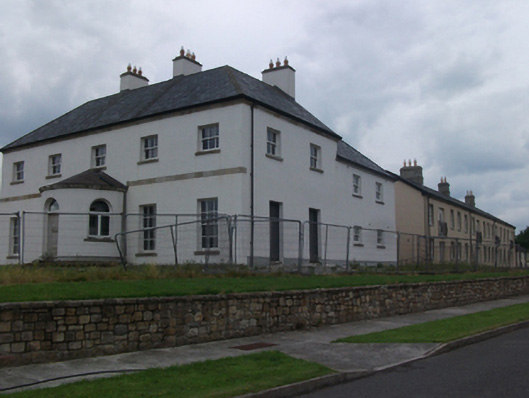
Ballyconnell House is recorded as country house in Cavan. Detached five-bay two-storey country house, built 1764, having single-storey bowed entrance, added c.1850, with returns to rear extended, 2008. Hipped roof slate roof to main house and pitched slate roofs to returns, having rendered chimneystacks, oversailing eaves and uPVC bargeboards.
Why it was built
The saved account records: Detached five-bay two-storey country house, built 1764, having single-storey bowed entrance, added c.1850, with returns to rear extended, 2008.
People and work
The saved account records: Hipped roof slate roof to main house and pitched slate roofs to returns, having rendered chimneystacks, oversailing eaves and uPVC bargeboards.
How it changed
The saved account records: Formerly attached L-plan multiple-bay two-storey range of former outbuildings to rear, now heavily altered and partially converted to apartments.
What survives
The saved account records: Partially surrounded by random sandstone rubble boundary wall with square cement coping and cast-iron railings.
Why it mattered
Ballyconnell House matters for the exact reasons given in its official assessment, rather than merely because it is an old structure. The source records: Ballyconnell Castle was completed in 1620 for Walter Talbot who had developed the town during the Plantation of Ulster. The castle was burnt and replaced in the eighteenth century by Ballyconnell House, apparently built by G. Montgomery, and retained the name "castle" well into the nineteenth century. Though recently renovated, the building retains much of its historic form, proportions, and character. The detailing in local sandstone is typical of Ballyconnell. As the former seat of the landlords of Ballyconnell, it continues to contribute to the history of the town and its surrounding hinterland. This explains what the place adds to local life, the street or the surviving built history.
History checked 15 August 2026 against the named sources below.
Places near here
- Bawn in Annagh (tullyhaw By.)castleunder 0.1 miles
- Ballyconnell Castle — Annagh (tullyhaw By.)castleunder 0.1 miles
- Children's playground — County Cavanattractionunder 0.1 miles
- Ballyconnell Amenity Areaattractionunder 0.1 miles
- Kieran Doherty TD Cavan Monaghan Memorialmemorial0.1 miles
- Ballyconnell Canal Walkviewpoint0.1 miles
- Mapped sculpture in County Cavanattraction0.1 miles
- Ballyconnell Market House — Main Streetbuilding0.1 miles
- Ulster Bank — Main Streetbuilding0.1 miles
- J. Mc Barron Public House — Main Streetbuilding0.1 miles
- Ballyconnell Methodist Church — Main Streetbuilding0.1 miles
- Daisy Hill Gardensattraction0.1 miles
Add the human story, a picture, a first-hand message or a missing place.
Earn 5 points after the picture is checked and accepted.
Add a pictureAdd its storyTalk or ask a questionAdd a new placeThis official record and map point do not grant access. Most recorded buildings are privately owned; view them only from public ground unless the owner allows entry.
Conversation about this place
Questions and messages sit beneath the source record. They are checked before appearing.
No questions or messages yet.
Ask a question or join the conversation