What is recorded here
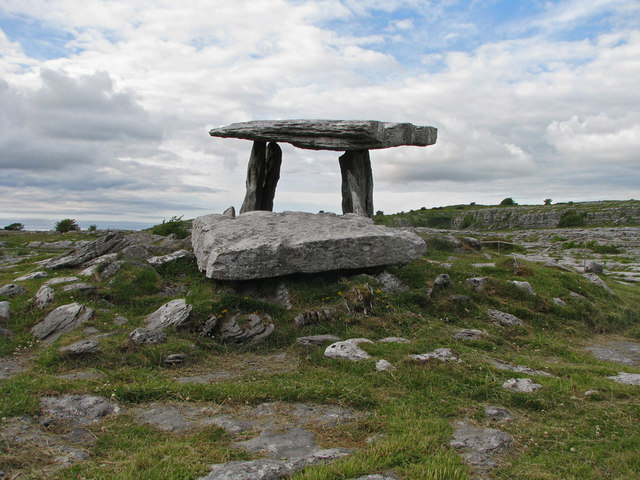
The collapsed chamber in Ballymihil still wears a carved cross on its capstone, proving that the dead did not keep the rock to themselves. A tall slab once stood beside the stones like a rude human figure or round-headed cross, but it has vanished, leaving the mound open to imagination. The tomb sits inside a later field wall near a cashel, suggesting that living people kept returning to mark, use and remember the same spot long after the first burial.
In elevated rocky pasture on a SW-facing slope with clear views to the W from Poulawack to Cappanawalla and within an extensive multiperiod field system (CL005-160001-). Indicated and named ‘Cromlech’ on the 1840 and 1916 OS 6-inch maps. Described by Westropp (1899, 373) as a ‘fallen cromlech’ and classified by de Valera and Ó Nualláin (1962, 13) as a ‘wedge-shaped gallery grave’. The details that follow are from de Valera and Ó Nualláin.
A collapsed wedge tomb orientated ESE-WNW set centrally within a low oval mound. The monument comprises a roughly trapezoidal capstone, widest at WNW and narrowing to ESE (L 3.45m; Wth 1.8-2.3m; T 0.15-0.2m), lying on top of the fallen sidestones. The sidestones are represented by four large broken slabs, three lie on the N side of the capstone, with one to the S. Only two of the N slabs are clearly visible (W stone Wth 1.8m; T 0.1-0.15m; E stone Wth 1.5m; T 0.1-0.15m), concealing a third fallen slab beneath. A single slab (L 1.55m; T 0.1-0.15m) is visible to the S. A low upright stone at the W end of the chamber (Wth 1.2m; H 0.3m) may be the base of a doorstone.
The mound (8.5m E-W; 6.6m N-S; H 0.75m) is grassed over with poorly defined edges. Five protruding upright stones suggest the presence of kerbing and/or internal walling in the mound. Two stones, one to the SW (Wth 0.8m; H 0.15m; T 0.1m) and one to the SE (Wth 0.35m; H 0.1m; T 0.07m), appear to represent an inner wall. Three stones to the NW, SW (Wth 0.6m; H 0.4m; T 0.15m) and SE (Wth 1.2m; H 0.45m; T 0.15m) appear to represent an outer wall or kerb.
A cross has been incised with a small hollow (L 0.15m; Wth 0.07m) on the centre of the capstone suggesting the reuse of the tomb as altar or mass-rock (CL005-310----). Westropp (1899, 373) and de Valera and Ó Nualláin (1961, 13) noted the presence of a small stack of stones on the top of the capstone holding an upright slab shaped like a ‘round-headed cross’ or ‘a rude human figure’. On inspection in 1998 the stack of stones remained, but the upright slab was not present.
The N edge of the mound is overlain by the drystone wall of a subrectangular enclosure. The wedge tomb and mound were incorporated into a mound wall aligned ENE-WSW and coaxial with a rectangular cashel (CL005-160010-) located c. 70m to the SW.
See linked document with details from Ruaidhrí de Valera and Seán Ó Nualláin, Survey of the Megalithic Tombs of Ireland. Volume I. County Clare. (Dublin: Stationery Office, 1961).
Date of upload: 24 December 2011
Wedge tomb, dating to the Late Neolithic or Early Bronze Age (c. 2500–1500 BCE). Its location within a multiperiod landscape suggests it was part of a broader ritual or funerary tradition in the region.
The monument record does not grant public access. Check the route and ask the landowner before entering private land.
- What survives
- Recorded monument
Places near here
 Mass-rock in BallymihilMass-rock · 1 yd
 IndicatedFairy fort / stone ringfort · 451 yd
 PoulnabroneMemorial · 1110 yd
 Gleninshing tombHeritage attraction · 1.1 mi
 Gleninshing portal tombHeritage attraction · 1.2 mi
 The Portal TombVisitor information · 1.2 mi
 Gleansleade Castle (in ruins)Castle, tower house · 1.2 mi
 Poulnabrone - Burren GeositeVisitor information · 1.3 mi
 Caherconnell Stone FortRuins · 1.6 mi
 Aillwee CaveCave · 2.1 mi
 Aillwee Cave Visitor Centreheritage centre/interpretative centre · 2.1 mi
 Cave of the Wild HorsesCave · 2.2 mi