What is recorded here
Glacial limestone erratic (H 1.45m; Wth 1.3m; T 0.27-0.65m) that has a stone head carved onto its surface which originally was located in a field near to Killavilla House and has since been removed from its original location and is now housed in the National Museum of Ireland (see DU018-209----) when it was acquired from the landowner in 1944. The adjoining field to where the stone was located was known locally as the cillín and in this field there was a low mound (diam. 41m; H 0.6m) surrounded by a shallow fosse (OF043-057----). The upper part of the stone head is pointed and rises to a peak above the forehead (Roe 1945, 263-66).
The above description is derived from the published 'Archaeological Inventory of County Offaly' (Dublin: Stationery Office, 1997). In certain instances the entries have been revised and updated in the light of recent research.
Date of upload: 23 May 2011
Likely dating to the Neolithic or Bronze Age, the stone head may represent an ancestral or spiritual figure, reflecting early ritual or symbolic practices in the region. Its removal from its original location may have disrupted any local folklore or ceremonial associations linked to the site.
The monument record does not grant public access. Check the route and ask the landowner before entering private land.
- What survives
- Recorded monument
Places near here
 Children's burial ground in KillavillaChildren's burial ground · 135 yd
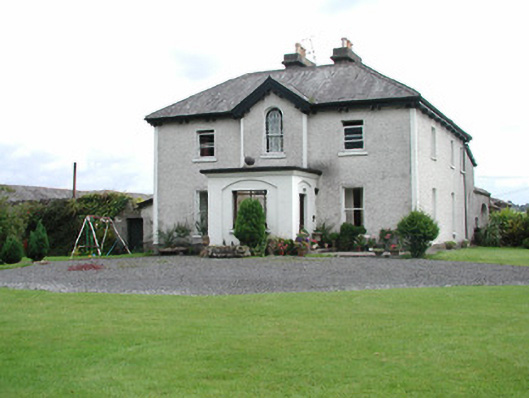 Killavilla Househouse · 141 yd
 CastleCastle, ringwork · 1230 yd
 IndicatedKiln, lime · 1511 yd
 Burnt mound in Gorraun (ballybrit By.)Burnt mound · 1567 yd
 Saint Kieran's WellSpring · 1687 yd
 Bawn in DungarBawn · 1.4 mi
 Millennium GardenMemorial · 1.4 mi
 European YewEuropean Yew · 1.8 mi
 European BeechEuropean Beech · 2.0 mi
 Roscrea Petty Sessions HouseHeritage attraction · 2.4 mi
 Golden Grove HillMountain / peak · 3.0 mi