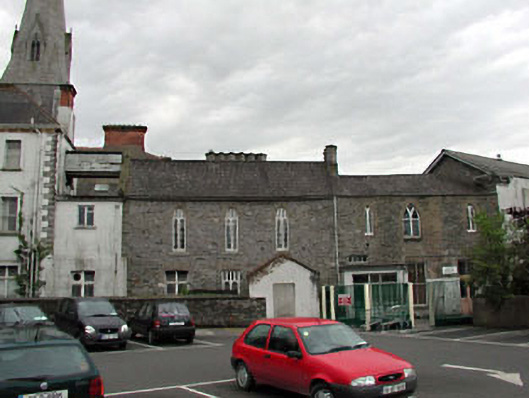
What is recorded here
Attached three-bay three-storey rubble stone Gothic-style building, c.1820, on a cranked plan with three-bay two-storey lower wing to north-west. Renovated, c.1900, with single-bay single-storey gabled projecting porch added to ground floor. Renovated, c.1960, with single-bay single-storey flat-roofed advanced bay added to ground floor on a shallow triangular plan. Gable-ended roofs on an cranked plan with slate. Clay ridge tiles. Rendered chimney stack. Rendered coping to gables. Cast-iron rainwater goods. Gabled to porch. Corrugated-iron. Rendered coping to gables. Flat-roofed to advanced bay. Bitumen felt. Random rubble stone walls. Repointed, c.1960. Rendered walls to porch and to advanced bay. Unpainted. Square-headed openings to ground floor. Stone sills. Red brick dressings. Pointed-arch window openings to first floor. Stone sills. Brick dressings. Traceried fixed-pane timber windows. Square-headed openings to porch now blocked-up. Square-headed window opening to advanced bay. Concrete sill. Timber casement window. Set back from road in grounds shared with Catholic church and convent.
This building, the original and present purposes of which are uncertain, is an attractive feature of a complex that includes a Catholic church (11814052/KD-19-14-52) and convent (11814053/KD_19-14-53) – the construction in rubble stone with brick dressings distinguishes the building amongst its neighbours, which are mostly rendered. The building retains many original features and materials, including traceried timber windows to the attractively-shaped openings, and a slate roof with cast-iron rainwater goods. Remodelled to part ground floor in the late twentieth century, the additional advanced bay does not complement the original integrity of the building, although it is an easily-removed feature. The building is of some social and historic importance, representing the continued expansion of a Catholic quarter in the town in the early nineteenth century.
This does not grant access. Most recorded buildings are privately owned; view them only from public ground unless the owner allows entry.
Places near here
 Catholic Church of Our Lady and Saint Davidchurch/chapel · 64 yd
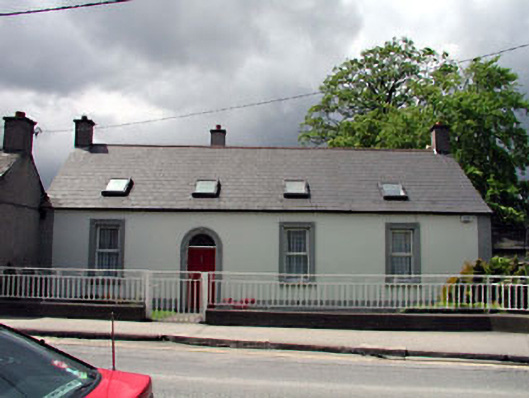 Beauforthouse · 111 yd
 Font in Naas WestFont · 158 yd
 Poplar SquarePicnic place · 190 yd
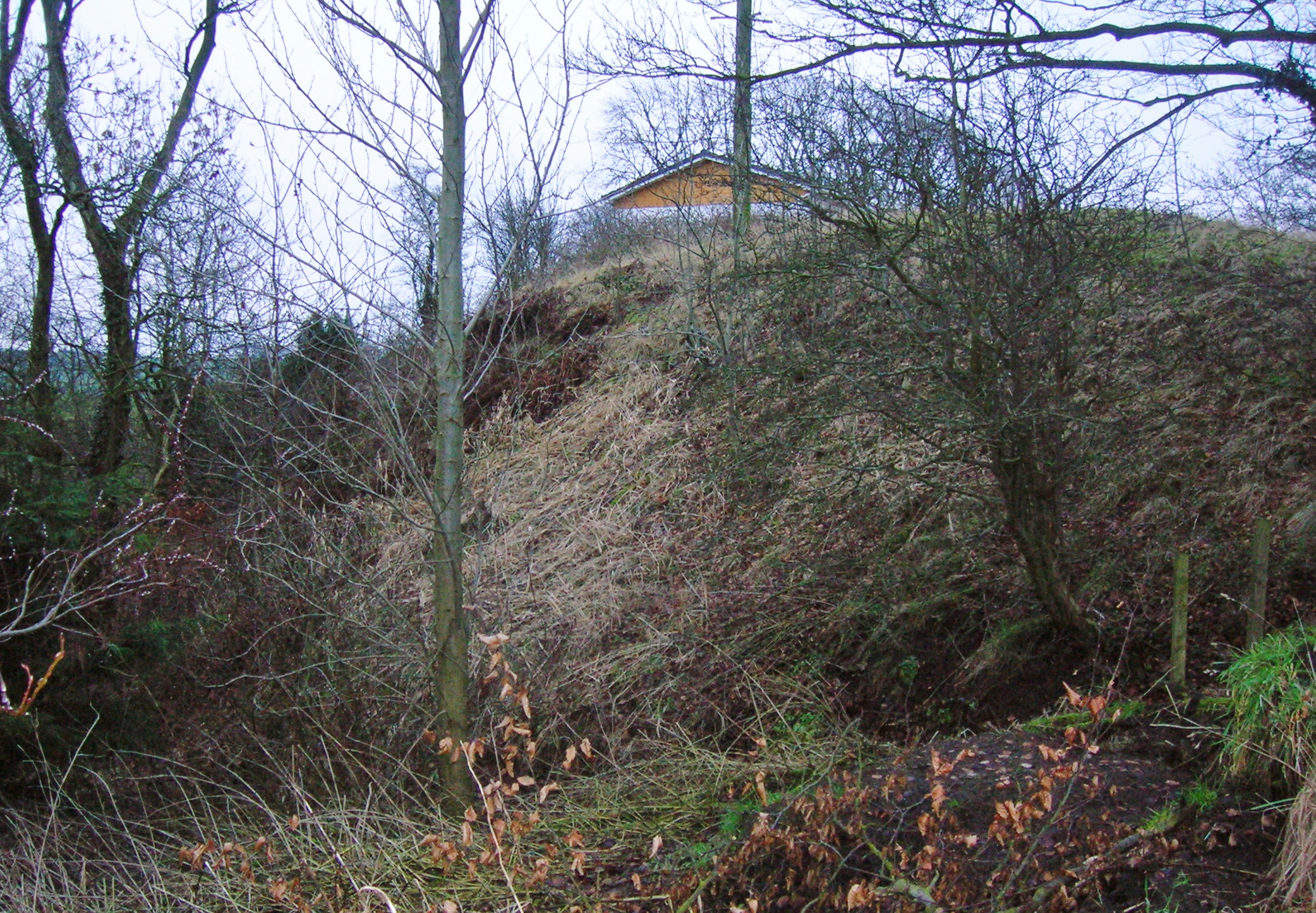 North MoteArchaeological place · 230 yd
 Site of Black CastleCastle, unclassified · 235 yd
 Site of Eustace CastleCastle, tower house · 251 yd
 Monread District Park WoodsWood · 1384 yd
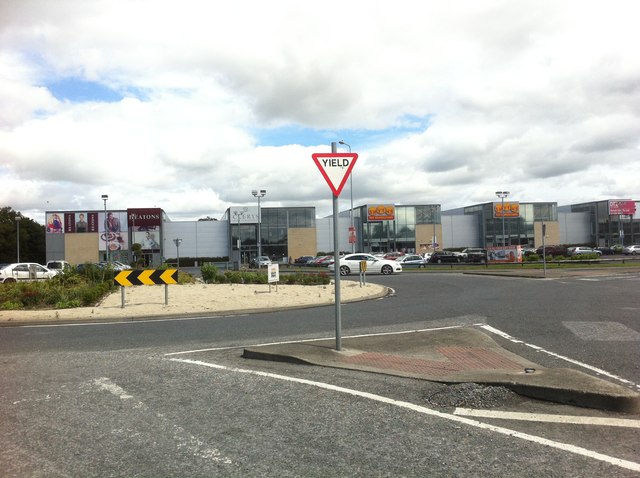 Naas ParkWood · 1545 yd
 Museum of MotorsportMuseum · 4.2 mi
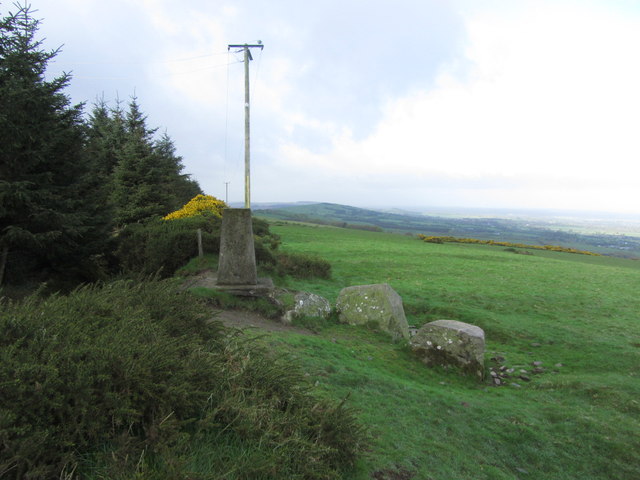 Cupidstown HillMountain / peak · 6.9 mi
 Athgoe HillMountain / peak · 7.7 mi
Other information
Photo: National Inventory of Architectural Heritage · Website use allowed for educational or private purposes with source credit