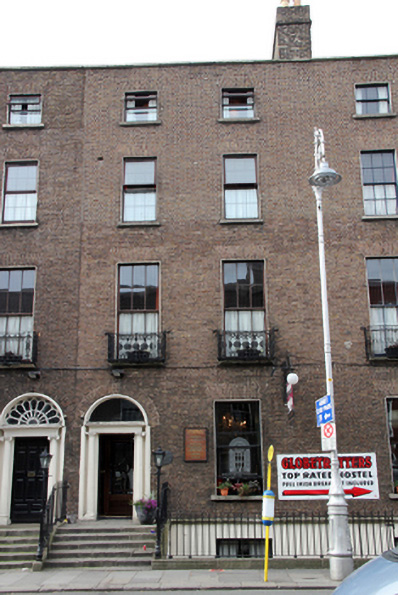
What is recorded here
Terraced two-bay four-storey house over raised basement, built c.1825, now in use as guesthouse, together with No.46 and 48. M-profile slate roof hidden behind parapet wall with granite coping. Rebuilt brick chimneystacks with clay pots to north party wall. Brown brick walls laid in Flemish bond with original lime pointing, re-pointed in cement to upper two floors, set on chamfered granite plinth course over rendered basement wall. Yellow brick walls to rear elevation laid in English garden wall bond. Gauged brick flat-arched window openings with patent rendered reveals, painted granite sills and replacement uPVC windows to second and third floors, replacement timber sliding sash windows to remainder. Replacement hardwood sash and casement windows to rear elevation. Cast-iron balconettes to first floor windows. Gauged brick round-headed door opening with projecting stucco surround and painted masonry Ionic doorcase. Original timber door with eleven raised-and-fielded panels flanked by engaged Ionic columns on plinth bases supporting panelled lintel cornice and plain glazed fanlight over. Door opens onto granite paved platform and five granite steps bridging basement. Platform and basement enclosed by wrought-iron railings set on moulded granite plinth wall with matching gate and further railings dividing platform and steps from adjoining house. Cast-iron corner posts replaced by modern steel lamp standards. Recent four-storey brick apartment development to rear site spanning sites of four former coach houses, accessed off Beresford Lane.
This former Georgian townhouse, built as part of a terrace of eight houses, was laid out in 1790 by Luke Gardiner. Developed in the 1820s, this terrace was initially occupied by members of the legal profession and linked the Custom House with Mountjoy Square. The house is significant as the childhood home of Dion Boucicault, a well-known playwright and actor who lived at this house in the 1830s, credited with influencing Wilde, Shaw, Synge and O'Casey. Despite the replacement windows, the house retains an original doorcase, ironmongery and overall composition, making a marked contribution to the intact appearance of this coherent Georgian streetscape.
This does not grant access. Most recorded buildings are privately owned; view them only from public ground unless the owner allows entry.
Places near here
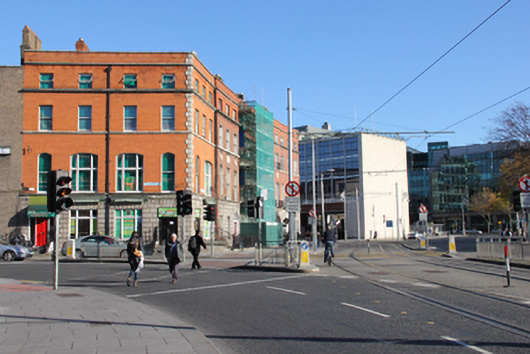 Paddy's Palacehouse · 104 yd
 Chariot of Lifemonument · 116 yd
 Burning of the Custom Housearmed conflict · 236 yd
 Custom House Visitor CentreHeritage attraction · 240 yd
 Spanish Civil War International BrigadeMemorial · 247 yd
 Burial in Unknown TownlandBurial · 406 yd
 1GQVisitor information · 411 yd
 Matt Talbot 1856-1925Memorial · 414 yd
 Discover Ireland CentreVisitor information · 437 yd
 Sir John Gray Knt MD JPMonument · 439 yd
 Burial ground in Unknown TownlandBurial ground · 686 yd
 Oriental planeOriental plane · 712 yd
Other information
Photo: National Inventory of Architectural Heritage · Website use allowed for educational or private purposes with source credit