
More pictures of this place


What is recorded here
This was opened before Glasnevin. Goldenbridge opened in 1829 as the first Roman Catholic cemetery after Catholic Emancipation, three years before Glasnevin.
Enclosed Roman Catholic cemetery established 1829, with upright and recumbent grave markers of varying materials and designs, dating from 1829 to the beginning of the twenty-first century. Mortuary chapel to centre, on raised podium within mature landscaping. Sexton’s house to north-east boundary having small yard to south. Calp limestone boundary walls with medallion motif, having rubble stone parapet to north boundary and north section of west boundary, wrought-iron railings over calp limestone plinth wall to south section of west boundary. Rendered entrance portal to north-east corner having rendered capping with cross finial, plaque with lettering ‘D.O.M’, segmental-headed opening having block-and-start cut granite surround and double-leaf wrought-iron entrance gates, giving access from Saint Vincent Street West. Located along the Grand Canal, Saint Vincent Street West and former Bulfin Street.
Goldenbridge opened in 1829 as the first Roman Catholic cemetery after Catholic Emancipation, three years before Glasnevin.
Established in 1829, following the passing of the 'Act of Easement of Burial Bills' in 1824 , this was the first Roman Catholic cemetery to be opened following Catholic Emancipation in 1829, pre-dating Prospect Cemetery in Glasnevin by three years. The high boundary walls, rich landscaping and delineated paths are typical of a nineteenth-century garden cemetery, as opposed to a churchyard. The variety of designs found in the grave markers is significant in terms of artistic value. The site is further enhanced by the mortuary chapel, the sexton’s house, the stone boundary walls and gates, and the mature trees and shrubs. W. T. Cosgrave, former president of the Irish Free State, was buried in Goldenbridge Cemetery in 1965. The cemetery is in no longer in active use but remains a significant part of the social fabric of the area, and an important social and historical reference.
The story behind this place
Goldenbridge opened in 1829 as the first Roman Catholic cemetery after Catholic Emancipation, three years before Glasnevin.
This does not grant access. Most recorded buildings are privately owned; view them only from public ground unless the owner allows entry.
Places near here
 Goldenbridge Cemeterygates/railings/walls · 53 yd
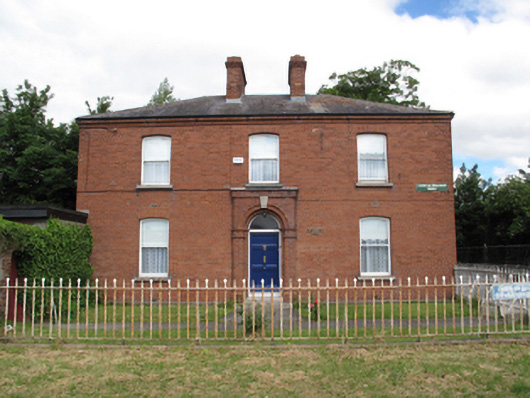 Saint Anne'spresbytery/parochial/curate's house · 73 yd
 Irish Citizen ArmyMemorial · 517 yd
 Toni'sPicnic place · 573 yd
 JailPrison · 862 yd
 Executions of the leaders of the 1916 risingMemorial · 880 yd
 Burials (site of)Burial · 882 yd
 Kilmainham Jail MuseumMuseum · 900 yd
 Royal Hospital KilmainhamHeritage attraction · 1378 yd
 Gairdín Foirmiúil Ospidéal Ríoga Chill MhaighneannVisitor information · 1521 yd
 Mote (site of)Castle, motte · 1594 yd
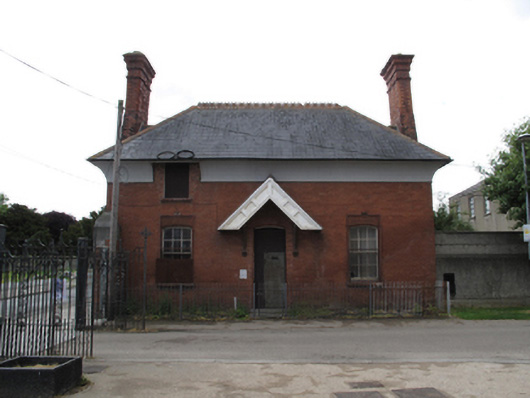 gate lodgegate lodge · 124 yd
Other information
Photo: William Murphy from Dublin, Ireland · CC BY-SA 2.0