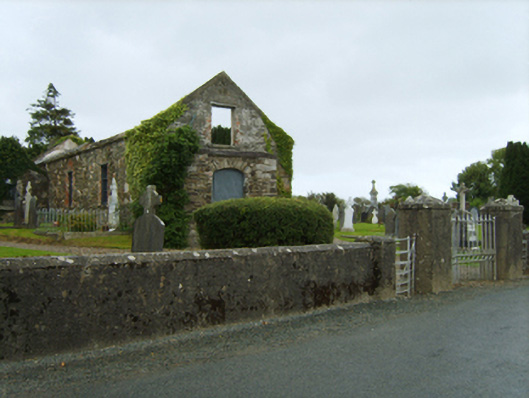
What is recorded here
Detached three-bay single-storey Catholic chapel, dated 1806, on a T-shaped plan originally three-bay single-storey single-cell comprising two-bay single-storey nave opening into single-bay single-storey gabled transepts with single-bay single-storey lean-to advanced porch to entrance (south) front. "Improved", 1829, producing present composition. Closed, 1885. Disused, 1905. In alternative use, 1940. Now in ruins. Pitched roofs now missing; lean-to slate roof (porch), creeper- or ivy-covered coping to gables, and no rainwater goods surviving on slate flagged rubble stone eaves. Part creeper- or ivy-covered walls retaining sections of limewashed surface finish. Remodelled square-headed window openings with lichen-spotted sills, and timber lintels framing timber casement windows. Camber-headed door opening to entrance (south) front in square-headed recess. Remodelled square-headed window opening (gable) below rough hewn date stone ("1806") with lichen-spotted sill, and timber lintel with no fittings surviving. Interior in ruins. Set back from line of road with rendered, ruled and lined piers to perimeter having lichen-spotted pyramidal capping supporting wrought iron double gates.
The shell of a chapel representing an integral component of the early nineteenth-century built heritage of north County Wexford with the architectural value of the composition, a 'handsome edifice erected by subscription' as the successor to a mass house destroyed by Crown forces in the retreat from the Battle of Arklow (9th June 1798; Lewis 1837 II, 99), suggested by such attributes as the traditional "T"-shaped plan form, aligned along a liturgically-incorrect axis; and the outline of "pointed" openings underpinning a contemporary Georgian Gothic theme: meanwhile, aspects of the composition clearly illustrate the later "improvement" of the chapel with those works coinciding with the dismantling of the Penal Laws under the Roman Catholic Relief Act, 1829.
This does not grant access. Most recorded buildings are privately owned; view them only from public ground unless the owner allows entry.
Places near here
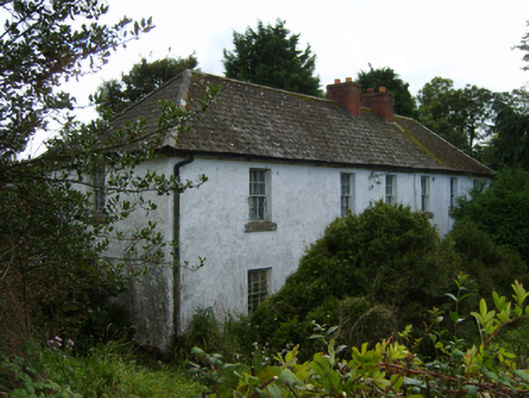 farm housefarm house · 749 yd
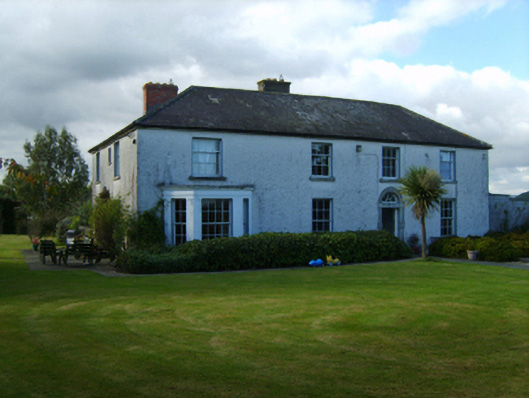 Ahare Parkfarm house · 1099 yd
 MoatArchaeological place · 1281 yd
 Kilgorman WellArchaeological place · 1.0 mi
 CastleCastle, unclassified · 1.9 mi
 Tara HillMountain / peak · 2.0 mi
 Curragh WoodWood · 3.4 mi
 Clogga StrandBeach / strand · 3.5 mi
 Arklow RockMountain / peak · 3.6 mi
 Nuns BeachBeach / strand · 3.9 mi
 Ballyfad WoodWood · 4.0 mi
 Kia Ora Mini FarmHeritage attraction · 4.1 mi
Other information
Photo: National Inventory of Architectural Heritage · Website use allowed for educational or private purposes with source credit