What is recorded here
Knockroe tomb art stands twenty-five metres from the burial chamber, leaning against a drystone wall like a forgotten sentinel. Diamond rings and chevrons still mark its western face, though weather has worn much of the work into faint shadows. The stones may have guided visitors past the dead or recorded memories now lost. Either way, someone shaped that boulder with patience and purpose before knocking it into a laneway where passers rub their hands across ancient lines without knowing their name.
In a laneway 25m NE of Knockroe passage tomb (KK034-019001-), propped up against a drystone wall. Identified and recorded by Aoibheann Lambe (25 April 2018). An irregularly shaped pentagonal upright boulder, its long axis running N-S. It is concave on the W face (H 1m; max. Wth 1m). The upper face of the S side curves inwards; the top side (0.5m), part of which is broken away, and the base (0.7m) are both arching slightly upwards. The E face is obscured from view by the wall against which it leans. The W face is heavily spalled, chevrons (sides c. 0.1m) and diamond shapes are barely traceable. Cupmarks (max. diam. 0.03m) are dispersed over the surface, most clearly visible at the top left and bottom right of the W face. The most clearly defined motif on the W face is a centrally located diamond-shaped ring in positive relief (L c. 0.16m), located c. 0.5m in from the N side and 0.25m above the base with two more diamond-shaped rings immediately S of this motif. Chevrons running N-S across the face above these rings. Other diamond shapes and chevrons on the W face are faint. The boulder’s edge between its N and W faces is punctuated by at least five evenly spaced hollows (Diam. 0.03m). The N-facing side (L c. 1m; T c. 0.2m) is heavily inscribed with diamond rings, chevrons and cupmarks. No inscriptions were observed on the exposed part of the E face, the base or side of the S face. (Lambe 2018, unpublished report).
Compiled by: Jean Farrelly
Date of upload: 2 May 2018
Passage tomb art; Neolithic period. The carved stone is significant as an example of megalithic art associated with a known passage tomb, reflecting early symbolic or ritual expression in Irish prehistory.
The monument record does not grant public access. Check the route and ask the landowner before entering private land.
- What survives
- Recorded monument
Places near here
 Holy well in Knockroe (kells By., Killamery Ed)Holy well · 7 yd
 Passage tomb in Knockroe (kells By., Killamery Ed)Passage tomb · 43 yd
 Knockroe Passage TombVisitor information · 57 yd
 CastleCastle, motte · 771 yd
 Church (in Ruins)Church · 1251 yd
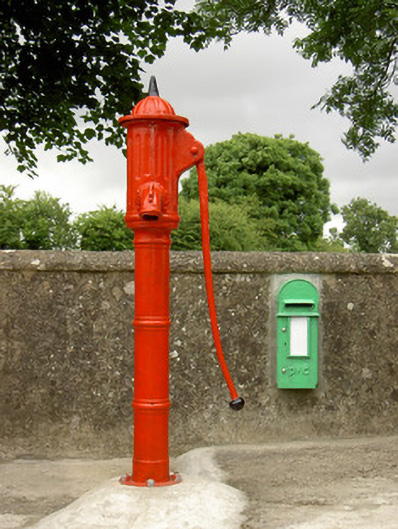 water pumpwater pump · 1371 yd
 Castle JohnCastle, tower house · 1655 yd
 Carrigadoon HillMountain / peak · 1.5 mi
 Brawder's Family BlacksmithHeritage attraction · 1.7 mi
 Irish Republic 1916-2016Memorial · 1.7 mi
 Kilmacoliver/ Tullahought School 1876-1973Visitor information · 1.7 mi
 Woodland LoopWalking route · 1.9 mi