What is recorded here
Labbanirweeny/Leaba an Fhir Mhuimhnigh: Located on fairly level ground near the summit of Caherard Hill, this well-preserved wedge-tomb commands an extensive outlook stretching from Brandon mountain in the NE, to the mountains of the Iveragh peninsula in the S, to Mount Eagle and Croaghmarhin in the W.
The structure consists of a slightly wedge-shaped gallery, covered by 3 overlapping roofstones and flanked at either side by the remains of an outer-wall. It is surrounded by vague traces of a low mound rising no more than .25m above ground level. The gallery measures 4m in overall length and is aligned E-W. It is 1.2m wide at the open W end and 1.1m wide at the E end. It decreases in height from 1m at the entrance to .6m at the backstone.
Two low stones at the W end of the gallery are set immediately inside the lines of the N and S walls and seem to represent the sides of a short, narrow portico. The side-walls of the main gallery are each formed by 5 orthostats and decrease in height from W to E. The westernmost stone on the S side has collapsed and consequently the W roofstone now lies in a tilted position. The E end of the gallery is closed by a single slab. Two stones outside the S wall and a single stone outside the N wall form a doubling of the side-walls. A 2nd stone outside the N wall may be a buttress. Three outer-wall stones are present on either side of the gallery and the 2 easternmost extend slightly beyond the E end of the tomb.
The above description is derived from J. Cuppage, ‘Corca Dhuibhne. Dingle Peninsula archaeological survey. Ballyferriter. Oidhreacht Chorca Dhuibhne’ (1986), no. 33. In certain instances the entries have been revised and updated in the light of recent research.
See linked document with details from Ruaidhrí de Valera and Seán Ó Nualláin, Survey of the Megalithic Tombs of Ireland. Volume IV. Counties Cork, Kerry, Limerick, Tipperary. (Dublin: Stationery Office, 1982)
Date of upload: 3 August 2013
Wedge tomb; dates to the Late Neolithic or Early Bronze Age (c. 2500–1000 BCE). Its well-preserved structure and commanding hilltop position suggest it was a significant ceremonial or funerary site with potential ritual or social importance in the local landscape.
The monument record does not grant public access. Check the route and ask the landowner before entering private land.
- What survives
- Recorded monument
Places near here
 An Chathair AirdMountain / peak · 350 yd
 Enclosure in An Chathair AirdEnclosure · 454 yd
 Settlement cluster in Ceann TráSettlement cluster · 536 yd
 Templemanaghan (Oratory)Church · 1.4 mi
 Rahinnane Castle (in ruins)Castle, tower house · 1.4 mi
 Séipéal Chaitlín Naofa [Saint Catherine's Catholic Church]church/chapel · 1.4 mi
 Binn BreacMountain / peak · 1.6 mi
 Trá Ciarán BeachBeach / strand · 1.8 mi
 Site of Ballingolin CastleArchaeological place · 2.0 mi
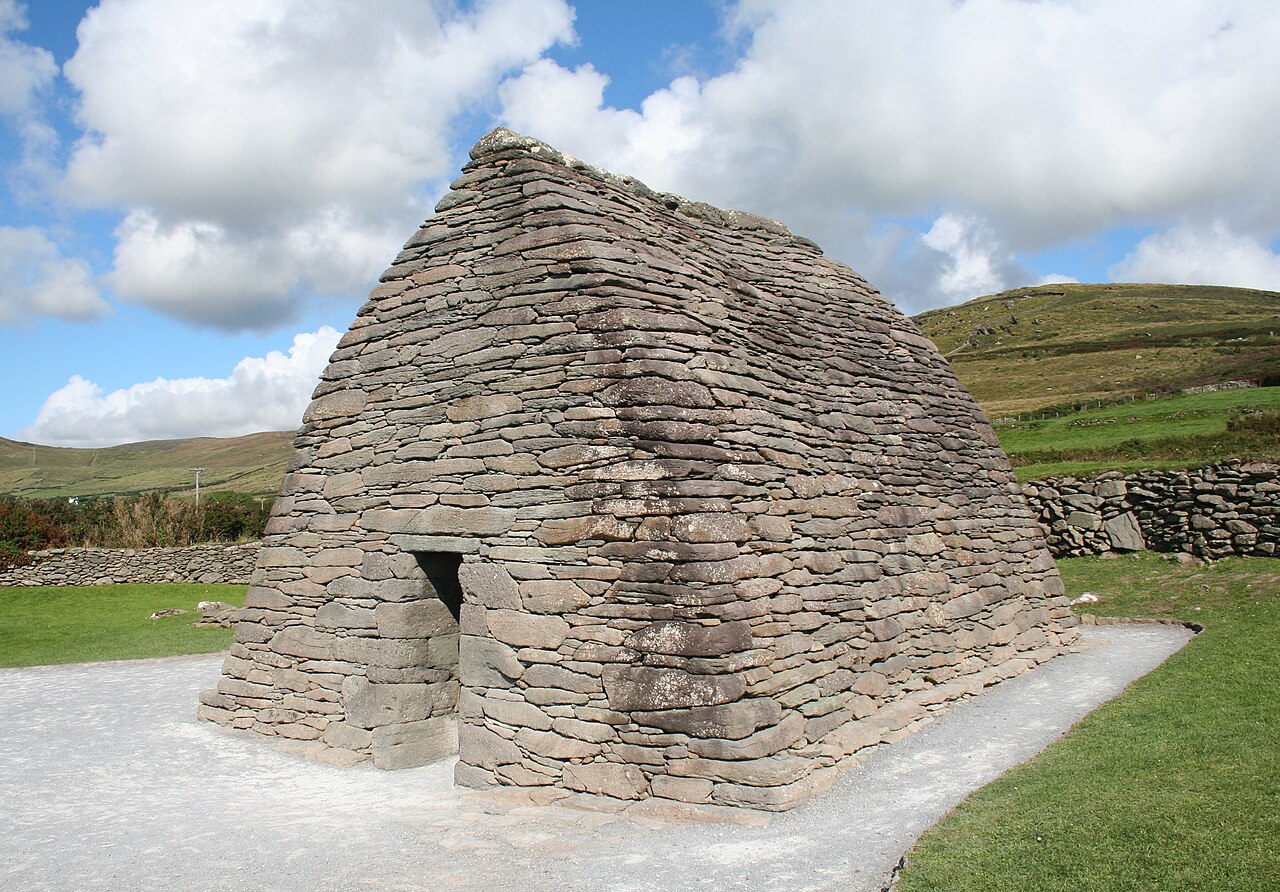 Gallarus OratoryHeritage attraction · 2.4 mi
 Riasc Monastic SettlementHeritage attraction · 2.6 mi
 St Brendan's WellSpring · 3.1 mi