What is recorded here
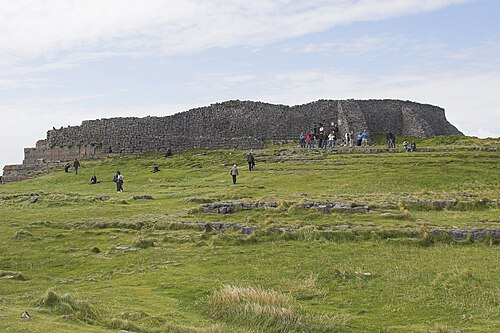
Half a century before Christ, a D-shaped room pressed its curved wall against the fort at Dún Aonghasa. Limpet shells piled beside it, animal bones lay under the foundation stones, and a paved floor dipped slightly into the earth. The house may have been woven like a basket or leaned like a shadow against the wall. Either way, it gave people a place to stand when the Atlantic wind came through the enclosure.
During the course of research excavations in the middle enclosure at Dún Aonghasa (GA110-039----) what proved to be the best-preserved Late Bronze Age house in the fort (identified as Structure 2.1) was uncovered at the W side of Cutting 2. The surviving short segments of the N and S walls suggested that the house was probably D-shaped in plan with an entrance in the E sector; it had a slightly sunken paved floor. The curved side-walls abutted the inner face of the original middle enclosure wall (phase 1) and were constructed of contiguous orthostats, socketed into an existing occupation build up (see GA110-039027-). A substantial limpet midden (GA110-039029-) occupied the area between the building and the top of the plateau to the SW. Possible reconstructions of the house suggest that it may have been a woven basket-type house or a lean-to building butted against the enclosing wall (Cotter 2012, vol. 2, 243). A sample of animal bone from four contiguous flat stones that projected out from under the foundation course of the inner enclosure wall to the S, and which marked the end of the occupation sequence of the house and the midden to its S, produced a radiocarbon date range of 900-510 cal. BC (ibid., vol. 1, 259-62).
Compiled by: Olive Alcock
Date of upload: 23 June 2020
The monument record does not grant public access. Check the route and ask the landowner before entering private land.
- What survives
- Recorded monument
Places near here
 Not locatedStructure · 30 yd
 Dún AonghasaNature reserve · 31 yd
 DunaengusCliff-edge fort · 37 yd
 Kilmurvey BeachBeach / strand · 281 yd
 TemplenaneeveChurch · 913 yd
 IndicatedChurch · 1361 yd
 Castle (in ruins)Castle, unclassified · 1.6 mi
 ÁrainnIsland · 1.6 mi
 An CharcairMountain / peak · 2.0 mi
 Seal Colony LookoutViewpoint · 2.4 mi
 An tOileán ThiarIslet · 3.5 mi
 Trá na mBuailte (Beach of the Booly)Beach / strand · 4.0 mi