What is recorded here
Brendan's Well sits dry inside a small field system on Inishtooskert, a rocky island where sea-cliffs cut off every escape route. Stone slabs line a shallow depression that may once have held water for prayer or drinking, while a faint local story still calls the place holy. The well no longer flows, but its buried shape preserves the moment when a small community marked the rock as sacred before the sea took back most of the island's life.
Inishtooskert, the northernmost of the Blasket island group, lies 4 miles off the W extremity of the Dingle Peninsula and 2.5 miles N of the Great Blasket. An area of 241 acres is bounded on all sides by sea-cliffs, and the land slopes upwards in a NW direction, from under 100 feet (30m) OD along the SE side to a maximum altitude of 573 feet (175m) roughly midway along the NW side of the island. The land is generally rocky with a thin soil cover and the N half of the island is devoid of any trace of settlement activity. Part of the S half of the island is occupied by a small field system, and it is within this that the Early Christian settlement, named after St. Brendan, is located.
(9) (KE051-001005-) Tobar Bréanainn [Brendan's Well] A depression, 1.5m x 1m x 1.2m deep, lined with slabs which are surmounted by drystone walling. It was probably originally provided with a flagged roof and there may formerly have been steps down to the water from the open S side. The well is now dry and there is only a faint tradition that it was ever considered holy (Ó Danachair 1960, 77).
The above description is derived from J. Cuppage, ‘Corca Dhuibhne. Dingle Peninsula archaeological survey. Ballyferriter. Oidhreacht Chorca Dhuibhne’ (1986), no. 844. In certain instances the entries have been revised and updated in the light of recent research.
Date of upload: 8 August 2013
The holy well on Inis Tuaisceart is associated with Saint Fionnchú, a 7th-century hermit known for his ascetic life on the Blasket Islands. Traditionally linked to healing and protection, the well was visited for its curative properties, particularly for ailments of the eyes and skin, and was often marked by small offerings or stones placed at its site.
The monument record does not grant public access. Check the route and ask the landowner before entering private land.
- What survives
- Recorded monument
Places near here
 Church in Inis TuaisceartChurch · 17 yd
 Field system in Inis TuaisceartField system · 60 yd
 Inis TuaisceartIsland · 418 yd
 Cliff-edge fort in An Blascaod MórCliff-edge fort · 2.8 mi
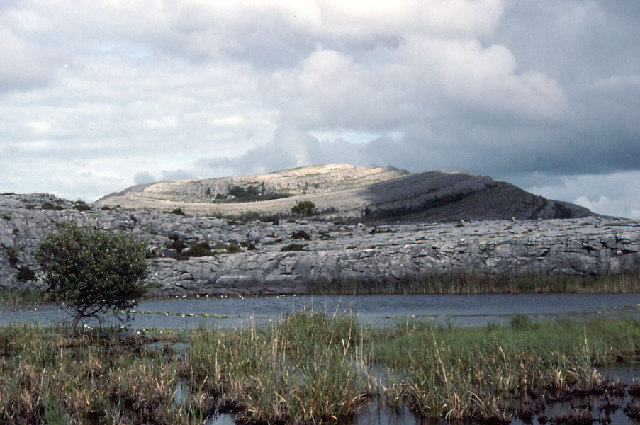 An Mullach RamharMountain / peak · 2.9 mi
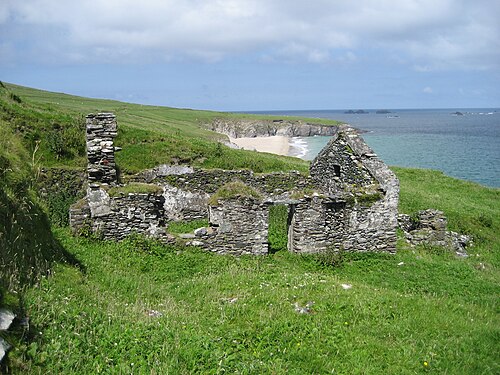 An Blascaod MórIsland · 2.9 mi
 An Cró MórMountain / peak · 2.9 mi
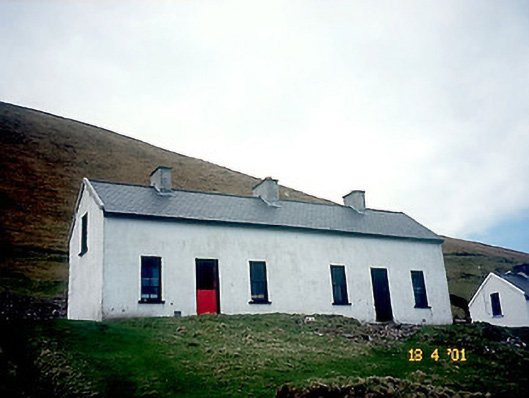 Tigh Peig Sayers [Peig Sayers's House]house · 3.2 mi
 Oileán na nÓgIslet · 3.2 mi
 An Dún MórHeadland · 4.5 mi
 Dunmore HeadViewpoint · 4.5 mi
 Mionnán an DúnaHeadland · 4.8 mi