What is recorded here
Kilmalkedar’s holy well stood across the road from the church, marked by a cross-inscribed stone and a stone-lined hollow where people once paid rounds for sore eyes and head trouble. The water has failed, but the lintelled hollow and upright slab remain beside the field, witnessing a older ritual life that stretched through the fenced stones and into the shadow of Reenconnell hill.
The Early Christian and Medieval ecclesiastical complex at Kilmalkedar (KE042-026----) lies at the foot of the W slopes of Reenconnell hill, overlooking Smerwick Harbour. The Reenconnell ridge peaks at 907 feet/276m to NE of the site and the area around Kilmalkedar is sheltered on its N and S sides by spurs of this hill.
(12) (KE042-026011-) Fig. 192f. The holy well located in the field to W of the roadway is now dry but the lintelled hollow that marks its site is still preserved. The cross-inscribed stone standing beside it is .92m high and bears a plain Latin cross on its W face.
Holy well described in 1948 by the County Kerry Field Club as; 'across the road from Kilmalkeader is the holy well this is marked by a small inscribed cross similar to that at Killelton. Rounds are paid here for sore eyes and head trouble and there are indications that the area was once portion of Kilmalkeader proper as there are many stones in the fences of an architectural nature' (Minutes of the Co. Kerry Field Club 31/07/1948; SMR File).
Described by Ó Danachair (1960, 77) as; ‘A small shapeless erection of dry stone, with a small stone-lined hollow, the whole surmounted by an upright slab which bears a cross incised on it. No tradition survives'.
See attached photograph of cross-inscribed stone standing above holy well courtesy of Amanda Clarke.
The above description is derived from J. Cuppage, ‘Corca Dhuibhne. Dingle Peninsula archaeological survey. Ballyferriter. Oidhreacht Chorca Dhuibhne’ (1986), no. 855. In certain instances the entries have been revised and updated in the light of recent research.
Date of upload: 8 August 2013
Linked to St. Maoilchéadair (Molua), an early Irish saint associated with the spread of Christianity in Munster, the holy well at Kilmalkedar was traditionally visited for healing and as part of seasonal rituals, particularly on St. Molua’s feast day. The site is part of a significant early Christian complex that includes a round tower, church, and high cross, reflecting its historical and spiritual importance in the region.
The monument record does not grant public access. Check the route and ask the landowner before entering private land.
- What survives
- Recorded monument
Places near here
 Cross in Cill MaoilchéadairCross · 40 yd
 KilmalkeaderEcclesiastical site · 113 yd
 Kilmalkedar Church in ruinsChurch · 116 yd
 IndicatedBuilding · 205 yd
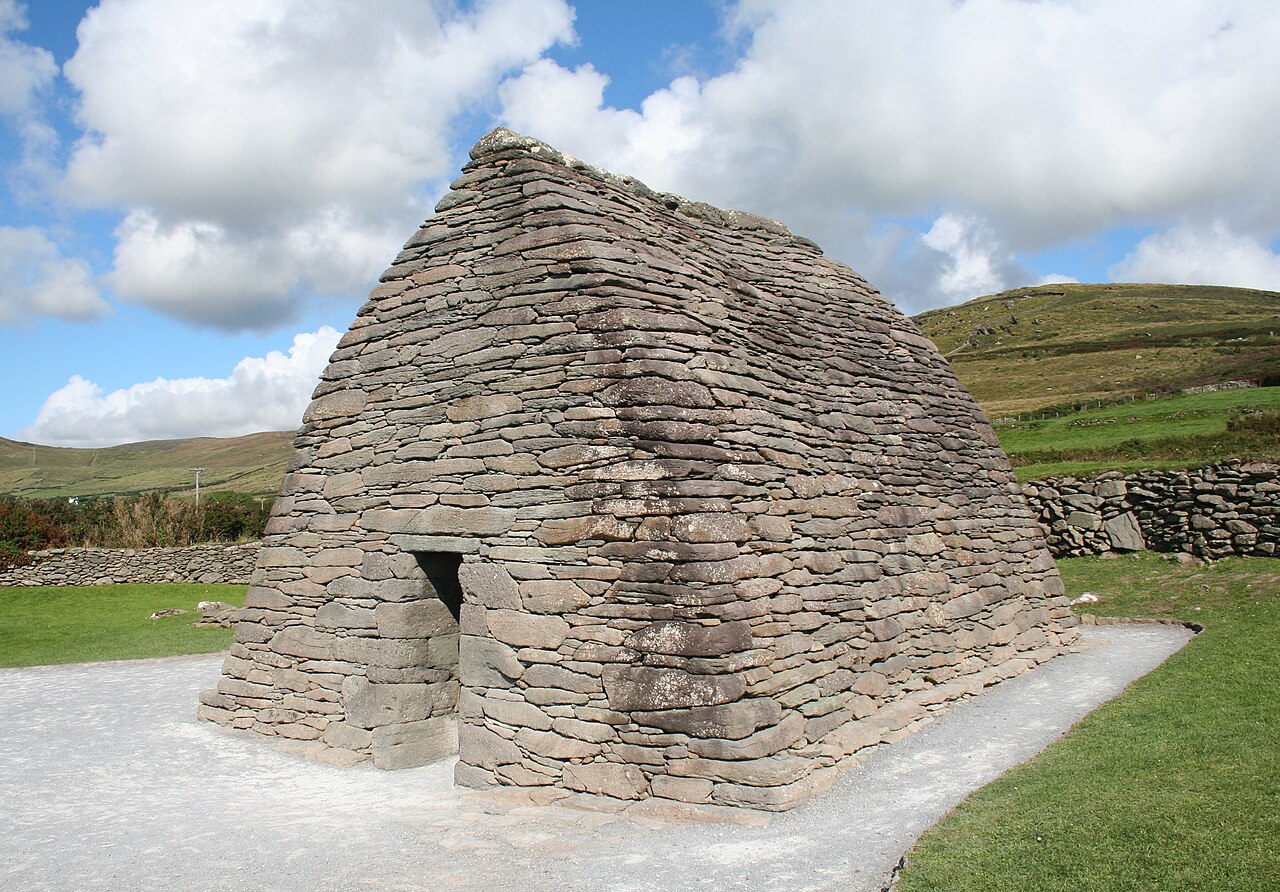 Gallarus OratoryHeritage attraction · 1654 yd
 Gallarus CastleCastle · 1701 yd
 Gallarus Castle (in ruins)Castle, tower house · 1702 yd
 Binn BreacMountain / peak · 1.6 mi
 Trá an FhíonaBeach / strand · 2.1 mi
 Cuan Ard na CaithneBay · 2.2 mi
 Riasc Monastic SettlementHeritage attraction · 2.4 mi
 Tráigh Bhéal BánBeach / strand · 3.0 mi