What is recorded here
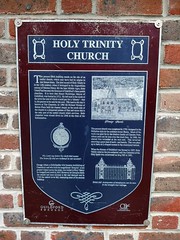
This multicoloured commemorative plaque records: Holy Trinity Church The present brick building stands on the site of an earlier church, which may have had its origins in late Saxon times. the first records of Holy Trinity is in the 12th century, when it belonged to the Augustinian canons of Merton Priory. By the later Middle Ages, Holy Trinity had become the foremost of Guildford's three parish churched. It is here that Henry Norbridge, Mayor of Guildford, was buried in 1512. He left land to the south of the town the rent of which would pay for a 'chantry' - that is, for prayers to be said for his soul. This land to this day is known The Chantries. In 1540 Sir Richard Weston of Sutton Place built his chantry chapel on the south side of the church in a chequered pattern of flint and stone; this is the only part of the earlier church which survives. Both chantries were closed down in 1548 at the time of the Reformation. The Latin tag below the clock dial means 'The hours fly and are reckoned to our account'. George Abbot, a Guildfordian who became Archbishop of Canterbury and who built the magnificent 'Hospital' or old people's home across the street, was buried in Holy Trinity in a magnificent tomb in 1633. However, by Georgian times the church had been allowed to fall into disrepair and in 1740 the central tower fell, destroying most of the ancient building. The present church was completed in 1763, designed in the Palladian style by the architect James Horne. Much of the work was paid for by the Onslow family of Clandon Park, whose crest can be seen over the clock face. In 1888, the church was extended at the east end. This involved removing a great deal of earth - and burials. This was piled up to form an L-shaped mound in the churchyard behind. When the diocese of Guildford was formed in 1927, Holy Trinity acted as the pro-cathedral until the Cathedral of the Holy Spirit was consecrated on Stag Hill in 1961. Dates and monograms of benefactors can be seen in the wrought iron railings. Recorded plaque organisation: Guildford Historic Trail.
Holy Trinity Church in Guildford has been a significant religious site since at least the 12th century, serving as the primary parish church by the later Middle Ages and housing notable burials such as Henry Norbridge and Archbishop George Abbot. The current structure, completed in 1763, replaced an earlier building that was damaged in 1740, and it has played a crucial role in local religious life, including serving as pro-cathedral for the Diocese of Guildford from 1927 until 1961.
A plaque record does not grant entry to a building or private land. View it from a public place unless permission is clearly given.
Places near here
 People chatting by the statue of George AbbotMonument or public art · 18 yd
 Hospital of the Blessed Holy TrinityListed building · 23 yd
 Abbot's HospitalHeritage attraction · 23 yd
 Guildford HouseListed building · 27 yd
 Guildford pub bombingsbomb attack · 127 yd
 Guildford Borough Boundary StoneMonument or public art · 178 yd
 War MemorialMemorial · 219 yd
 CastleViewpoint · 250 yd
 Guildford CastleScheduled monument · 299 yd
 Pewley HillMountain / peak · 798 yd
 Menhir at Surrey UniversityAncient stone or rock art · 1404 yd
 Grotto Below St Catherine's HillCave or cavern · 1419 yd
Other information
Photo: Simon Harriyott · CC BY 2.0