What is recorded here
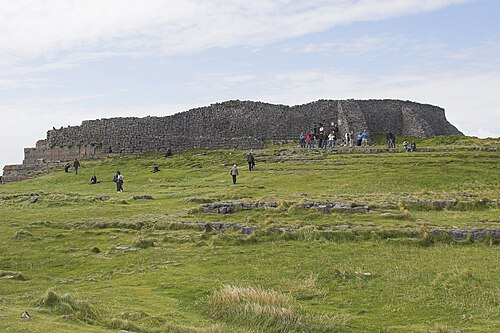
Cill Mhuirbhigh, a Galway coast townland, is where Dún Aonghasa stands. The cliff-top fort and its rocky hollows have watched the Atlantic since before written history. People lived there, fired hearths, and left bone and charcoal behind. The sea still claims what the cliff cannot hold.
During the course of research excavations centered on the north entrance (Cutting 9) of the middle enclosure of Dún Aonghasa (GA110-039----) two focal areas of occupation were identified, one to the W of the entrance passageway, the other to its E. The earliest habitation appeared to have been in and around a bedrock hollow (F990) in the E zone. The excavated parts of this feature, a depression (3m N-S; 1.2m E-W) with a narrow rock-cut gully along its S edge, appeared to be enhanced natural dips. The N end of the dip extended down under the terrace of the enclosure wall. Although no associated built structures were evident, it appeared that it formed part of a living space. Animal bone, dispersed limpet shell, charcoal fragments and five sherds of cooking ware were recovered from its fill. A possible hearth (F966) was identified to its SE. Later features uncovered towards the end of this primary phase of settlement included a paved pathway that was laid to the W of the hearth and ran in a NW direction towards the hollow. A later fragment of double-faced walling (L 1.8m; W 1.05m; H 0.22m) was also uncovered to the E of the hollow. It ran N-S and continued in under the wall terrace (Cotter 2012, vol. 1, 242-6; vol. 2, 243).
To the W of the entranceway a paved surface marked the earliest occupation material; slight charcoal staining and a few scraps of burnt animal bone provided evidence of a hearth (F988). Three carefully placed limestone slabs may have been associated with it. A sample of animal bone from the associated horizon produced a radiocarbon date of 1260-920 cal. BC (ibid., vol. 1, 235-9).
Compiled by: Olive Alcock
Date of upload: 23 June 2020
The monument record does not grant public access. Check the route and ask the landowner before entering private land.
- What survives
- Recorded monument
Places near here
 Not locatedStructure · 3 yd
 Dún AonghasaNature reserve · 33 yd
 DunaengusCliff-edge fort · 61 yd
 Kilmurvey BeachBeach / strand · 261 yd
 TemplenaneeveChurch · 883 yd
 IndicatedChurch · 1329 yd
 ÁrainnIsland · 1.6 mi
 Castle (in ruins)Castle, unclassified · 1.6 mi
 An CharcairMountain / peak · 2.0 mi
 Seal Colony LookoutViewpoint · 2.3 mi
 An tOileán ThiarIslet · 3.6 mi
 Trá na mBuailte (Beach of the Booly)Beach / strand · 4.0 mi