What is recorded here
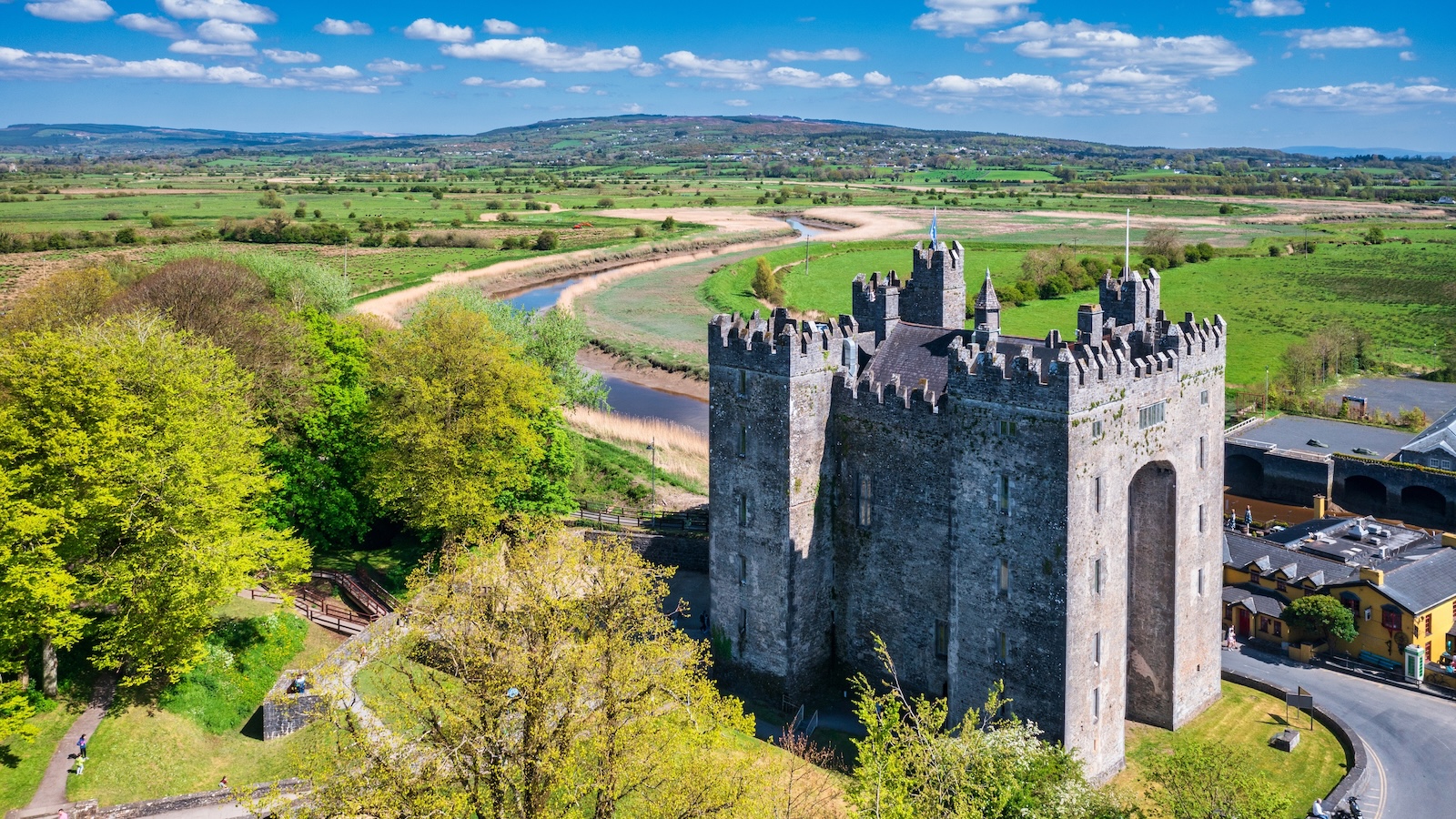
Castletown Castle is a ruined tower house on a rocky hillock overlooking Castletown Lough, built by Sean and Donnchad Mac Conmara and later held by MacNamara, Neylon and Bourke families. Its western wall still stands three metres high with a splayed window, while a broad cairn of loose stone surrounds the footprint where the rest collapsed. The castle gave up its own rocks to build the deserted farmstead beside it, as if retreat required carrying its bones elsewhere.
Twigge states the castle was built by Sean and his son Donnchad Mac Conmara of Magh na Neamhan. The 1570 list refers to it as 'Ballymaslen' and the occupier at that time as William Neylon while in 1574 it is called Castletown Nevenanagh. The MacNamara`s regained control of the castle sometime after 1600 but John Og MacNamara lost it after the 1641 Rebellion when it was granted to Sir Oliver Bourke and Gibbon Fitzmaurice Fitzgibbon, both transplanters. In 1661 Dr. John Neylon was the tennent, and around 1712 the castle was leased back to James MacNamara and this family continued to live here until about 1740.
Situated on a rocky hillock overlooking Castletown Lough, c. 100m to the E. Rectangular grass-covered area (dims. 7m E-W; 6m N-S) defined by stone spreads at N (L 4m; Wth 4m; H 1m) and S (L 7m; Wth 2m; H 0.4m). Part of the W wall (L 6m N-S; H 3m; T 1.6m) with a window (Wth 0.85m; H 1.03m) in a splayed embrasure survives. The remains are surrounded by a cairn (diam. 30m N-S; 28m E-W; H 2.5m to 4m at E), and stone from the castle was re-used in the now deserted farmstead just to the W (O Murchadha 1995).
See attached document with details from Risteárd Ua Cróinín and Martin Breen, The Castles and Tower-houses of Co. Clare (unpublished report). Uploaded courtesy of R. Ua Cróinín and M. Breen.
Date of upload: 11 December 2014
Castletown Castle was built by Sean and his son Donnchad Mac Conmara of Magh na Neamhan in the 16th century and later appears in records under different names, including Ballymaslen. It is remembered for its historical association with local Gaelic families and its mention in early English administrative surveys.
The monument record does not grant public access. Check the route and ask the landowner before entering private land.
- What survives
- Recorded monument
Places near here
 ToberinneenboyHoly well · 295 yd
 Enclosure in Castletown (bunratty Upper By.)Enclosure · 503 yd
 Killavella Church (in Ruins)Church · 716 yd
 Carntemple Church (in ruins)Church · 1051 yd
 CastleCastle, unclassified · 1.4 mi
 Kilcatherine GraveyardWood · 1.5 mi
 Clooney Castle (in Ruins)Castle, tower house · 2.2 mi
 Quin AbbeyHeritage attraction · 2.8 mi
 Ennis AbbeyMuseum · 2.9 mi
 Post Office FieldNature reserve · 3.1 mi
 G.A.A. Commemorative StoneMemorial · 3.2 mi
 Irish Famine MemorialMemorial · 3.2 mi
Other information
Photo: Credit not shown in the picture search · Rights wording not checked; contact us if this picture should be removed