What is recorded here
Death and memory collided at Killcolman, where three bullaun stones still mark the church yard. They are not decorations but witnesses, carrying the shape of human repetition into rock. The largest stands before the ogham stone, while two smaller ones hold shallow circular bowls, as if prayer itself had pressed through flesh and marble.
National Monument No. 10044. Kilcolman/Cill na gColmán: An Early Christian church site KE042-141001- lying on the S slopes of an E-W spur of Lateevemore, overlooking Ventry Harbour.
(7) Three bullaun stones collected from various parts of the site have now been set in the ground in front of the ogham stone. The largest is KE042-141009-. The other two measure .28m x .2m (KE042-141011-) and .21m x .21m (KE042-141012-) respectively, their circular depressions measuring .11m in diameter x .03m in depth and .08m in diameter x .02m in depth.
The above description is derived from J. Cuppage, ‘Corca Dhuibhne. Dingle Peninsula archaeological survey. Ballyferriter. Oidhreacht Chorca Dhuibhne’ (1986), no. 868. In certain instances the entries have been revised and updated in the light of recent research.
Date of upload: 9 August 2013
Likely dating to the Early Christian period, bullaun stones were often used for ritual purposes, such as the preparation of holy water or as part of ecclesiastical sites. Their association with church sites suggests a religious or ceremonial function within the local Christian community.
The monument record does not grant public access. Check the route and ask the landowner before entering private land.
- What survives
- Recorded monument
Places near here
 OutlinedEcclesiastical enclosure · 16 yd
 An Chathair AirdMountain / peak · 653 yd
 Settlement cluster in Ceann TráSettlement cluster · 966 yd
 Rahinnane Castle (in ruins)Castle, tower house · 1.0 mi
 Templemanaghan (Oratory)Church · 1.4 mi
 Séipéal Chaitlín Naofa [Saint Catherine's Catholic Church]church/chapel · 1.4 mi
 Binn BreacMountain / peak · 1.4 mi
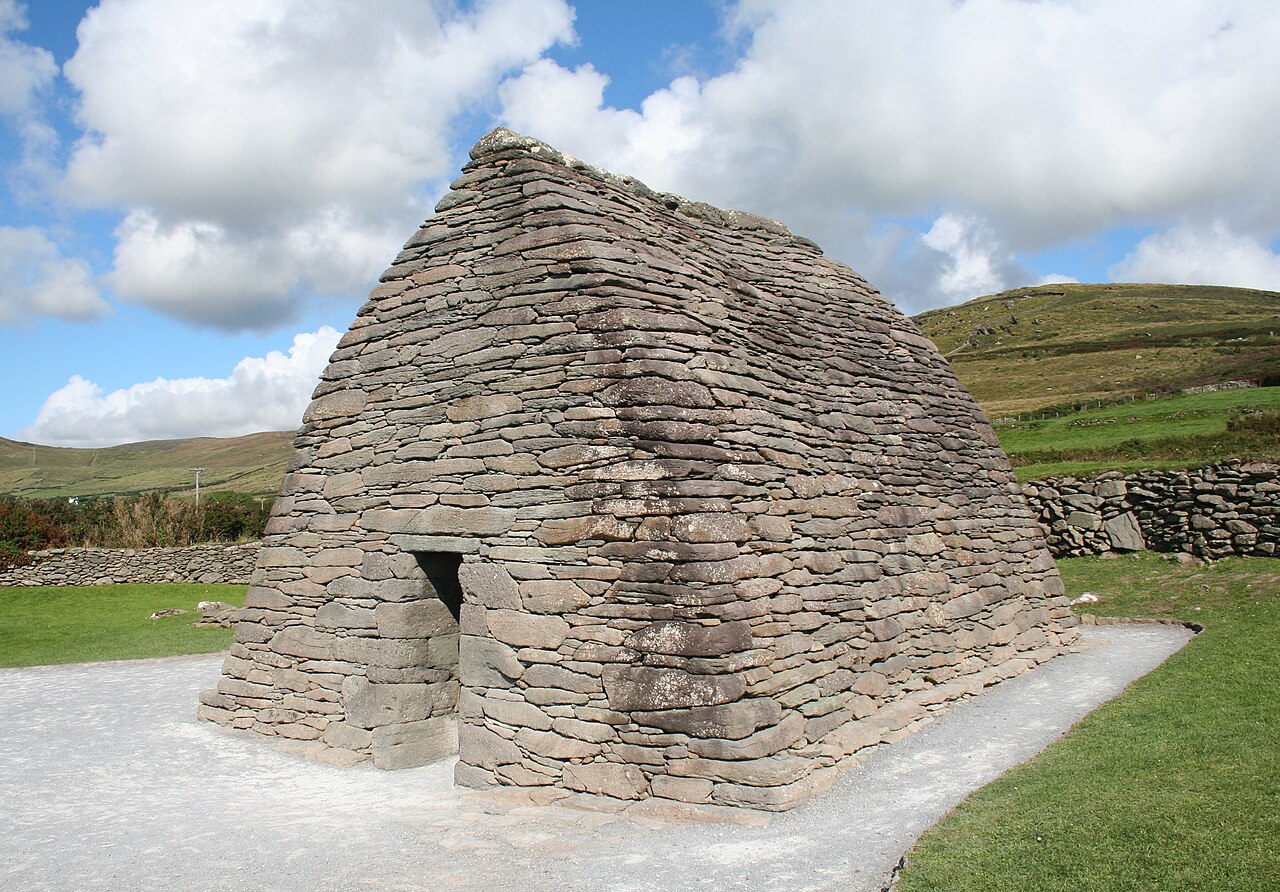 Gallarus OratoryHeritage attraction · 2.0 mi
 Riasc Monastic SettlementHeritage attraction · 2.1 mi
 Trá Ciarán BeachBeach / strand · 2.1 mi
 Gallarus CastleCastle · 2.2 mi
 St Brendan's WellSpring · 2.6 mi