What is recorded here
Five plaques cling to the east gable of the old Sexton's house, including one bearing the arms of Edward VI. The dragon and greyhound still guard a shield of French fleurs-de-lys and English lions, though the exact church that first displayed them has vanished from memory. Henry VIII forced these symbols into every worship room, turning faith into royal property, but Edward's name arrived later on a separate slab. The stones survived the reigns, the wars and the forgetting, waiting at the top of St. Canice's steps for someone to read what power once wrote in limestone.
Located at the top of St. Canice's steps, on the W side. One of five plaques inserted into the E gable of what was the Sexton's house in the 17th century (Lanigan and Tyler 1987, 90; Farrelly et al. 1993, 89). The original location of the plaque is unknown.
The limestone plaque, within a moulded surround, consists of two slabs, the lower bears a coat of arms and the upper, and highly fossiliferous slab, displays a raised inscription in four rows, in capitals in Lombardic style which has been transcribed and translated by Crotty (2004, 107) as, ‘EDWAR E GRA REX AN LIE FRANCIE ET HIBERNIE VI’, (expanded form: Edward[d] [D] e [i] Gra[cia] Rex An[g]lie, Francie et Hibernie VI), Edward VI, by the Grace of God King of England, France and Ireland.
The coat of arms is displayed with a dragon supporter on the dexter side and a greyhound supporter on the sinister side, both regardant (looking backward) (ibid. 110). Crotty (ibid. 107) describes how these were used by Henry VIII but not his son Edward, and thus the inscription, which is on a separate slab, must be a replacement, presumably made soon after Edward’s accession in 1547. The shield, which is surmounted by a crown, shows the fleur-de-lys of France in the first and fourth quarters, with the lions of England in the second and third (ibid.). There is a Tudor rose at each corner of the armorial slab. Beneath the shield there is a portcullis badge, repeated twice, which was originally the badge of the Beauforts (ibid. 111).
Crotty (ibid. 111) suggests that the coat of arms was made at the time of the Reformation, after 1534, when Henry VIII decreed that his arms should be displayed in all churches as a sign of the royal supremacy over the Protestant church. The inscription is slightly later, dating to Edward’s reign, 1547-53.
See attached photograph:
KK019-026152----_01
Compiled by: Jean Farrelly
Date of upload: 18 January 2023
The monument record does not grant public access. Check the route and ask the landowner before entering private land.
- What survives
- Recorded monument
Places near here
 Round TowerRound tower · 45 yd
 Saint Canice's Cathedral Round TowerViewpoint · 47 yd
 Font in Gardens (kilkenny City By., St. Canice Par.)Font · 63 yd
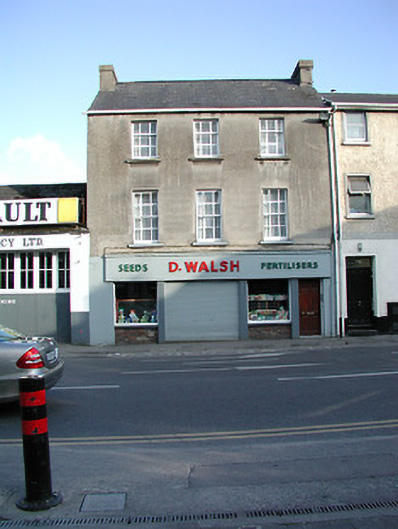 D. Walshhouse · 65 yd
 Saint Canice's Cathedralgates/railings/walls · 76 yd
 Market Yard GatesMemorial · 81 yd
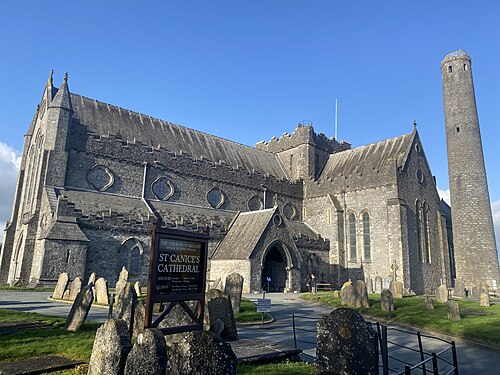 St. Canice's CathedralVisitor information · 83 yd
 Bishop Hugh de MapiltonMemorial · 89 yd
 Black PoplarBlack Poplar · 252 yd
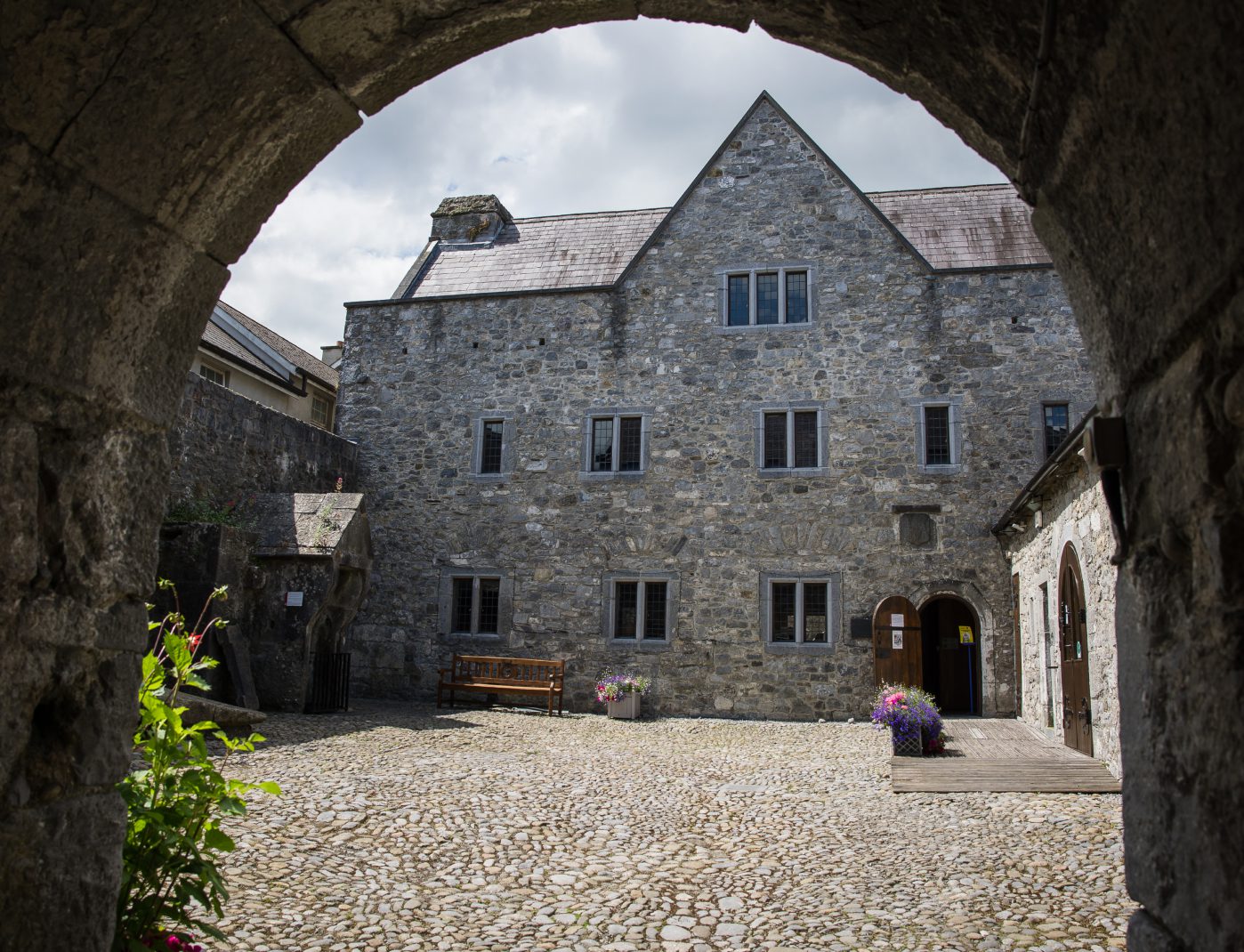 Rothe House & GardenMuseum · 287 yd
 Black AbbeyVisitor information · 292 yd
 Grace's Old CastleCastle · 322 yd