What is recorded here
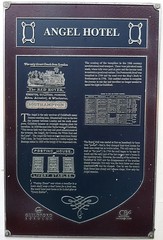
This blue commemorative plaque records: Angel Hotel The Angel is the only survivor of Guildford's many famous coaching inns. Situated half-way on the two day journey between London and the south coast ports, Guildford became an overnight stopping place for travellers. In 1636 the poet John Taylor wrote of Guildford, "This towne hath very fine inns and good entertainment at the tavernes, the Angell, the Crowne, the White Hart and the Lyon". The Angel has been an inn at least since Henry VIII's time. Its Tudor timber-framing is visible behind the frontage added in 1820 at the height of the stagecoach era. A "Posting House" was where a traveller in a hurry could swap a tired horse for a fresh one. You could leave your horse to be looked after at "Livery Stables". The coming of the turnpikes in the 18th century revolutionised road transport. These were privatised main roads, where tolls were paid at gates and the income used to maintain a good road surface. The Portsmouth Road was turnpiked in 1749 and the road over the Hog's Back to Southampton in 1758. This enable coaches to complete the journey in one day and travellers no longer needed to spend the night in Guildford. The Royal Mail was carried at first on horseback by boys who "posted" - that is, they changed their tired horses for fresh ones every ten or twelve miles. (We still refer to the mail as "the post".) In 1784 the mail began to be sent by coach and the early part of the last century saw a boom in the coaching trade. However, the coming of the railway to Guildford in 1845 saw the disappearance of the coaches almost overnight. Not only was the train faster and more comfortable, it was far cheaper. One by one the town's High Street inns closed and became shops. Now only the Angel remains. Recorded plaque organisation: Guildford Historic Trail.
The Angel Hotel is a historic inn in Guildford that has served as a crucial stopping point for travelers since at least Henry VIII's reign, reflecting the town’s importance on the route between London and the south coast ports during the coaching era. Its survival makes it a unique remnant of the once-thriving coaching inn culture that was significantly impacted by the advent of railways in the mid-19th century.
A plaque record does not grant entry to a building or private land. View it from a public place unless permission is clearly given.
Places near here
 The Angel HotelListed building · 15 yd
 The GuildhallListed building · 114 yd
 GuildhallHeritage attraction · 123 yd
 CastleViewpoint · 170 yd
 Guildford House GalleryGallery · 184 yd
 War MemorialMemorial · 209 yd
 Guildford CastleScheduled monument · 234 yd
 Guildford pub bombingsbomb attack · 241 yd
 Guildford Borough Boundary StoneMonument or public art · 386 yd
 Pewley HillMountain / peak · 934 yd
 Menhir at Surrey UniversityAncient stone or rock art · 1296 yd
 Grotto Below St Catherine's HillCave or cavern · 1296 yd
Other information
Photo: Simon Harriyott · CC BY 2.0