What is recorded here
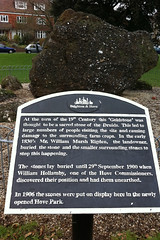
This black commemorative plaque records: At the turn of the 19th Century this 'Goldstone' was thought to be a sacred stone of the Druids. This led to large numbers of people visiting the site and causing damage to the surrounding farm crops. In the early 1830's Mr. William Marsh Rigden, the landowner, buried the stone and smaller surrounding stones to stop this happening. The stones lay buried until 29th September 1900 when William Hollamby, one of the Hove Commissioners, discovered their position and had them unearthed. In 1906 the stones were put on display here in the newly opened Hove Park. Recorded plaque organisation: City of Brighton & Hove.
William Marsh Rigden was a landowner who buried the 'Goldstone' and surrounding smaller stones in the early 1830s to prevent damage caused by visitors attracted by the stone's supposed Druidic significance. William Hollamby, one of the Hove Commissioners, rediscovered and unearthed these stones in 1900, leading to their eventual display in Hove Park in 1906, thus preserving a site of historical and cultural interest.
A plaque record does not grant entry to a building or private land. View it from a public place unless permission is clearly given.
Places near here
 GoldstoneHeritage attraction · 45 yd
 The "Goldstone Dolmen"Ancient burial place · 195 yd
 Coral Brighton & Hove Greyhound StadiumStadium · 412 yd
 Hove Railway Station and footbridgeListed building · 527 yd
 Church of St BarnabasListed building · 615 yd
 Tony MagdiMemorial · 1005 yd
 Hove ManorMemorial · 1506 yd
 St Ann's Well Bowling ClubOld or holy well · 1711 yd
 Welcome to Regency SquareVisitor information · 1.5 mi
 Brighton hotel bombingbomb attack · 1.7 mi
 Coal Shed at Former Goldstone Pumping StationListed building · 616 yd
 FingermazeHeritage attraction · 618 yd
Other information
Photo: Jez Nicholson · CC BY-SA 2.0