
More pictures of this place


What is recorded here
The quiet ground has a harder story. Bas-relief to north and west and south, that to north by Thomas Farrell depicts Battle of Waterloo, that to west by John Hogan depicts Civil and Religious Liberty, that to south by Joseph Kirk depicts Indian Wars.
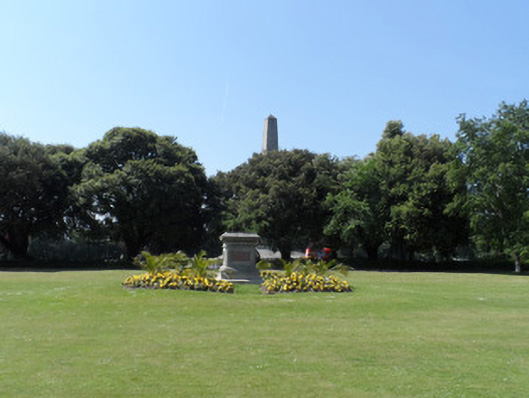
Freestanding granite obelisk, 62 metres tall, designed by Sir Robert Smirke as testimonial to Arthur Wellesley, Duke of Wellington. Foundation stone laid 1817, completed June 1861. Tapering, four-sided shaft with pyramidal apex, on three-stepped monumental pedestal. Each face contains bronze plaque cast from cannons captured at Waterloo. Bas-relief to north and west and south, that to north by Thomas Farrell depicts Battle of Waterloo, that to west by John Hogan depicts Civil and Religious Liberty, that to south by Joseph Kirk depicts Indian Wars. To east face inscription in Latin and English: 'Asia and Europe, saved by thee, proclaim / Invincible in war thy deathless name / Now round thy brow the civic oak we twine / That every earthly glory may be thine'. Square-plan stylobate of nine raking steps on raised flat-topped earthen mound, accessed on eastern side by eight granite steps with closed granite strings. North side of mound reduces to ground level at west end. South edge enclosed by boundary fence of Phoenix Park.
Bas-relief to north and west and south, that to north by Thomas Farrell depicts Battle of Waterloo, that to west by John Hogan depicts Civil and Religious Liberty, that to south by Joseph Kirk depicts Indian Wars.
A monumental granite obelisk located in a large grass area in Phoenix Park, one of Europe’s largest designed urban spaces. Designed by Sir Robert Smirke to commemorate Arthur Wellesley, the Duke of Wellington, who is reputed to have been born in Dublin, and his military victories. It was to have an equestrian statue of the duke, flanked by lions, but this was never executed. As construction began during Wellington’s lifetime, the term testimonial, rather than memorial, is officially used. Obelisks were a popular feature of demesne landscapes, particularly in the late eighteenth and early nineteenth centuries due to the influence of the Egyptian Revival. The tallest obelisk in Europe, the monument is a popular attraction in Dublin.
The story behind this place
Bas-relief to north and west and south, that to north by Thomas Farrell depicts Battle of Waterloo, that to west by John Hogan depicts Civil and Religious Liberty, that to south by Joseph Kirk depicts Indian Wars.
This does not grant access. Most recorded buildings are privately owned; view them only from public ground unless the owner allows entry.
Places near here
 Wellington MonumentMonument · 1 yd
 Liffey Railway Bridgebridge · 201 yd
 Carlisle Monumentmonument · 225 yd
 Silver mapleSilver maple · 276 yd
 Sean HeustonMemorial · 278 yd
 Asian lionHeritage attraction · 465 yd
 Silver LimeSilver Lime · 491 yd
 Sulawesi crested macaqueHeritage attraction · 505 yd
 Jerome ConnorMemorial · 520 yd
 Monument of RemembranceMonument · 571 yd
 Gairdín Foirmiúil Ospidéal Ríoga Chill MhaighneannVisitor information · 700 yd
 Islandbridge LodgeVisitor information · 701 yd
Other information
Photo: C. G. P. Grey · CC BY 2.0