What is recorded here
A fourteenth-century priest still wears his chasuble in limestone, hands pressed across his stomach as if keeping warm beside the River Nore. He lost his legs before the water took him, perhaps when bridge piles struck the tomb or when men weary of sacred images hurled it into the current. The river did not destroy him; it waited with him, carrying marble through floods until modern tools lifted him beside the bridge he had guarded.
Five partial funerary monuments were recovered from the River Nore during the archaeological excavations (01E0036) carried out in 2001 as part of the River Nore Drainage Scheme (Brady 2004, unpublished). These were found associated with the late medieval bridge (KK019-026070-), immediately N of the current John’s Bridge. Brady (ibid. 22) suggests that these monuments were deliberately defaced and dumped in the river by iconoclasts during the Reformation in the 1540s. The closest church is St Mary’s parish church (KK019-026115-) c. 100m to the W, with St John’s Priory (KK019-026068-) a little further, being c. 200m to the NE. Doyle and O’Meara (2004, 16-19) contend that the these monuments may have been seen as a convenient supply of stone, and were deliberately reused as part of the rubble needed to form a protective apron for the piers of the late medieval bridge.
An effigial tomb (overall dims. L 1m; Wth 0.59m; T 0.16m), described by Brady (ibid. 46) as an, ‘Incised effigial slab of limestone in two large pieces and one chip, showing an ecclesiastic with his hands in the orant position. The figure is tonsured, and is shown wearing an amice and chasuble. His hands are placed together across his stomach with the palms facing outwards. His head rests on a pillow with chevron decoration, and he is framed within a cusped ogee frame. The design is well and competently executed, and the surface is very well preserved. The slab is however fragmentary and the monk’s legs and feet are missing. It may have been fractured by the pile driving of Timber 2 during the 1760s. Date: fourteenth century’.
It is possible that another fragment (KK019-026432-), recovered from the vicinity by Doyle and O’Meara (2004, 13, 16), with incised decoration consisting of a partial shoe and folds of a garment, may belong to this effigial tomb.
This slab is currently on display in the Medieval Mile Museum, formerly St Mary’s parish church (KK019-026115-), Kilkenny.
Compiled by: Jean Farrelly
Date of upload: 17 January 2023
Effigial tomb, medieval period; significant as a rare funerary monument type, indicating local or regional burial practices and craftsmanship.
The monument record does not grant public access. Check the route and ask the landowner before entering private land.
- What survives
- Recorded monument
Places near here
 Medieval Mile MuseumMuseum · 4 yd
 Graveslab in Gardens (kilkenny City By., St. Mary’s Par.)Graveslab · 16 yd
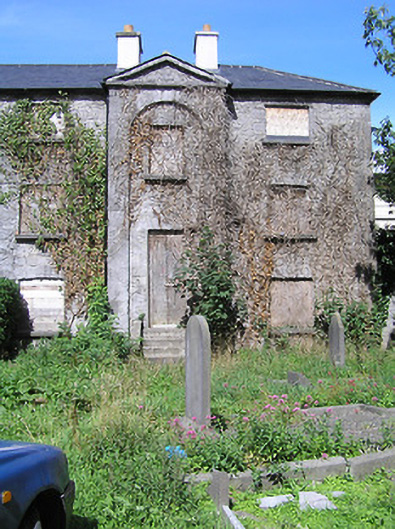 Saint Mary's Church (Saint Mary's)almshouse · 37 yd
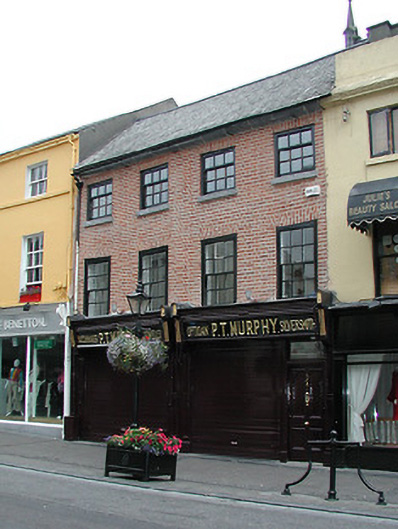 P.T. Murphyhouse · 51 yd
 TholselHeritage attraction · 54 yd
 Almshouse in Gardens (kilkenny City By., St. Mary’s Par.)Almshouse · 70 yd
 Irish River LifeVisitor information · 131 yd
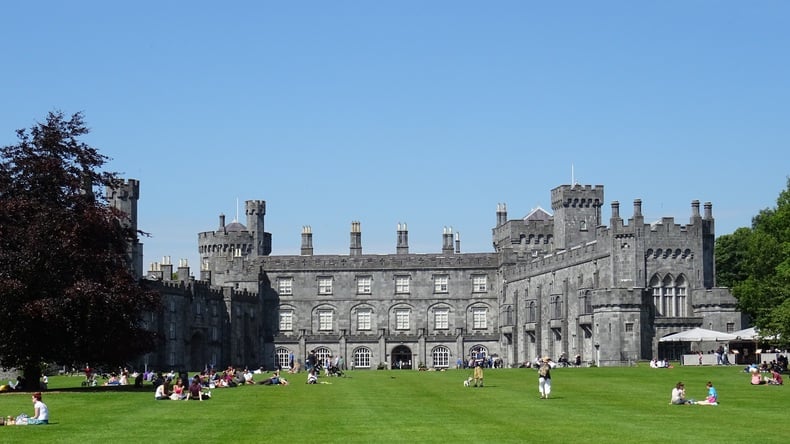 Thomas DollardMemorial · 170 yd
 Thomas MooreMemorial · 197 yd
 Kilkenny CourthouseVisitor information · 291 yd
 Grace's Old CastleCastle · 316 yd
 Black PoplarBlack Poplar · 788 yd