What is recorded here
Tobermolagga is a dry holy well in County Kerry where people still made rounds at the start of the twentieth century. The site keeps a cross-slab, edge-standing stones and a shallow hollow that may have held the vanished stream. An underground passage appeared nearby about 1930, suggesting the hill is not finished giving up its shape. What is missing is not loss but invitation: go before the path forgets itself.
Tobermalogga/Tobar na Molaige: This site lies in the N corner of a field at the foot of the E slopes of Croaghmarhin, about 400m E of An Raingiléis (KE042-094001-). The focal point of the site was probably the holy well (KE042-100001-) and cross-slab (KE042-100002-), and the mounds and slabs laid on edge in the irregularly-shaped area between these and the field walls are probably the remains of penitential stations (KE042-100001-). Rounds were still being made here at the beginning of this century (Curran no. 16), but the practice had died out by 1960 (Ó Danachair, 75). An underground passage was discovered in an adjacent field c. 1930 (O'Sullivan 1931, 524).
The well was described by Ó Danachair as 'a good spring well with some rough drystone work' but it is now dry. Its covering slab is still in situ and the hollow in front of this may be the dried up bed of the stream which flowed from it (OSNB Marhin, 16).
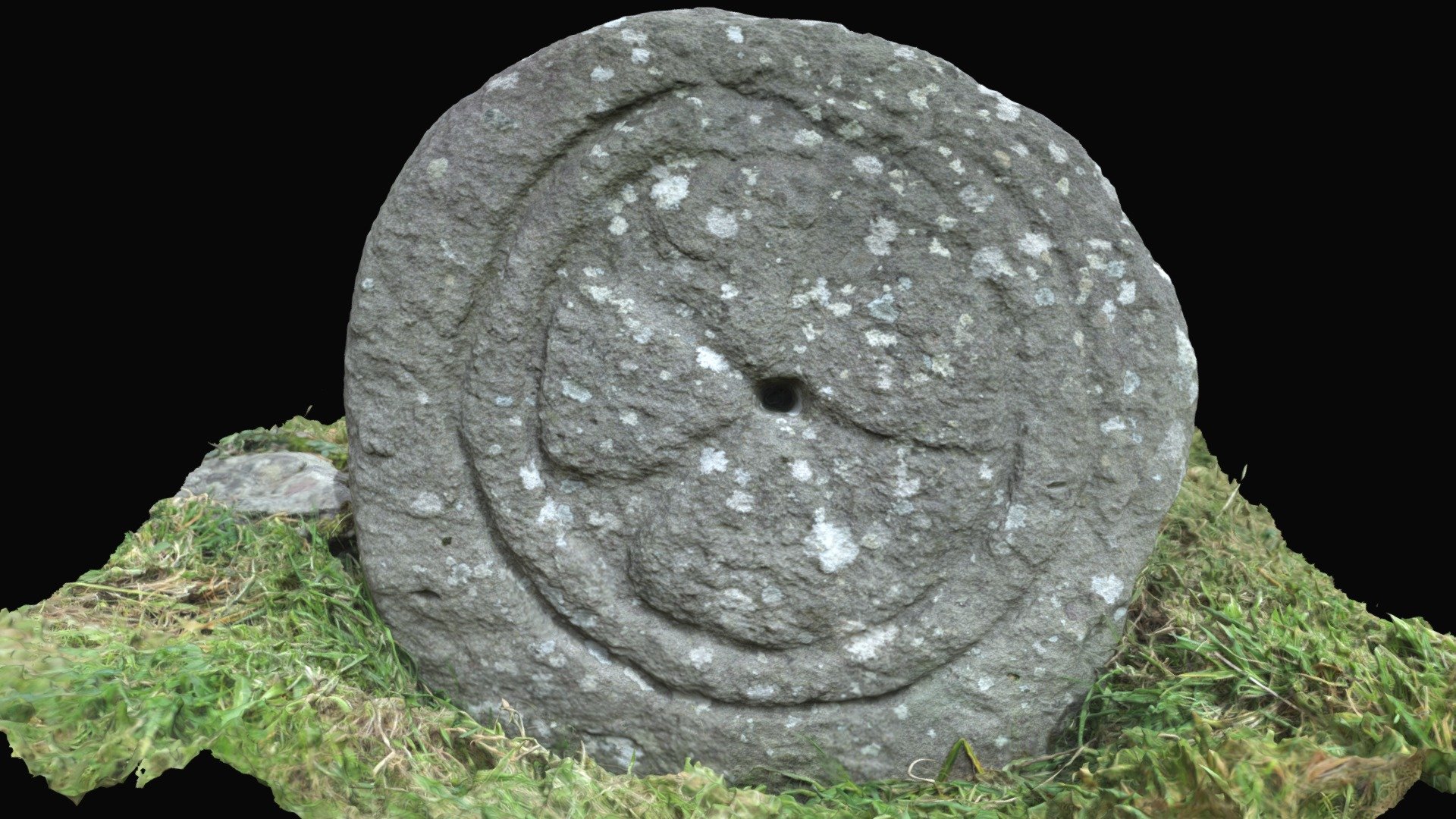
The cross-slab (KE042-100002-) stands on the W side of this hollow and is .94m high, .68m wide and .13 to .17m thick. The decoration on its E face consists of a plain cross within an irregular oval, with a small plain cross occupying each of the quadrants; the lower left cross is barely traceable. Short notches project beyond the circle on either side of the side and lower arms of the cross; there may have been a notch above the upper arm also but this area is now much eroded and it is not possible to be certain. Two unusual cross motifs occur beneath the circle, one with up-turned arms, resembling a triple-branched candelabrum, the other with down-turned arms and a small dot in the angles between arms and shaft. It is possible that these symbolise the good and bad thieves crucified with Christ.
See attached photographs of Tobermolagga, taken 1947 by taken by Caoimhín Ó Danachair courtesy of and © National Folklore Collection, UCD. The Photographic Collection, F025.18.00372 accessible online at https://www.duchas.ie/en/cbeg/16912; F025.18.00373 accessible online at https://www.duchas.ie/en/cbeg/24616
See attached colour photographs courtesy of Amanda Clarke
The above description is derived from J. Cuppage (compiler) 'Corca Dhuibhne. Dingle Peninsula archaeological survey.' Ballyferriter. Oidhreacht Chorca Dhuibhne (1986), no. 828. In certain instances the entries have been revised and updated in the light of recent research.
Revised by: Caimin O'Brien
Date of revised upload: 25 April 2022
Tobermolagga is associated with Saint Molaga, a 7th-century Irish saint known for his ascetic practices and healing miracles. The well was traditionally visited for cures related to skin ailments and was often visited on the saint’s feast day with offerings of coins and cloth.
The monument record does not grant public access. Check the route and ask the landowner before entering private land.
- What survives
- Recorded monument
Places near here
 Penitential station in Baile An BhaoithínPenitential station · 1 yd
 Cross in Baile An BhaoithínCross · 453 yd
 BallywiheenArchaeological place · 476 yd
 Church (in ruins)Church · 485 yd
 Ballineanig HillMountain / peak · 544 yd
 St Brendan's WellSpring · 951 yd
 Músaem Chorca DhuibhneMuseum · 965 yd
 Riasc Monastic SettlementHeritage attraction · 1393 yd
 Rahinnane Castle (in ruins)Castle, tower house · 1.3 mi
 Cruach MhárthainMountain / peak · 1.4 mi
 Trá an FhíonaBeach / strand · 1.5 mi
 Tráigh Bhéal BánBeach / strand · 1.7 mi