What is recorded here
Mullynaolman is an empty meadow, but the missing tower and church still shadow the grass. A strange stone figure once watched the doorway with broad eyes and exposed flesh, perhaps mocking fear or warning every visitor that the body belongs to the earth. St Brecin’s monastery vanished beneath footsteps and forgetting, leaving only a meadow that remembers shape through absence.
Locally known as 'Church Meadow', this site is traditionally believed to be St Brecin's monastic settlement which formerly comprised a round tower, church and cemetery. According to Davies (1948, 116-7) traces of both church and round tower were evident as late as 1948, in addition to a number of cut stones, querns, and a large lump of iron slag which may have been a furnace bottom. The 'Tomregan Stone' (CV010-012002-) located inside doorway of the Church of Ireland chapel in Ballyconnell village is traditionally believed to have originated from here. No trace of monastic site at ground level (Barrow 1979, 58). Described by Freitag as a doubtful sheela-na-gig 'carved on sandstone block, curved section cut from lower left hand corner to fit architectural setting. Triangular, earless head with big, round eyes. Arms slightly splayed with hands hanging at sides of body; legs splayed exposing large, deeply cut almost rectangular-shaped pudenda from which a V-shaped object is protruding. There is a band-like feature partly across the flank (Freitag 2004, 143). Listed by the National Museum of Ireland as an exhibitionist figure which had been mistakenly identified as a sheela-na-gig (Cherry 1992, 10).
The above description is derived from the published 'Archaeological Inventory of County Cavan' (Dublin: Stationery Office, 1995). In certain instances the entries have been revised and updated in the light of recent research.
Compiled by: Caimin O'Brien
Date of upload/revision: 29 May 2012
This Sheela-na-gig carving is likely from the medieval period, associated with the nearby monastic settlement of St Brecin. Such figures are often interpreted as symbols of fertility, the life cycle, or as guardians of sacred sites.
The monument record does not grant public access. Check the route and ask the landowner before entering private land.
- What survives
- Recorded monument
Places near here
 Church in MullynagolmanChurch · 1 yd
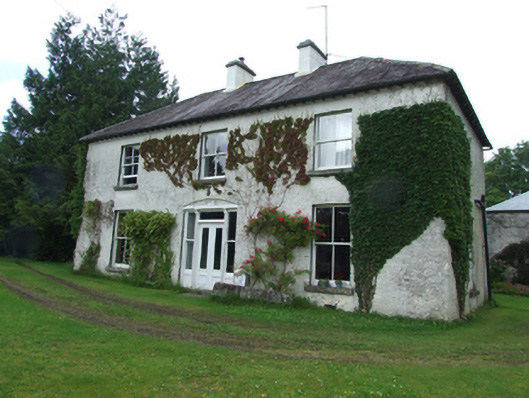 Sandville Househouse · 1312 yd
 Bilberry HillMountain / peak · 1.2 mi
 Ballyheady CairnArchaeological place · 1.4 mi
 Enclosure in KillarahEnclosure · 1.5 mi
 Bellaheady MountainMountain / peak · 1.5 mi
 Killarah ForestForest · 1.8 mi
 Ballyconnell Log CabinsForest · 2.1 mi
 Kieran Doherty TD Cavan Monaghan MemorialMonument · 2.4 mi
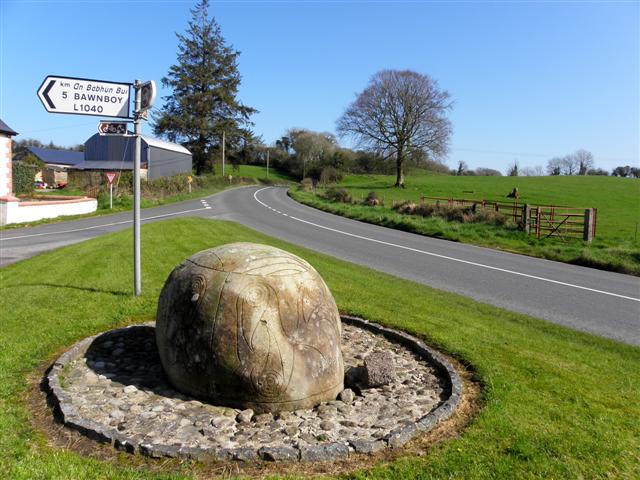 Killycluggin StoneVisitor information · 2.6 mi
 LissanoverCastle, unclassified · 3.1 mi
 CastleCastle, unclassified · 3.8 mi