What is recorded here
Rock art in An Chathair Bhearnach preserves cupmarks and rings on a small upright sandstone now buried partly beneath a concrete path. The marks may belong to the marked stone O'Malley noted nearby in 1937, but the wall and house have taken the stone into ordinary domestic life. Its original setting has been lost, while the cups and rings remain exposed enough for a passing hand to read.
Set in cement in the boundary wall of a house at this location is a small decorated stone, .37m x .19m. The main motifs comprise a cup-and-two penannular rings with a long radial groove and two cup-and-penannular rings with curved radial grooves. Twenty-one simple cupmarks occur on the remainder of the surface. The original location of this stone is unknown, but it may be the ‘marked stone’ noted nearby by O'Malley in 1937 (OPW).
See attached drawing of rock art taken from O'Sullivan and Sheehan 1996, Fig. 44
The above description is derived from A. O'Sullivan and J. Sheehan (compilers), 'The Iveragh peninsula: an archaeological survey of South Kerry'. Cork University Press (1996), no. 264. In certain instances the entries have been revised and updated in the light of recent research.
Date of upload: 28 July 2013
On NW-facing wall (38m OD) defining access path leading to garden of bungalow. A smooth and unfractured, upright sandstone (dims. 0.33m NW-SE; 0.19m NE-SW) which is well maintained and preserved, although lower portion is obscured by concrete footpath. The decorated surface (dims. 0.33m NW-SE; 0.19m NE-SW) covers the whole face of this stone and consists of a cup-and-two-ring motif (overall diam. 11cm; ring Wth 1cm; D 4cm; cup diam. 3cm; D 5mm) with a radial groove (L 11cm; Wth 8mm; D 3mm) extending from cupmark, roughly in centre. A cup-and-ring motif (overall diam. 5.5cm; ring Wth 1cm; D 4cm; cup diam. 2.5cm; D 8mm) is located at top of stone. The lower margin of the stone was not seen as it is below the concrete footpath: Only part of a cup-and-ring motif is evident above the concrete. The radial groove extending from this cup-and-ring motif and the two cupmarks as described by O’Sullivan & Sheehan (1996, 81), were not seen. Approximately nineteen cupmarks (diam. 1.5-2cm; D 6-9mm) are densely distributed across the stone’s surface, around the other motifs.
Compiled by: Alison McQueen and Vera Rahilly
Date of upload: 6 July 2017
Likely dating to the Neolithic or Bronze Age, this rock art may have held ritual or symbolic significance, possibly linked to water or fertility. Such motifs are commonly found in ritual contexts across Atlantic Europe.
The monument record does not grant public access. Check the route and ask the landowner before entering private land.
- What survives
- Recorded monument
Places near here
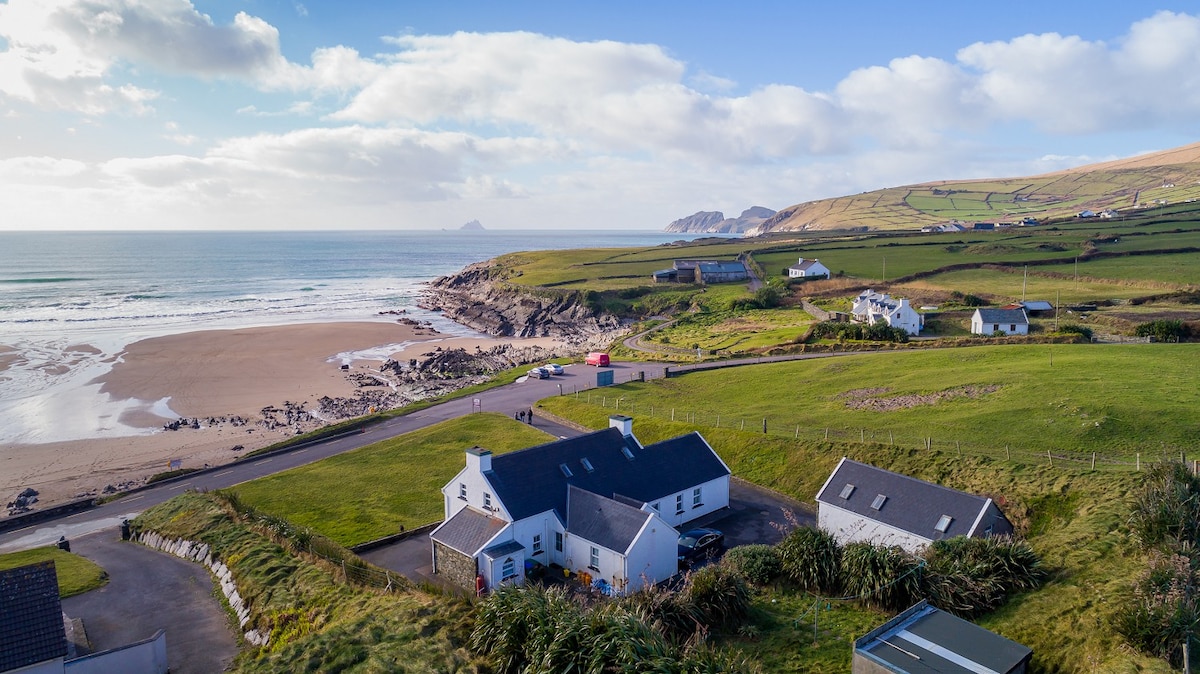 St Finans WellHoly well · 288 yd
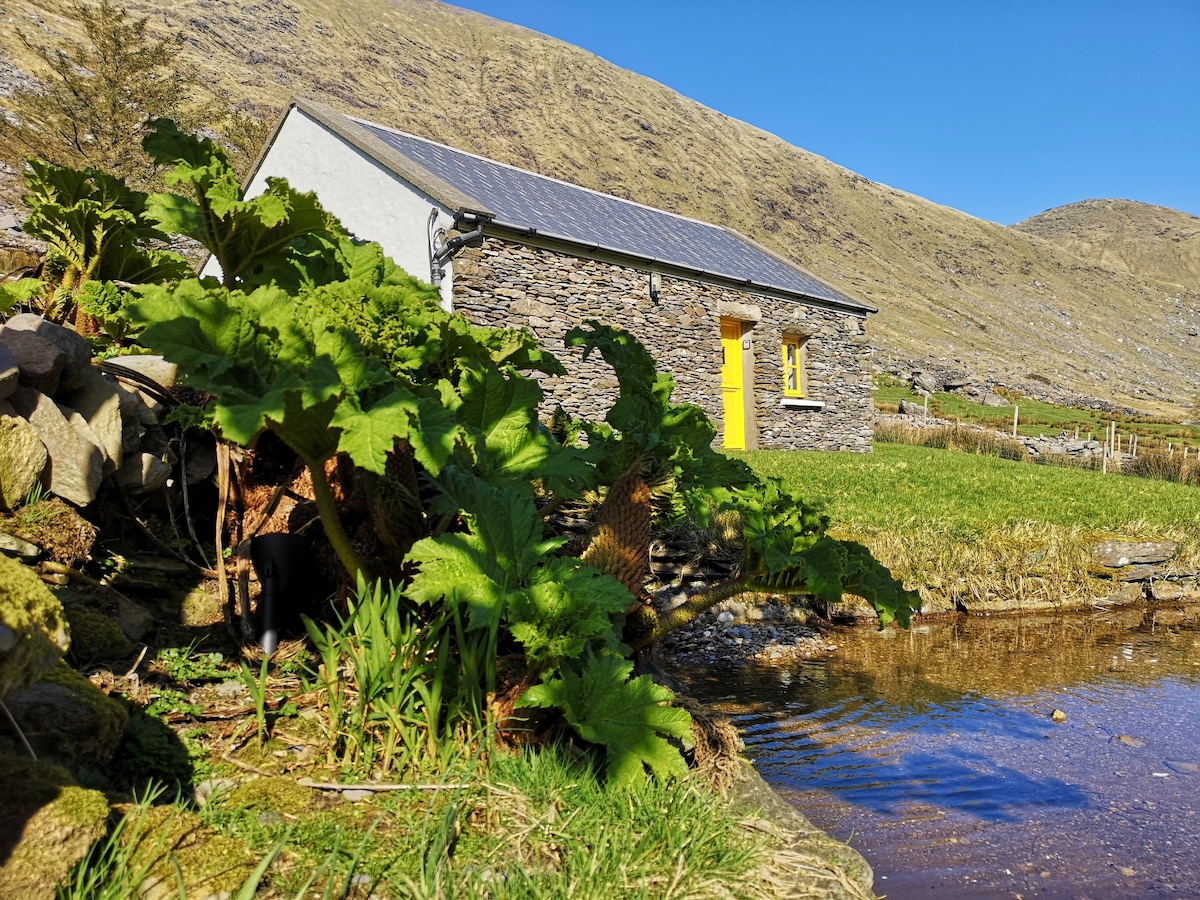 Hut site in An Chathair BhearnachHut site · 326 yd
 St Finans CellHouse, early medieval · 1679 yd
 St Finans ChurchChurch · 1730 yd
 CoomduffMountain / peak · 1.6 mi
 An PlaoscHeadland · 2.2 mi
 CastleCastle, tower house · 2.4 mi
 Butler MemorialMemorial · 2.4 mi
 T. C. Millerick MemorialMemorial · 2.5 mi
 Waterville PromenadeWalking route · 2.6 mi
 GlanbegMountain / peak · 2.7 mi
 Inny StrandBeach / strand · 3.2 mi