What is recorded here
Birr is the last known place before the museum claimed her, though the stone may have marked a doorway where people passed for centuries. Her arms still pull back the flesh, not in shame but in warning, forcing every watcher to see the exact boundary between life and death. The chipped legs and torn shape suggest someone tried to erase her, yet the deep hole remains open like a mouth refusing to swallow the truth.
Found in the Birr area and now housed in the National Museum (Coll. 1956:14; Cherry 1992, 6). Interesting and unusual Sheela-na-gig which is carved in relief on the underside of a large hammer dressed limestone corbel (0.3m x 0.24m x 0.42m). The figure consists of a poorly preserved pear shaped face which is carved on the upward sloping part of the corbel with a small round body with bow shaped arms pulling vulva apart, which is represented by a small circular hole. There are two small circular breasts one between each arm. The head is the dominant part of the figure being carved in high relief and placed on the most visible part of the corbel. The rest of the body is carved in lower relief and is placed on the lower underside of the corbel. May have originally come from the medieval church (OF035-012001-) in the town of Birr. Described by Freitag as a ‘figure carved on curved underside of oblong stone (dims. H -0.53m; Wth 0.3m) which might be a broken-off corbel; quite weathered. Large (now) featureless head on elongated thick neck. Thin bent arms with small round breasts under armpits. Both well shaped hands in front of body, pointing to vulva whose irregular shape looks torn. Lower part of sculpture appears to have been deliberately damaged. Legs no longer traceable’ (Freitag 2004,125).
Compiled by: Caimin O'Brien.
Date of upload: 05 June 2012
Dated to the 12th to 13th century, this Sheela-na-gig is associated with medieval Christian Ireland, often linked to themes of fertility, childbirth, or moral allegory. Such figures may have had symbolic or didactic roles in monastic or ecclesiastical settings.
The monument record does not grant public access. Check the route and ask the landowner before entering private land.
- What survives
- Recorded monument
Places near here
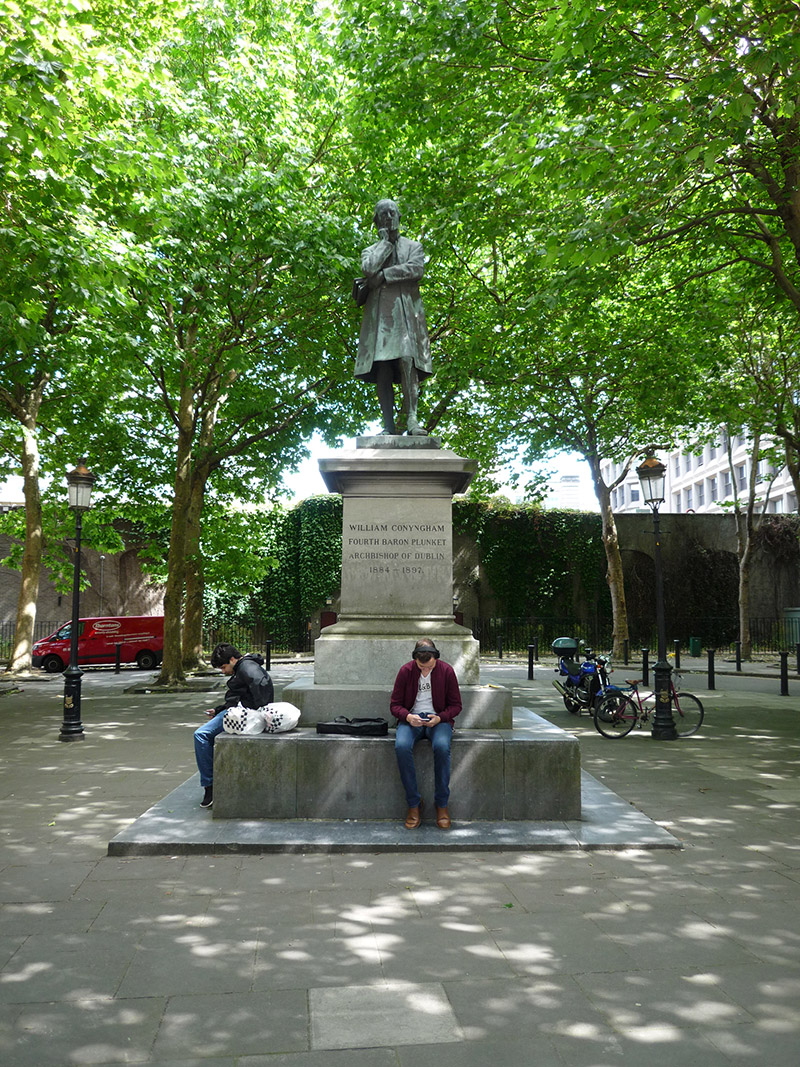 Archbishop Plunket Memorialmonument · 57 yd
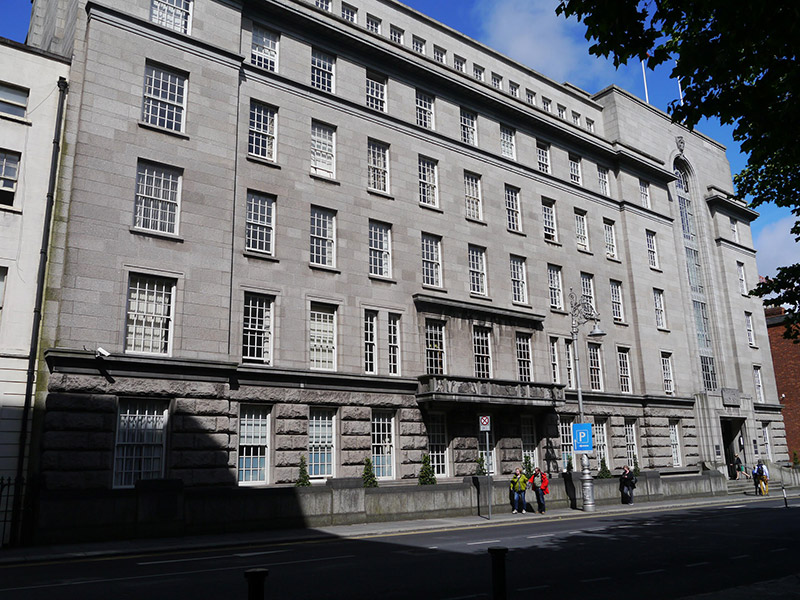 Dept. of Enterprise & Employment\Dept. of Cultureoffice · 68 yd
 The Soup BowlMemorial · 179 yd
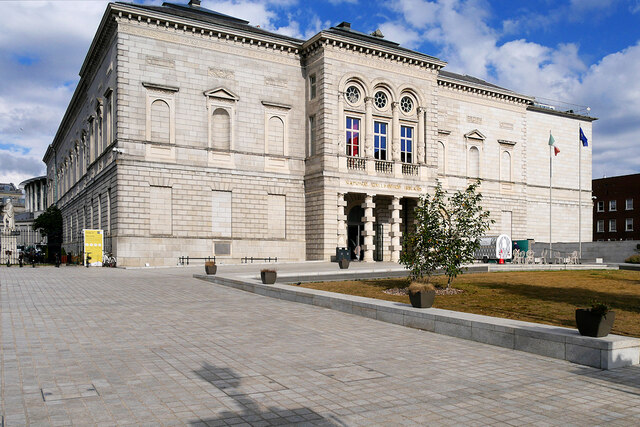 National Gallery of IrelandMemorial · 212 yd
 Dublin MillenniumMemorial · 240 yd
 The Little Museum of DublinMuseum · 259 yd
 O'Donovan RossaMonument · 388 yd
 St. Patricks WellHoly well · 391 yd
 Weeping willowWeeping willow · 395 yd
 Bigleaf MapleBigleaf Maple · 502 yd
 Battle of DublinMajor battlefield · 866 yd
 Tourist Information CentreVisitor information · 950 yd