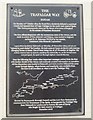
What is recorded here
This commemorative plaque records: The Trafalgar Way. Egham On Monday 21st October 1805 the Royal Navy decisively defeated a combined French and Spanish fleet off Cape Trafalgar on the south west coast of Spain. This victory permanently removed the threat of invasion of England by the armies of Napoleon Bonaparte. The first official dispatches with the momentous news of the victory, and the death in action of Vice Admiral Lord Nelson, were carried to England on board H.M. Schooner Pickle by her captain, Lieutenant John Richards Lapenotiere. Lapenotiere landed at Falmouth on Monday 4th November 1805 and set out "express by post-chaise" for London. He took some 37 hours on the 271 mile journey, changing horses 21 times. One of these being late on 5th November at Bagshot. His orders were to lose no time in reaching the Admiralty so, as the horses were not yet spent, he sped on through Egham towards Staines. Over the following four weeks other important messages arrived from the fleet with further details of the victory and anxiously awaited information on casualties. All the dispatches were landed at Falmouth and their couriers took the same route through Egham, where horses and hospitality were available from the inns to all travellers on what is now The Trafalgar Way. Erected by Runnymede Borough Council and the Loch Fyne Restaurant to commemorate the bicentenary of the Battle, to inaugurate The Trafalgar Way from Falmouth to London and to honour the men of Surrey who fought for their country at Trafalgar.
Lieutenant John Richards Lapenotiere was the captain of H.M. Schooner Pickle, which carried the first official news of the British victory at the Battle of Trafalgar and the death of Vice Admiral Lord Nelson to England in 1805, significantly impacting national morale and security during the Napoleonic Wars.
A plaque record does not grant entry to a building or private land. View it from a public place unless permission is clearly given.
Places near here
 Almshouses at Strodes CollegeListed building · 285 yd
 Egham MuseumMuseum · 431 yd
 Literary InstituteListed building · 441 yd
 King John Statue, EghamMonument or public art · 661 yd
_by_the_A30,_Egham_Hill,_Egham_-_geograph.org.uk_-_6614287.jpg?width=1280) Old Milestone (north face) by the A30, Egham Hill, EghamMonument or public art · 829 yd
Old Milestone (north face) by the A30, Egham Hill, EghamMonument or public art · 829 yd Air Forces MemorialMonument · 1089 yd
 Roadside Monument, EghamMonument or public art · 1223 yd
 The IslandIsland · 1350 yd
 Coopers HillMountain / peak · 1617 yd
 John F. Kennedy Memorial at RunnymedeHeritage place · 1.0 mi
 Magna Carta IslandIsland · 1.1 mi
 The Kennedy MemorialVisitor information · 1.1 mi
Other information
Photo: Sean Davis on Geograph · CC BY-SA 2.0