Add your own picture and explain the route, parking, gates, paths or landmarks that help people find it.
Earn 5 points after the picture is checked and accepted.
Add your photo and local directionsShare what you foundWhat is recorded here
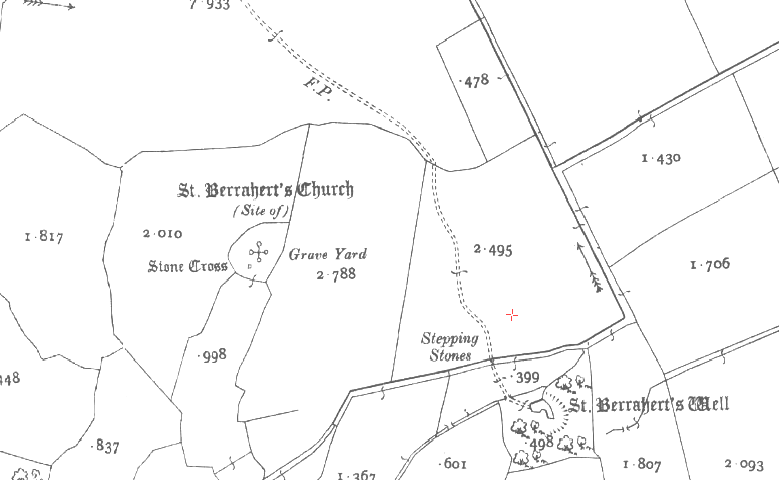
In wet, marshy terrain. A recent wooden plank walk-way has been constructed across the marsh to give access to the well, which otherwise is very difficult. The holy well consists of a large, roughly circular area (diam. c. 30m) defined from NW-N-E-S by a bank (Wth crest 2.9-3.3m; Wth base 6-7.2m; int. H 1.45-1.75m; ext. H 0.73-0.8m at SE and NW respectively). The edge of the pool is not clearly defined in the S-W-NW sector, here the ground falls gradually towards the pool. The S bank runs into a field boundary which runs roughly E-W along the S side of the monument and joins with another field boundary which runs roughly N-S along the W side of the monument. The surrounding area and most of the S half of the enclosed pool, which is marshy, is covered in trees. Only the N half of the well is a pool, though the NW quadrant is heavily overgrown with water plants. The pool has bubbling spring water which is very clear (D 0.8-1m at least) and there is a channelled run-off in the NNE with a small foot-bridge over it. There are several rag bushes on the N side of the well which vary in size, age and species, including willow, holly, birch and oak. Suspended from the branches are ribbons, which are predominately red and green, CDs, rosary beads, scapulas, handkerchiefs and gloves as well as mugs. At the base of the oak tree there are various representations of Our Blessed Lady and prayers to saints, including one to Blessed Faustina Kowalska, a Polish nun who died in 1938 and was beatified in 1993. Though this is a recognised holy well it may have pre-Christian origins as a ritual pond.
Compiled by: Jean Farrelly
Date of upload: 26 August 2011
The monument record does not grant public access. Check the route and ask the landowner before entering private land.