Add your own picture and explain the route, parking, gates, paths or landmarks that help people find it.
Earn 5 points after the picture is checked and accepted.
Add your photo and local directionsShare what you foundWhat is recorded here
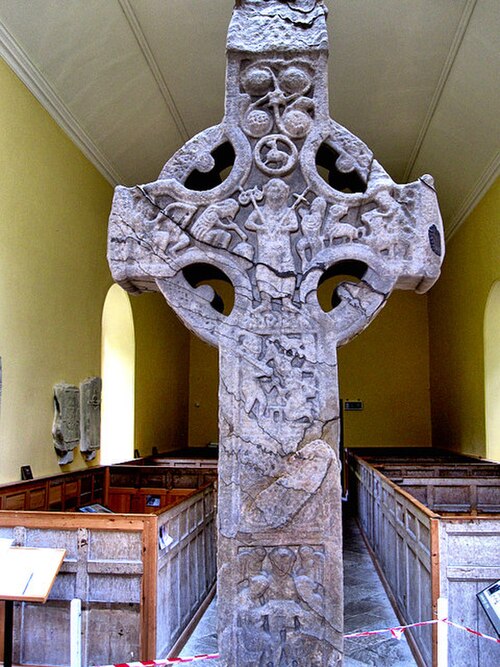
National Monument No. 313. A monastery was founded at Durrow reputedly by Colum Cille [of the church] who died in 597 and whose feastday is celebrated on the 9th of June (Ó Riain 2011, 213-14). Colum Cille whose original name may have been Criomthann was descended from a branch of the Ceinéal Conaill of Donegal (ibid., 211). He established a monastery at Iona in Scotland and is the earliest known founder of a church outside of Ireland (ibid., 212). Over sixty churches claim to have been founded by Colum Cille many of which have no historical documentation to support their claim (ibid., 213). Until recently the Durrow high cross stood in the W quadrant of Durrow graveyard (OF009-005009-) a short distance to the W of the W gable of the C of I church (OF009-005013-) as depicted on all editions of the OS six-inch maps. The high cross has been moved from this location and is now housed inside the C of I church which has been recently conserved by the OPW. A 3D model of the high cross can be downloaded from Offaly County Council website at www.offaly.ie/eng/Services/Heritage/Archaeology/3D_Surveying_of_Archaeological_Monuments/
In 2006 limited excavations were undertaken by Tracy Collins of Aegis Archaeology Ltd at Durrow under licence No. CO02, E3161, as part of the ongoing conservation works at the national monument, on behalf of the OPW. Three areas were investigated including an area around where the cross had stood measuring 5m by 5m was opened to address the following research questions: Was the cross in its original position? What was it sitting on? Was there an earlier cross? Further information was required on the context of a cross slab excavated by De Paor in 1954: did it cover a grave, for instance?
The excavation around the cross site showed that burial had occurred to the north, south and east of the cross base. Seventeen individuals were excavated, along with much disarticulated remains. Initial examination suggests that all the burials were late in date, probably none earlier than the 18th century. The cross appears to have been in its original (early medieval) position, in that all burials respected the location of the cross base. The cross rested on a layer of redeposited boulder clay, which contained a few fragments of animal bone. There was no evidence of an earlier timber cross at this location, nor was there any evidence of burial beneath the cross. The excavation results would suggest that the cross slab found by De Paor did not cover a specific grave but may have been placed to the east of the cross in order to ‘close’ that area from any further burial – perhaps placed there in the 19th century (Collins 2009, 449).
The Durrow high cross was described by Harbison (1992, vol. 1, 79-82) as following; 'The complete monolithic cross is 3.16m high, 1.39m across the arms, and the shaft is 46cm wide and 31cm thick at the bottom. It rests on a base which measures 1.30m by 1.10m at ground level, and which is 38cm high. The sides of the base are slightly convex, and have a step hear the top. The base has grooved lines forming a base-line above which are the frames of two undecorated panels-two each on the broader faces, and one each on the sides. The cross has a roll moulding around the edges, and the smaller roll mouldings framing the panels come in from each side between the panels and double back on themselves without meeting in the centre. This moulding has a number of small horizontal grooves, best seen on the north side. The head has a smaller moulding inside the roll moulding on the edges.
EAST FACE
Shaft
Plinth : Due to its heavily worn condition, the subject matter of the plinth is difficult to ascertain. On the left there is what could be the head of a ringed cross on a possible shaft, or a lamb with ringed head, but the nature of the small ring on the right is more enigmatic. In the centre there may be a human figure flanked by an animal or bird, or it could be two centaurs face to face, but identification is very uncertain.
E1: THE RAISED CHRIST - A figure of Christ in the upper centre of the panel has an angel on either side of the head. His feet rest on the knees of two long-robed figures in profile who are seated opposite one another beneath him. They hold an open book between them, and represent Apostles, almost certainly Peter and Paul.
E2 : A panel of interlace forming circular devices.
E3 : THE SACRIFICE OF ISAAC - Abraham is shown in profiel on the left, with his sword over his right shoulder, and holding up in his left hand an enigmatic object best interpreted as the fire. On the right is his son Isaac, whose left knee is on the ground. Isaac holds an axe above the altar in his left hand, and his right is placed just above the altar. A rope around his body holds the wood for the sacrificial fire on his back, and above him is the angel which holds the hind leg of the ram in front of him.
Head
Centre: (?) THE LAST JUDGEMENT - Christ stands in centre wearing a long robe with slightly diagonal folds at the waist. In his left hand he holds a cross-staff, and in his right a sceptre with a head blossoming out into a spiral foliate ornament on each side. Above his head is the lamb in a circle. He stands on an interlace, presumably symbolising clouds. On the right there is angel with folded hands, and on his left a seated angel blowing a pipe. At the end of the pipe there is a single human head, the significance of which is not clear.
South arm : DAVID PLAYING THE LYRE - David is seated, facing towards Christ, and placing his hand on a lyre resting on his lap. His left knee protrudes in an anatomically curious fashion. The frame at the end of the arm bears an upright panel of interlace, with volutes above and below.
North arm : DAVID SLAYS THE LION. - David has his left knee on the back of the lion whose jaws he pulls asunder with his hands. In front of him, in the contraction of the arm, there is a lamb with upright neck which presumably belongs to this scene rather than to (?) THE LAST JUDGEMENT. The frame at the end of the arm is similar to that on the south arm, except that the interlace is more tightly meshed.
Top : A square panel has a rounded boss in each corner, on one of which interlaced decoration is preserved. Emerging from them are some animals which bite one another in the centre, and others with their heads on the outer periphery of the bosses. Above this panel is the roof, decorated with an imitation of shingles.
The ring : The ring has roll mouldings on the edges, framing panels of animal interlace in the lower left and upper right segments, and fretwork with spiral terminations in the lower right segment. The nature of the decoration in the upper left segment is not clear. Attached to the inner surface of the ring are the cylinders, the ends of which are decorated with a round boss surrounded by a circle of pellet decoration.
SOUTH SIDE
Shaft
Plinth : On the plinth two winged animals are seen in profile, contorting the neck so that the head is almost frontal. The animals stand opposite one another under a tree. The right-hand animal seems to grasp the stem of the tree with its right front paw.
S 1 : EVE GIVES THE APPPLE TO ADAM. - Cain, with sharply pointed nose and dressed in a tunic with wavy hem at knee-level, is shown in profile on the left. He holds up a curved club with which he strikes the head of his brother Abel, who is shown in a frontal pose, wearing a long robe with rope-like front, and placing his hands on his lap.
S 3 : DAVID AS KING - David, seated frontally and wearing a flowing moustache and interlaced beard, holds a sword up over his right shoulder and a shield with central boss in his left hand. By his side, two upright animals put their heads on his lap.
Head
Underside of ring : Snake and heads - The sunken panel in the centre has a snake - with its head and tail on top and its back decorated with pelleting - which coils its way among three human heads. It is flanked by a pa
The monument record does not grant public access. Check the route and ask the landowner before entering private land.