Add your own picture and explain the route, parking, gates, paths or landmarks that help people find it.
Earn 5 points after the picture is checked and accepted.
Add your photo and local directionsShare what you foundWhat is recorded here
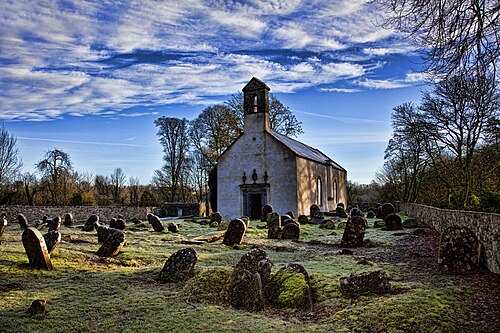
National Monument No. 313. A sixth century monastery was founded at Durrow reputedly by Colum Cille [of the church] who died in 597 and whose feastday is celebrated on the 9th of June (Ó Riain 2011, 213-14). There is a fragment of the shaft (L. 0.51m; Wth 0.4m; T 0.26m) of a possible high cross cemented into the S end of the W wall of the graveyard (OF009-005009-), this piece appears to have come from the shaft of a high cross and has interlace decoration on its visible side. The missing cross head described below and the fragment of the shaft cemented into wall of graveyard may belong to the same cross. The cross-head is now housed in Dublin, in the National Museum of Ireland (IA file, IA/29/1988). In 1974 the head of this high cross was removed from the monastery at Durrow.
Described by Harbison (1992, vol. 1, 82-3) as following: 'a cross-head of sandstone stood for centuries on top of the gable of the now disused Protestant church (OF009-005013-) to the east of the main cross (OF009-005006-). It fell to the ground in the late 1950s, after which it was placed on a base just south of the church. In 1974 it was, apparently, removed to Durrow Abbey nearby, in the grounds of which the old monastic site lies. The cross-head is 43cm high, 68cm across the arms, and the lower part of the shaft has a maximum width of about 20cm. The arms expand markedly at the terminals, and it seems unlikely that the cross originally had a ring. The ends of the arms are probably not decorated.
EAST FACE : (?) DAVID AS SHEPHERD. A figure stands with a crook in its left hand, and there may be a sheep with turned-back head to the right. Above the figure's head there is what is probably an angel, on the analogy of panel S3 of the Cross of the Scriptures at Clonmacnois. The figure is most likely to represent David as Shepherd, the presence of David in such a position at the centre of the cross-head being rendered quite likely in view of the David interpretation suggested here for the scene at the centre of head of the Tall Cross at Monasterboice. The arms are decorated with interlace.
WEST FACE : THE CRUCIFIXION - Christ is shown in a tight-fitting garment, stretching his arms out at right angles. Stephaton and Longinus are indicated as busts beneath Christ's arms, though their attributes are not shown. At the end of the arms there is a whirl from which serpent-headed animals emerge. Above Christ's head, a bird flies upwards to the left.'
The above description is derived from the published 'Archaeological Inventory of County Offaly' (Dublin: Stationery Office, 1997). In certain instances the entries have been revised and updated in the light of recent research.
Compiled by Caimin O'Brien
Date of upload/revision: 23 April 2014
The monument record does not grant public access. Check the route and ask the landowner before entering private land.