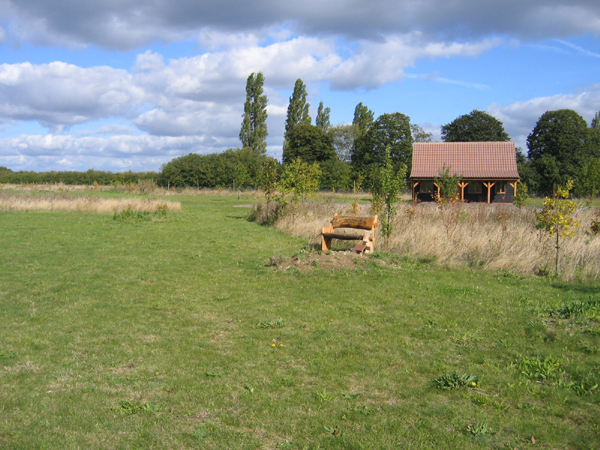
Add your own picture and explain the route, parking, gates, paths or landmarks that help people find it.
Earn 5 points after the picture is checked and accepted.
Add your photo and local directionsShare what you foundWhat is recorded here
Report on Discovery of Human Remains at Glebe Townland Near Fin Lough, Co. Offaly.
IA/66/2006 - National Museum of Ireland report written by Fiona Reilly, Assistant Keeper, National Museum of Ireland, 20 April 2006 (Cahill & Sikora 2011, vol. 2, 507-08). Human remains were discovered on 17 April 2006 during a hand-dug excavation to facilitate the insertion of a grease-trap approximately 3m west of a newly constructed conservatory at the Holmes residence. Fiona Reilly (NMI) inspected the site on 19 April 2006 and retrieved the disturbed remains thought to represent at least two / three individuals. The remains of another skeleton were identified at that time and preserved in situ. The groundworks associated with the grease-trap and out-fall pipe was to facilitate wastewater from the recently constructed conservatory extension to the existing dwelling (plan ref: 95/336). No archaeological condition was attached to the grant of planning. In order to facilitate the insertion of the grease-trap, the western baulk of the existing hole was extended by approx. 10cm. No additional fragments of skeletal material were identified in the stony silty sand (C1?). The depth of the hole was increased by 55cm into the naturally occurring sand. In order to minimise the possibility of encountering further remains, it was advised that the pipe should be inserted beneath the pre-existing concrete path (sunken in places) which was also proposed to be removed prior to the construction of decking at a later date. The line of the pipe towards the septic tank was 12.5m in length (Plate 1). It was apparent that the construction of the path in the 1970s had caused disturbance. The concrete slab (approx. average 10cm) was removed as was modern red brick and stone (approx. average 20cm in depth) introduced to provide the foundation for the path. As there was a naturally occurring fall / slope southwards towards the septic tank, it was not necessary to remove any additional soil beneath the rubble to facilitate the insertion of the pipe. All material was removed by hand and spread and searched. The pipe was connected and the trench backfilled. One clay pipe fragment, 26 small fragments of possible human bone and at least 6 human skull fragments were retrieved from the brick and stone rubble beneath the concrete path and these were forwarded on 12 May 2006 to F. Reilly in NMI for analysis. No in situ remains were uncovered. The discovery of this small quantity of disarticulated human bone suggests that the potential for additional in-situ and disarticulated human remains in the immediate vicinity is high (pers. comm. Laura Claffey, 24 April 2006).
The Remains
The remains had been found during the excavation of a pipe trench and hole for a grease trap. The pipe trench ran from the back of the house in a roughly southerly direction. The human remains were uncovered in the hole for the grease trap 3.00m west of the newly constructed conservatory. No human remains were discovered during the construction of the extension. The hole was irregular and roughly 1.30m by 1.10 and 0.60m deep. Loose bone was visible on the surface of the spoil still around the hole and in its base though all larger pieces of bone had been removed. This spoil was trowelled through by myself and any fragments of bone removed. It also transpired that some spoil had been dumped in another area nearby to the south at the site of a delisted enclosure. Several pieces of bone were found at this location when the material was trowelled through.
On investigating the loose spoil at the bottom of the grease hole rib bones were noticed protruding from the eastern baulk and perhaps in situ foot bones at the northern base of the cut. It was decided to plan and remove these bones (Skeleton 1). During the removal of the rib bones, clavicle, scapula, humerus and part of an ulna of what appeared to be the right side a second long bone and skull were noticed (Skeleton 3). This long bone was under the humerus of Skeleton 1. The long bone was removed but the skull was left in situ. The teeth of the skull indicated that it faced west.
From what Vivienne Holmes has told me it seems that a skull (Skeleton 1) was located at the southern end of the hole and faced east. She thought that the skeleton had lain on its side. From the positions of the ribs etc. in the eastern baulk it seems likely that the trunk of the individual was supine. The location of possible foot bones in the north of the trench suggests that the legs of the individual had been bent. The discovery of a fragment of a second lower jaw (Skeleton 2) in the loose spoil around the trench indicated that at least two individuals had been disturbed. It cannot now be determined whether the remains had been disturbed on a previous occasion and that the remains of two individuals are represented or whether the second jaw was a stray fragment. Many bones are missing and there are not enough to represent two complete individual skeletons.
Stratigraphy
The in situ ribs were 0.40m below present ground level. They lay within a silty sand with occasional medium sub-angular stones (C1). In the western section this was 0.23m deep. In section the skeleton lay on 0.03m of lime (C2). Lime could also be seen in patches at the base of the hole. It is probable that it had covered the entire base of the hole. Below the lime was fine light brown sand (C3). Sand is common in the area (V. Holmes pers. comm.). C1 was covered with garden soil (C5), which in turn was sealed by concrete (C4).
Discussion
The remains of at least three individuals were discovered in Glebe. Skeleton 1 had almost entirely been removed before my site visit, Skeleton 2 is represented by a fragment of a lower jaw and Skeleton 3 was left in situ. Since most of the bones had been removed prior to my site visit it was impossible to ascertain whether they had been laid in separate grave cuts. The quantity of bone found indicates that complete skeletons were not recovered. The skull of skeleton 1 had faced to one side (V. Holmes pers. comm.) and the position of possible in situ foot bones belonging to this skeleton suggested that the legs of Skeleton 1 had been flexed. The skull and feet positions of Skeletons 1 and 3 and the position of the humerus of Skeleton 1 over a long bone of Skeleton 3 suggests that they might have been interred in a single grave cut. The presence of lime suggests that they had been diseased.
The present house (the Glebe House) was built in the late 1940's so does not appear on the O.S maps. It was built in the grounds of Carrowkeel House which has since been demolished. The coach house of Carrowkeel house still stands to the south of the present dwelling. The rector of Clonmacnoise lived in Glebe House. There is no evidence for a church site or burial ground at this spot that might explain the location of the burials. 'Caltragh burying ground' as it is named in the OS 6-inch 1st edition map (sheet 6) is located a distance to the east.
Summary
Human remains were discovered at Glebe townland on Easter Monday the 17th April 2006. On investigation by Fiona Reilly it transpired that the remains of at least three individuals were represented though it is unclear at this point how complete the remains are. The majority of the bones representing what appears to be two skeletons had been collected before the site visit by Fiona Reilly. Some ribs, arm bones and scapula were still in situ and were excavated during the site visit. There are not enough bones to represent two complete skeletons and it is possible that the second jaw fragment was a stray bone. A third skeleton was identified at this time and left in situ.
Compiled by: Caimin O'Brien
Date of upload/revision: 10 August 2012
The monument record does not grant public access. Check the route and ask the landowner before entering private land.