Add your own picture and explain the route, parking, gates, paths or landmarks that help people find it.
Earn 5 points after the picture is checked and accepted.
Add your photo and local directionsShare what you foundWhat is recorded here
After a rebellion the land of Brian Óg Mac Mahon, amounting to three Ballybetaghs or villages, was forfeited, and in 1609 it was granted to Sir Thomas Ridgeway as the manor of Upper Trough. This became the core of the Glaslough estate, consisting of almost all of Donagh parish, which was owned by the Countess of Carlisle in 1640, probably as mortgage security (Shirley 1879, 135). In 1661 John Leslie, who had been successively bishop of the Scottish Isles and Raphoe, was appointed to Clogher, and he had acquired Glaslough by 1665 (ibid. 140-5). The core of the estate has remained in the Leslie family down to the present.
Ridgeway was not remiss in developing his property. In 1611 it was reported by Lord Carew, a special Commissioner reporting on the Plantation of Ulster, that 'Sr. Thomas Ridgway knight, hath erected a fforte or bawne at Lurgan-glaslough in the said countie, w'th a stone walle rounde aboute it, each curtine 160 foote longe, the whole circuet of the fforte 752 foote w'th a rampier or foote pace of earth round aboute w'th 4 bulworks and lups of a foote in length, from the topp of the walle downeward, 5 feete distance one from th'other and a ditch, and trench 18 foote broade and 10 foote deepe, w'thin wh'ch is already buylte a little English house, and means to buyld a castle. This was done upon like consideration as that of Sr. Edward Blanye (i.e. at the King’s charge). There is buylte 12 houses or tenem’ts of stone, some few already a storie high, some lesser, and 8 ordinarye tenem’ts thorowlie finished, besyds the foundation of 8 stone houses more, w’ch are nowe to be removed and drawne into the fforte towerds the buyldinge of the castle. He hathe also buylte a corn myll there' (Hunter 1975, 81)
Ridgeway was building a fort (dims c. 48m x c. 48m) with four corner bastions, a rampart behind the wall and a fosse (Wth c. 5m; D c. 3m) in front of it. The walls had gun-loops (H 0.3m) placed 1.5m apart, and a small house was within the fort. A settlement was also developing around the fort, but as Glaslough was outside the official Plantation and Ridgeway had accompanied Carew while the Commissioner was in Ireland it is a moot point as to how much was actually completed in 1611 rather than planned.
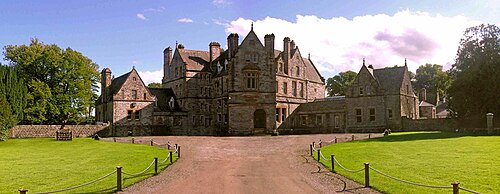
The location was probably on the E-W ridge of Glaslough, but perhaps no more than the English house had been constructed. In 1720 it is recorded in a letter that ‘the brick house has fallen down’ and this may have been Ridgeway’s ‘little English house’. It was replaced by a seven bay three storey and attic house in a Queen Anne style with the double bays at either end stepped slightly forward (Shirley 1879, 146). This is the house that is described as Castle Leslie on the 1834 edition of the OS 6-inch map. It was replaced by the present house, located just to the NE, in 1878, for which see this web-page accessed on 12/12/2017: http://www.buildingsofireland.ie/niah/search.jsp?type=record&county=MO®no=41301017
Date of revised upload: 12 December 2017
The monument record does not grant public access. Check the route and ask the landowner before entering private land.