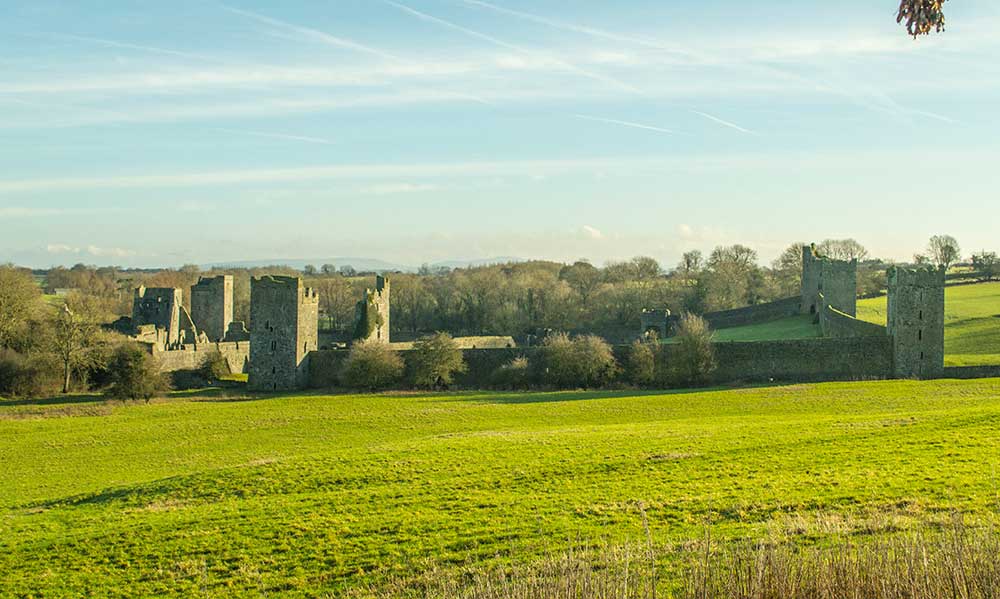
Add your own picture and explain the route, parking, gates, paths or landmarks that help people find it.
Earn 5 points after the picture is checked and accepted.
Add your photo and local directionsShare what you foundWhat is recorded here
A house of Augustinians dedicated to St. Mary was established 1140-8 at Kells at the suggestion of St Malachy, and it may have been a double monastery of canons and nuns since it was described as a dependency of the Arroasian house at Clonard in 1195. The abbey may have been destroyed by the campaigns of Dermot MacMurrough in 1171 or the Anglo-Normans in 1176 since it was re-founded by Hugh de Lacy before 1186 and its charter was confirmed by Richard II at Drogheda in 1395. The charters list extensive lands in counties Meath, Cavan, Louth, Kildare, Leitrim and Fermanagh, and most of the churches of Kilmore diocese were impropriate to the abbey. The canons seem to have been largely Irish throughout its history and to have a close connection with Kilmore diocese, providing its bishop in 1286. In 1409 indulgences were granted as the buildings were in a state of disrepair. In 1420 Pope Martin V appointed John Oraghillich (O’Reilly), ‘a canon of Cruczelingen outside the walls of Constance’ as abbot but he proved to be too radical and was deposed in 1444 to be succeeded by John O’Reilly who was translated to the See of Kilmore in 1465. The abbey was suppressed in 1539 when Richard Plunkett was abbot, and he and two canons received pensions. (Gwynn and Hadcock 1970, 181; Bradley and King 1985, 82-3)
At the Suppression the church was being used as a granary, and in addition there were three chambers and a steward’s room, all occupied by the farmer, William Dormor (White 1943, 262-3). There were 12 acres arable and pasture near the town and 60 acres of scrub. There were other lands beyond that as well as the tithes of seven parishes. In 1541 the property was granted to Sir Gerald Fleminge (Gwynn and Hadcock 1970), and in 1608 it was granted to Gerald Fleming of Cabragh, Kingcourt (O’Connell 1960, 16). The location of the abbey is not absolutely known. A survey of 1655 makes it clear that it was ‘outside Cannon (Canon) Gate’ and a field on the S-facing slope outside the walls here is known as ‘Abbey Field’ (ibid. 15).
Compiled by: Michael Moore
Date of revised upload; 29 June, 2019
The monument record does not grant public access. Check the route and ask the landowner before entering private land.