Add your own picture and explain the route, parking, gates, paths or landmarks that help people find it.
Earn 5 points after the picture is checked and accepted.
Add your photo and local directionsShare what you foundWhat is recorded here
The monastery of Inismocht was founded on an island in what is now a dried out lake of the River Dee, by Mochta Mac Cearnagh, a priest of Armagh who died in 922. Mochta is remembered on 26 March and is not to be confused with St. Mochta of Louth (Ó Riain 2011, 466). It served as the parish church of Inismott and is listed in the ecclesiastical taxation (1302-06) of Pope Nicholas IV (Cal. doc. Ire. 5, 261). Ussher describes Ennismoughton as a ruined (Erlington 1847-64, 1, xcvii) as does Dopping (1682-5) when it was not enclosed (Ellison 1973, 6). It is depicted as a roofless ruin on the Down Survey (1656-8) barony map of Slane where it is described as ‘Enesmott church in the bog.’ By the 19th century the tithes of Innismott were impropriate to St. Mark’s chapel in Drogheda (Lewis 1837, 2, 24).
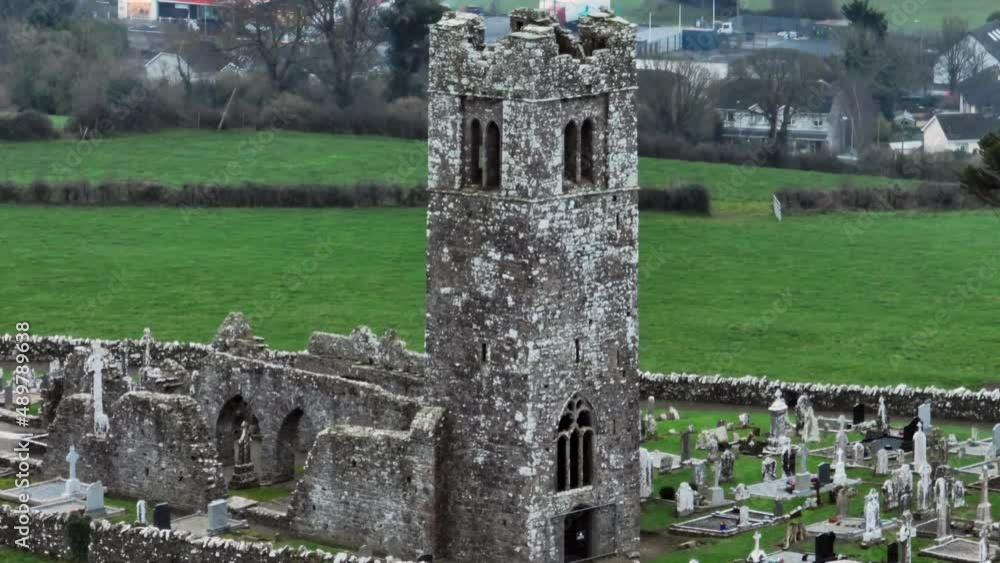
The church is on a rise in a level landscape with the canalised W-E River Dee c. 230m to the S. The remains consist of the N and S walls of a church (ext. dims 8.3m E-W, originally c. 14.5m; 7.2m N-S) standing in a rectangular enclosure (dims 33m NE-SW; 21m NW-SE) defined by scarps. There is no evidence of grave markers but bones have been found in vicinity (Tempest 1944).
The above description is derived from the published 'Archaeological Inventory of County Meath' (Dublin: Stationery Office, 1987). In certain instances the entries have been revised and updated in the light of recent research.
Compiled by: Michael Moore
Date of revision: 10 December, 2014
The monument record does not grant public access. Check the route and ask the landowner before entering private land.