Add your own picture and explain the route, parking, gates, paths or landmarks that help people find it.
Earn 5 points after the picture is checked and accepted.
Add your photo and local directionsShare what you foundWhat is recorded here
Located on the shoreline of Rockfleet Bay, a sheltered but deep inlet on the NE side of Clew Bay. It is built on limestone bedrock on the W side of the mouth a small river that flow into the NE end of the inlet.
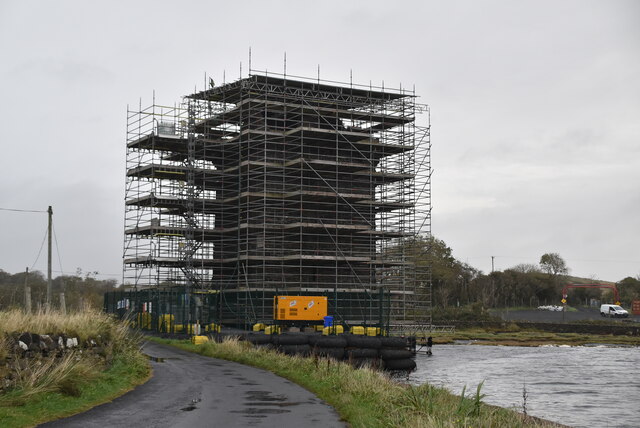
This tower house is a National Monument (no. 454) in state ownership. It is indicated as ‘Rockfleet Castle (in Ruins)’ on the OS 6-inch maps, but is also known by the Irish version of that name, Carrickahowly or Carraig a’Chabhlaigh, meaning ‘Rock of the Fleet’. It was partly restored in the 20th century when still in private ownership. The Office of Public Works is currently undertaking a programme of restoration and conservation at the castle.
Aligned NNE-SSW, the tower house will be described here for convenience as though N−S.
It is a four storey rectangular building (ext. dims. c.7.5m WNW−ESE; 9m NNE-SSW; wall T 1.8-2m) with a neatly integrated base batter. The (restored) gabled roof, the gabled ends at E and W, is set in from the walls of the tower, allowing space for a parapet walk with bartizans projecting from the NW and SE corners. Located directly on the shore, at high tide the sea laps against the base of the N, E and S walls.
The entrance is at the E end of the N wall; the pointed arched doorway, reached by three stone steps, has a cut-stone surround. Stone corbels projecting from the interior walls supported the original wooden floors. There are no stone stairs from the ground level to the first floor; access was most likely by wooden ladder or stairs. A spiral stone stairs built into the SE angle leads from the first floor to the upper floors and the battlements, and also gives access to mural chambers and a garderobe or latrine in the thickness of the E wall. Effluent from the garderobe fell through a shute to the base of the wall, where it was conveniently flushed away at each high tide. Windows throughout are small, narrow, rectangular opes or loops. The second floor has a vaulted stone ceiling. This supports the stone-flagged floor of the uppermost chamber, which is located directly beneath the pitched roof and appears to have been the principal chamber of the castle. It features a large fireplace in the S wall, the large chimney of which rises from the exterior wall; no fireplaces are evident on any of the lower floors. There is a large pointed-arch opening in the N wall, which is likely to have served as a door through which goods and supplies could be hoisted up, an easier method than carrying them up the narrow spiral stairs.
Stone corbels protruding from the exterior face of the W wall indicate that another building or structure once abutted this side of the castle; a long rectangular building is shown on the 1836 OS 6-inch map on this side of the castle. A mid-19th- century account of the castle suggests that it was originally enclosed within a bawn (MA067-025004-) and an early 17th century document, which mentions the ‘castle and town of Carrickowla’, points to the existence of an associated settlement (MA067-025002-).
The plain and unassuming character of this small tower house belies its interesting history. A castle of the Burke clan, descendants of the Angle-Norman de Burgos, Rockfleet is more famously associated with Gráinne Ní Máille (Grace O’Malley), or Granuaile as she is popularly known. She moved here in 1567 following her marriage to Richard an Iaranin (iron) Burke, whom she married three years after the death of her first husband. In 1570 Richard an Iarainn was designated táiniste (successor or heir) to the MacWilliam, clan chief of the MacWilliam Iachtarach or Mayo Burkes.
The safe harbour of Rockfleet provided a convenient base from which Gránne could maintain her fleet of galleys and continue her family’s traditional seagoing lifestyle of fishing, trading and opportunistic raiding or piracy. Raids carried out by Gráinne’s fleet on Galway trading ships prompted Galway city in 1579 to send a fleet under Captain William Martin to besiege Rockfleet. But Gráinne successfully repelled the attack, and Captain Martin barely escaped capture. Following a period of conflict, Richard an Iarainn made a deal with Sir Nicholas Malby, English governor of Connacht, and as result not only succeeded to the Gaelic title of the MacWilliam, but also received an English knighthood. In 1580 he and Gráinne moved their base of operations to Lough Mask. But after his death in 1583, Gráinne returned to Rockfleet. The appointment the following year of Sir Richard Bingham as governor of Connacht initiated a decade of turmoil in the province. By 1591 Bingham had destroyed Gráinne’s fleet and confiscated her properties, reducing her to destitution. She appealed directly to Queen Elizabeth I for redress in 1591, and again in 1593, when she famously travelled to London and in a personal audience with Elizabeth succeeded in making a deal that allowed her to resume her former life. She is believed to have died at Rockfleet in 1603. In 1612 the castle was listed amongst the manorial properties granted by James I to Thomas Butler, Earl of Ormonde (Curtis 1934, 50).
Compiled by: Jane O'Shaughnessy
Date of upload: 13 November 2020
The monument record does not grant public access. Check the route and ask the landowner before entering private land.