Add your own picture and explain the route, parking, gates, paths or landmarks that help people find it.
Earn 5 points after the picture is checked and accepted.
Add your photo and local directionsShare what you foundWhat is recorded here
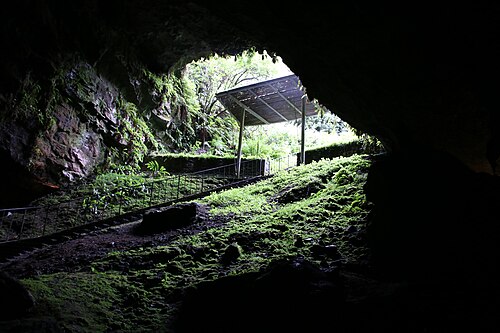
National Monument (No. 399). A N-S ridge of limestone, rising to the Castlecomer Plateau to the N and E and falling to the Dinin valley to the W and NW, surrounded by younger Carboniferous rocks consisting of sandstones, shales and siltstones (Drew and Huddart 1980, 2). The cave is divided into a number of chambers of which the Market Cross Chamber in the extreme S and the Rabbit Burrow in the extreme N, were the most difficult to access. The cave is mentioned in Old Irish literature as being one of the darkest places in Ireland, and as the place where the monster Luchtigern, ‘The Lord of the Mice’ was slain (Harbison 1970, 129). The Annals of the Four Masters (O’Donovan 1854) state that in A. D. 928, ‘Godfrey, grandson of Imhar, with the foreigners of Ath Cliath, demolished and plundered Dearc Fearna, where one thousand persons were killed’, though other Annals give 929 and 930 as the date of the raid (Drew and Huddart 1980, 2, 18). O’Donovan tentatively associated Dearc Fearna, the ‘Cave of the Alders’ with Dunmore cave (O’Donovan 1854), a suggestion which was supported by later authors (Drew and Huddart 1980, 2).
A description of the cave by Molyneaux in 1709 mentions human skeletal remains in the Rabbit Burrow and these were further described by others in the second half of the 19th century (ibid.). Isolated finds within the cave include a bronze and an iron plain ringed pin with a looped head, which were simple dress fasteners worn by both Irish and Vikings in the Early Medieval Period, a fragment of a decorated bronze strap and an iron axe-head found in association with a large number of bones (ibid., 14-15). The Market Cross Chamber and the Rabbit Burrow were excavated in 1973 and human bones, silver coins, half an amber ring, iron objects and glass beads were uncovered (ibid., 16-17). The coins, all from the Market Cross Chamber, provide the firmest dating evidence, giving a date range not earlier than 879 and not later than 930 A.D. (ibid., 18-19) which appears to accord with the chroniclers who suggest that the Dublin Vikings were led by Guthfrith who was expelled from York in 927 (ibid., 19). Four of the coins are from NE England, three from York itself and all struck in the 920s (ibid.).
The minimum number of individuals identified from bone remains within the cave is forty-four, including men, women and children, the majority of which appear to be women and children (ibid., 21). There is no evidence that these people had been living in the cave and given that the bones were found in the innermost recesses of the cave and that there were few possessions associated with them, it seems likely that they had been seeking refuge in the cave and were blocked in, and as a result suffocated or starved (ibid., 22). The presence of coins, which at this time not used by the Irish, suggests that they were dropped by a Viking and were washed or rolled downslope into the accumulating sediments at the base of the chamber (ibid., 19). It is possible that the target of the raid was a large ringfort or early church (KK014-015003-; KK014-015001-) c. 400m to the W, and another large ringfort (KK014-016----) 30m S of the previous one, c. 400m to the WSW of the cave. In 1940 the cave was designated a National Monument and in the 1960s it was decided to open the cave to the public (ibid., 2).
Compiled by: Jean Farrelly
Date of upload: 4 September 2017
The monument record does not grant public access. Check the route and ask the landowner before entering private land.