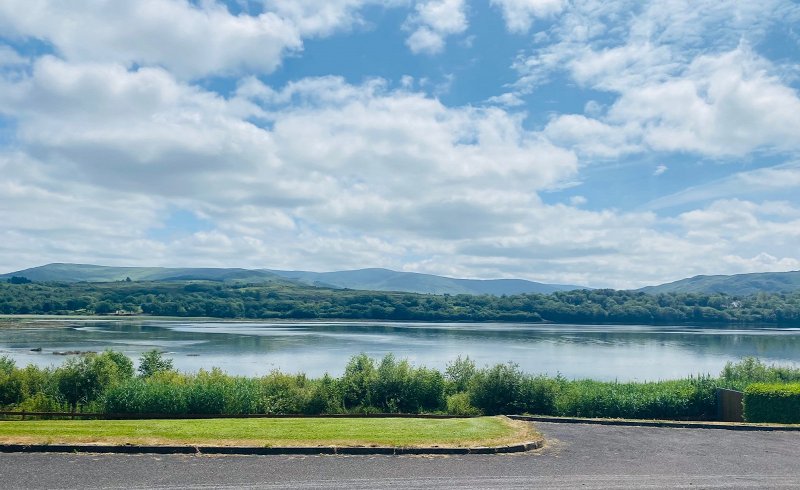
Add your own picture and explain the route, parking, gates, paths or landmarks that help people find it.
Earn 5 points after the picture is checked and accepted.
Add your photo and local directionsShare what you foundWhat is recorded here
In pasture, to the N of Kenmare Bay. This house no longer survives. According to local information, its ruins were removed in the 1960s/70s by Kerry County Council. It is described by Bary (1994, 156) as having been a small two-storey house with a chimney on each gable and a steep slated roof. There was a square stableyard to the rear. The walls of a small stone-built structure (int. dims: 1.85m x 1.35m; max. H of walls 1.9m), said to have been a lavatory, stand to the E of the house site. A cylindrical stone pillar (H 0.75m; diam. 0.25m) surmounted by a hexagonal stone (H 0.25m; diam. 0.25m) stands to the SW of the lavatory; this is reputedly the base of a sundial. Gate piers (H 2m) of coursed stone mark the entrance to the demesne from the road. The date of the house is uncertain but there appears to have been a dwelling on the site in the 17th-century which was occupied by Joseph Taylor, an officer in the Cromwellian army (Orpen 1930, 74). The house was subsequently associated with the Orpen and Palmer families. This house is sometimes confused with 'White House', another house (KE093-100---) in the same townland, which was referred to as 'Killowen house' by Sir William Petty in his journal of 1675 (Wood 1934, 39).
The above description is derived from the published 'Archaeological Inventory of County Kerry. Volume I: South-West Kerry' (Dublin: Stationery Office, 2009). In certain instances the entries have been revised and updated in the light of recent research.
Date of upload: 30 May 2011
The monument record does not grant public access. Check the route and ask the landowner before entering private land.