Add your own picture and explain the route, parking, gates, paths or landmarks that help people find it.
Earn 5 points after the picture is checked and accepted.
Add your photo and local directionsShare what you foundWhat is recorded here
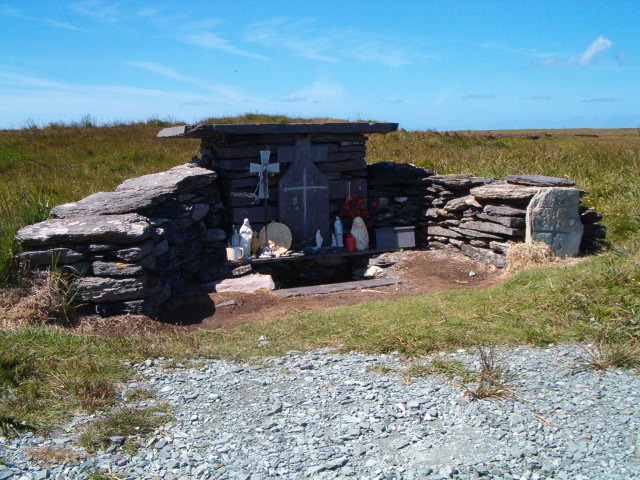
'Tobar Olla Brenainn' or the 'Holy Well of St. Brendan's Anointing', is located on a small rock-knoll towards the centre of Emlagh Bog, Valencia Island, and overlooks the Atlantic just 400m to N. It comprises a holy well, a cross-slab, three stone crosses and a number of miscellaneous features, including a possible leacht. The well is dedicated to St. Brendan, on whose feast day rounds are still performed at the site. A stone layer composed of angular cobbles and boulders was recently revealed in a peat-face (KE078-024----) a short distance to N (Mitchell 1989, 69-73). Probing indicated that this layer, .9m deep, represents a trackway that extends towards the well and crosses, one of which (2), appears to stand upon it. Peat at the level of the stone layer yielded a date of 1720±80 BP. In 1984, to commemorate the patron's fifteen hundredth anniversary, peat was cleared from around the crosses and the well was rebuilt.
Holy Well (KE078-005001-): This is a slab-lined, rectangular hollow which measures 0.8m x 0.7m x 0.5m deep. It is surrounded by various tokens, statues and coins. A slate cross which previously surmounted a jumble of slabs beside the well now stands just above it on a recently constructed curving wall. The cross is 0.76m high and measures 0.34m wide at base, tapering slightly as it rises. Its shaft features three incised crosses.
Cross-Slab (KE078-005007-): This slab stands against one end of the low wall which protects the well. It is a roughly rectangular slab which measures 0.5m x 0.4m x 0.06m thick. A number of plain crosses and random lines have been scored onto its exposed face. Two crosses are larger and more deeply incised than the others. In the upper right quadrant of the largest cross is a small, encircled Latin cross. All of these crosses may be of relatively recent date.
Stone Crosses: (1) (KE078-005002-) This crude cross is located 33.5m E of the well at the highest point of the site. Now fixed in cement, it stands 1.4m high. The maximum width of its shaft is 0.57m, while the width across its rudimentary arms is 0.76m. The upper shaft and both arms are rounded. A rough, linear Latin cross is incised on the E face of the stone.
(2) (KE078-005009) This cross, which prior to renovation work was engulfed by c. 0.9m of peat, is located a short distance SSE of the well. It stands 1.3m high, is 0.53m wide at base and its rectangular arms extend to a maximum width of 0.81m. The upper portion of the shaft is roughly trapezoidal, tapering towards the top.
(3) (KE078-005010-) This cross is located 5.7m NE of the well and is set upright in cement. It stands to a height of 0.98m, with a maximum width of 0.55m and an average thickness of .06m. Its arms are little more than undulations along its edges, though a distinct upper shaft emerges from its sloping shoulders. A crude linear cross is incised on the stone's ENE face.
Leacht (KE078-005008-): Henry noted the existence of some upright slabs E of the knoll (1957, 92). These were described by both Westropp and Macartney Robbins (1912, 301; 1942), and appear to be the remains of a leacht which measured 17 feet (5.2m) NE-SW x 10 feet (3m) NW-SE. This may be the 'Penitential Station' noted at the site on the second edition of the OS map. Macartney Robbins also noted two arrangements of upright slabs, which he called 'graves', at this part of the site. A number of slabs protrude through the ground surface just E of the knoll, and may be the remnants of the features described. Delap (1911, 407-8) the following pattern associated with this well; 'It is much frequented by pious pilgrims, who perform certain devotions there, and many miraculous cures are popularly believed to have been granted to such devotions. The " round," as the devout practice is called, consists in repeating certain prayers,
when going along by four large stones, sunk in the earth, in the form of a cross; and it appears that each of these stones is a rude cross of a very ancient type, which is partially covered by the boggy soil'.
The following folklore about St Brendan's Well was collected between 1934-8 from Cahersiveen School; ' "Tober - Ola Breanáin" or "the Holy Well of St. Brendan's Anointing" is situated is situated in a district named Coarha Beg in a lonely stretch of bog. Around the well are heaps of small stones with many tokens of the "rounds" paid there by the faithful. The old stone crosses marking the "rounds" are almost sunk into the soft boggy soil. One day when Saint Brendan was sailing in his little Currach from his oratory in the Blasket Island to visit the monastery of St. Beoanigh at the Glen in the parish of Killemlagh, he was suddenly hailed as he drew near the north-coast of Valentia, by a man on the headland who signalled to him to come without delay. The saint came at once and put his little boat into the narrow creek where he found a landing place, like that he came to on the first island he reached on his "great voyage", where the rocks stood on every side like a wall. He drew up his boat and ascended the frowning cliff by means of steps. He learned from the stranger that two people were on the point of death and had not received the Last Sacraments. He followed his guide, who led him into the thick of a forest, which is now an extensive bog. Here he found two men dying who desired to become Christians. These men had not been baptized nor received any religious instruction for want of opportunity. The strange guide then disappeared. St Brendan having instructed the dying man, he gave him the Sacraments of Baptism and Extreme Untion and after a short time they died holy and happy deaths. They were buried where they died and two pillar-stones which must have been brought from afar, mark the place where they were laid to rest. The well from which the saint produced the water for their baptism flows near the place of their burial and this is ever since known and looked upon as a holy well. Many miraculous cures are popularly believed to have been granted to such devotions as “rounds”. The “rounds” as the devout practice is called consists in repeating certain prayers, when going along by four large stones sunk in the earth, in the form of a cross. it is believed that each of these stones is a crude cross of a very ancient type, which is partially covered by the boggy soil. The little creek near the present Cool Head(?) by which St. Brendan landed on the island received from him a special blessing so that ever afterwards its abounded in excellent fish. Unfortunately the great supply of fish there led to the breaking of the Sabbath by some fishermen a profanation which brought on the waters of the creek the curse of barrenness, which clings to them to the present day' (The Schools’ Collection, Volume 0476, Pages 299-300; https://www.duchas.ie/en/cbes/4742132/4738885).
In 1938 the following folklore was collected from Baile an Ridire or Knightstown School; 'St Brendan's well in Corobeg is sometimes called "Tubberolabréannán". One day St. Brendan was going from the Blaskets to Skellig Rock by boat. When he was passing Imlagh he saw a man standing on the cliff, calling him. The saint came ashore and he found two men lying on the ground. He knew they were dying and he baptised and annointed them. The well in which he got the water to baptise the men is called "St Brendan's well" ever since. There are two pillar stones standing on the spot where the two men are buried. The path by which the saint climbed the cliff is called "Staighre Breanndhán"; and the rock on which he landed is called "Leac Bheannuighthe". He never saw the man who called him afterwards and it is thought that he was no earthly man. People go on visits to that well sometimes' (The Schools’ Collection, Volume 0479, Page 066; https://www.duchas.ie/en/cbes/4742142/4740192/4815982?ChapterID=4742142).
The following folklore about this 'Blessed Well' was collected from Ballyhearnay School recorded the tradition that ; 'There are a few w
The monument record does not grant public access. Check the route and ask the landowner before entering private land.