Add your own picture and explain the route, parking, gates, paths or landmarks that help people find it.
Earn 5 points after the picture is checked and accepted.
Add your photo and local directionsShare what you foundWhat is recorded here
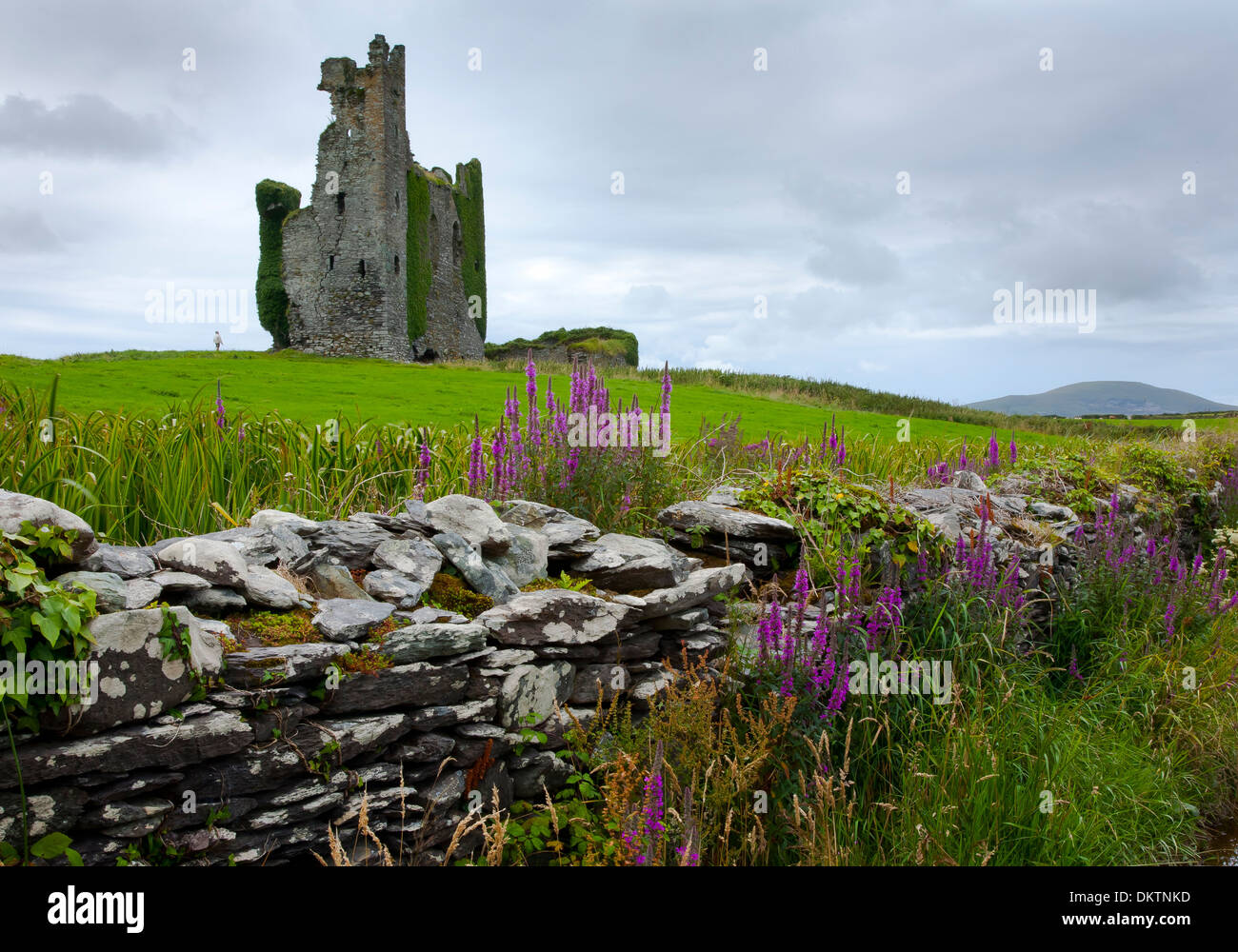
The ruins of Ballycarty watermill stands on the demesne lands of Ballycarty House located on site of Ballycarty Castle (KE038-043----) located 160m to SW. Small keyhole archaeological excavation at the ruins of Ballycarty watermill under licence No. 10E0229 by Laurence Dunne in 2010 was summarised as follows; 'A large, possibly 17th-century, building is located at the north-east corner of a small housing development in Ballycarty townland, Tralee, Co. Kerry. The structure is situated on the west bank of an unnamed tributary of the River Lee. This unusual building has often been referred to locally as a castle or a mill. It would appear that the current edifice was an earlier 17th-century defended structure that was added or remodelled in the post-Cromwellian period. The building is structurally unsafe and consolidation works are proposed. In advance of the consolidation works, a single cutting 1.2m in width and 1m in length was excavated to an average depth of 0.35m by hand over the visible extant ragged limits of an internal rib wall to determine its subsurface extent in order to expose a consolidation footing for possible future conservation works. The small keyhole excavation revealed a number of fallen or tumbled limestone within a dark organic-rich topsoil that lay directly on the subsurface remains of the 0.45m-thick rib-wall that was exposed for a distance of 0.7m. No further excavation was required and no finds were recovered' (www.excavations.ie 2010:370).
The watermill of Ballycarty belonged to Robert Blennerhasset of Ballycarty Castle (KE038-043----) and in 1641 the miller's name was Edward Thorne. This watermill is mentioned in the 1641 Deposition of a weaver by the name of Josyas White who is described as 'late of the Towne of Ballymacarty' and who described the existence of a mill associated with 'Edward Thorne one of the ward of ballycarty and miller to Robert Blenerhasset of Ballycarty aforesaid {did?} by the permission of thise said Robert grind Corne oftentimes for the {r}ebelles att the seidge of Tralee and the said Robert had two partes {o}f the toll for the use of his mill and since that time the said Edward {h}ath often times ground wheate for Captain Morrish mc Ellegott for to macke {h}im Bisket' (TCD MS 828, fol. 206r; 217r). Mark Humphrys has suggested that the remains of this building located to the NE of Ballycarty House which may be the remains of Ballycarty Castle (https://humphrysfamilytree.com/Blennerhassett/ballycarty.html). In 1786 the following details were recorded about Ballycarty; 'A mile beyond Arbella, on the L.[eft] close to the roadside, are ruins of Ballycarthy castle, the property of Mr. Nash' (Wilson 1786, 186). According to local historian, Bill Jehan, the precise location of old Ballycarty Castle is uncertain. It may have been incorporated into the later Ballycarty House, but the parts of Ballycarty watermill, whose ruins survive close by on the bank of the River Lee, appear strong enough to have been defensive - if so perhaps the old castle was adapted to become the mill".
See attached photographs of watermill taken by Bill Jehan in 2004 (https://humphrysfamilytree.com/Blennerhassett/Jehan/Ballycarty.Castle/2.jpg)
Compiled by: Caimin O'Brien
Date of upload: 2 June 2022
The monument record does not grant public access. Check the route and ask the landowner before entering private land.