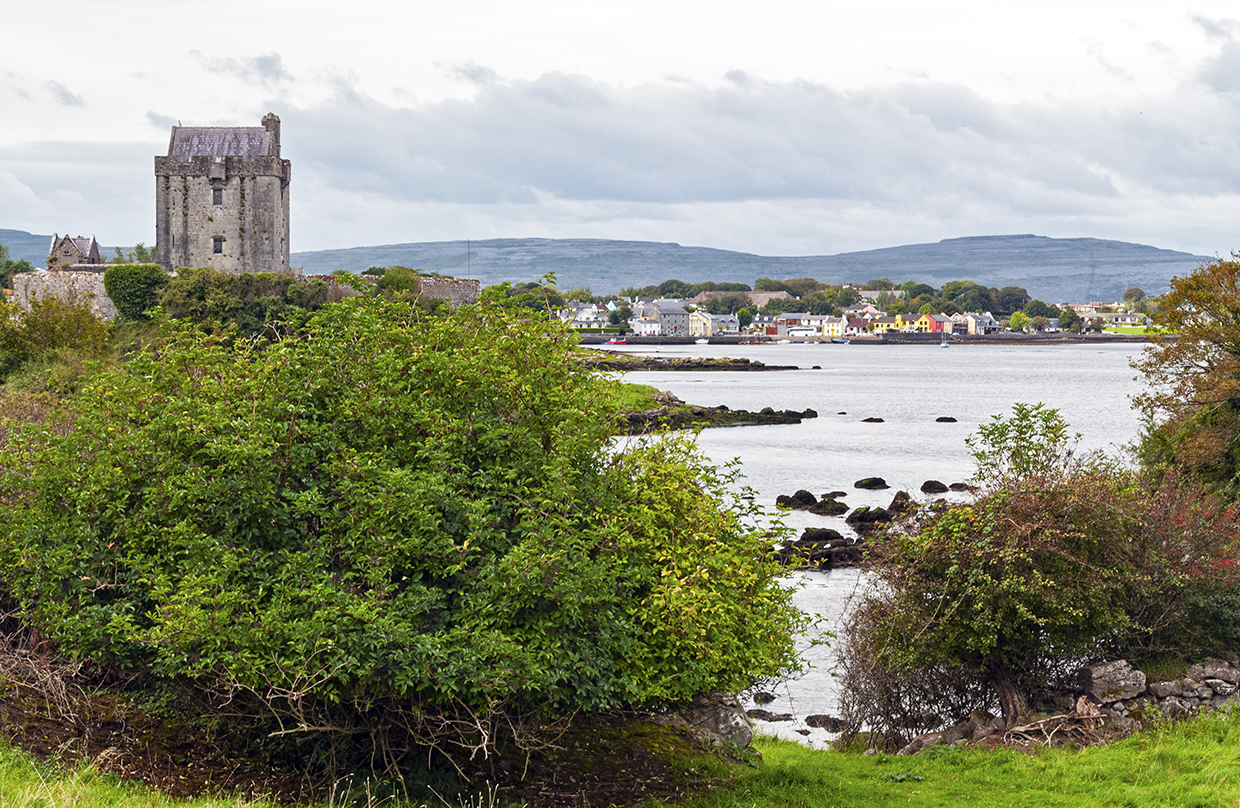
Add your own picture and explain the route, parking, gates, paths or landmarks that help people find it.
Earn 5 points after the picture is checked and accepted.
Add your photo and local directionsShare what you foundWhat is recorded here
On a wooded hillock overlooking Kinvarra Bay to the N and now completely enclosed by modern houses and business premises. This fairly well-preserved medieval church (c. 17m E-W; c. 7.8m N-S), dedicated to St. Coman, is roughly centrally located within an associated graveyard (GA113-139002-). Gwynn and Hadcock (1970, 396) recorded that 'there is said to be ... the stump of a round tower [GA113-139005-] here', suggesting that there was possibly an earlier foundation here. However, a programme of archaeological works funded by the Heritage Council and undertaken over fours seasons (2004-2007) found no evidence of earlier occupation of the site (Carey 2008, 22-31). The detailed study of the church revealed that it is constructed of mortared limestone blocks with numerous pinning stones. Its main architectural features include a blocked-up ope towards the E end of the N wall, into which a small alcove was subsequently inserted; a fine, but also completely blocked-up, lancet window in the E gable, above which, but to its S, is a circular window. A two-light mullioned window with hood-moulding towards the E end of the S wall is inserted into an earlier lancet window, the E side and top of the latter window are clearly visible in the wall fabric. Towards the W end of this wall a round-headed doorway fronts onto the rear garden of a house. Three beam slots above the doorway correspond with three in the N wall, indicating that there was formerly a loft at this end of the church. The W gable is featureless and does not survive to its full height; its upper part is overgrown with ivy. Numerous 18th- and 19-century burials occur within the church and three possible 16th-century examples (GA113-139002-, GA113-139003- and GA113-139004-) were also recorded, as well as a 17th-century inscribed slab (GA113-139006-), which was noted above the alcove in the N wall. Two interesting pieces of incised graffiti were also revealed. One is on a quoinstone in the S wall and consists of a smiling elfin face with pointed headgear. The other is on the W reveal of the twin-light window in the S wall; it consists of a complete figure with similar headgear. Both pieces are initialed WQ.
Based on a study of the cut stone in the church, Carey (ibid., 29) has concluded that two phases of construction are evident. The first dates to the early 13th century and is indicated by the diagonal tooling visible on the lancet windows in the E gable and S wall, and the traces of cyclopean masonry in the lowest courses of the walls. The workmanship of the E window is typical of the style known as the 'School of the West'. The church was substantially rebuilt in the late 15th/early 16th century when the round-headed doorway and mullioned window were inserted in the S wall. The bolder rough sparrow pecking on the stonework of these features is typical of this period. (Carey and Coady 2005, 2006, 2007)
Compiled by: Olive Alcock
Updated by: Olive Alcock
Date of revised upload: 15 August 2023
Carey, A. and Coady, M. 2005 Saint Coman's Church, Kinvara, Co. Galway. Drawn and photographic survey. Unpublished report, The Heritage Council.
Carey, A. and Coady, M. 2006 Saint Coman's Church, Kinvara, Co. Galway. Excavation of interior. Unpublished report, The Heritage Council.
Carey, A. and Coady, M. 2007 Saint Coman's Church, Kinvara, Co. Galway. Drawn and photographic survey of graveyard. Unpublished report, The Heritage Council.
The monument record does not grant public access. Check the route and ask the landowner before entering private land.